Protests in Kyiv continued on 24 July at Franko Square, a few hundred metres from the President's office, with the same demand protesters have been making since 16 July: that Mykhailo Fedorov be reinstated as Minister of Defence.
This time, the organisers announced the gathering without a time limit, as the government had accepted only part of their demands. Commander-in-Chief Oleksandr Syrskyi and Chief of the General Staff Andrii Hnatov were formally dismissed on the same day, 22 July, while the decision regarding Fedorov remained unchanged.
On 15 July, during the cabinet reshuffle, Volodymyr Zelensky announced that Fedorov would no longer remain a minister, offering no public explanation for dismissing a minister whose technological programmes and reforms of military administration enjoyed considerable support among the public and within parts of the armed forces.
The Verkhovna Rada of Ukraine formalised the dismissal a day later, on 16 July, by approving the composition of the new government. Within ten days, that personnel decision had become a serious domestic political test for the Ukrainian president.
The protests have already led to the replacement of the entire top tier of the military command, but they have also shown that it is easier for Zelensky to remove two generals than to reverse the decision on the minister and risk defeat within his own parliamentary majority.
Nine days that transformed military leadership
Fedorov headed the Ministry of Defence for exactly six months, having previously become one of the most recognisable faces of Ukraine’s technological response to the Russian invasion as the first deputy prime minister responsible for digital transformation.
Under his leadership, the drone programme was expanded, cooperation with private manufacturers accelerated, and the broader use of data introduced in procurement, logistics and military resource management.
His conflict with Syrskyi concerned control over the pace and direction of reforms, as well as the boundary between the Ministry of Defence’s responsibilities and the traditional military chain of command.
The day after his dismissal, Fedorov publicly accused Syrskyi of blocking reforms, saying that the existing relationship between the civilian and military leadership did not reflect how the war, which had been completely transformed by new technologies, could be won.
On 16 July, Zelensky announced that Yevhenii Khmara, the former commander of the Alpha Group of the Security Service of Ukraine, who had been formally appointed by the government, with the president’s approval, as acting minister on 17 July, would become the minister.
Khmara has extensive experience in special operations, but has not managed the military procurement system, the administration of the Ministry of Defence, or the state’s complex cooperation with Ukraine’s growing defence technology sector.
Zelensky told journalists that Fedorov and Syrskyi had failed to cooperate and that problems at the front, in the brigades and in the mobilisation system had not been resolved, which remains the most comprehensive public explanation of the change.
Appointing a special unit commander as the temporary head of the Ministry of Defence further raised the question of what the president expects from that department in the next phase of the war.
The return of Fedorov remained the only part of the demands to which Zelensky did not respond
The Ministry of Defence now plays a central role in weapons production, the procurement of foreign systems, drone development, financing domestic companies, and integrating the technology sector with units at the front.
Khmara’s professional experience lies in a different part of the security system, which is why his appointment did not resolve the question of who will continue the work started by Fedorov or what direction the reform will take.
On the same day, protests were held in Kyiv and other cities across the country, a rare occurrence in a nation that has been under full-scale Russian invasion and martial law for over four years.
Protesters carried banners reading “Bring Fedorov back”, “Fedorov for defence minister” and “Let the manager manage”, openly blaming Syrskyi for Fedorov’s departure. The deputy commander of the Ukrainian Air Force, Pavlo Yelizarov, resigned, saying that the minister’s dismissal had severly damaged the country’s defence capability.
On 21 July, Zelensky announced that the new commander-in-chief would be Mykhailo Drapatyi, publicly thanking Syrskyi for the defence of Kyiv, the Kharkiv counter-offensive and the Kursk operation.
Formal decrees on the dismissal of Syrskyi and Hnatov, and on the appointment of Drapatyi and Skybyuk to their posts, were published only the following day, 22 July, when the supreme commander and the chief of the General Staff were formally dismissed simultaneously.
The military leadership was changed in less than a week after the protests clearly formulated both demands, so it can hardly be argued that the protests did not influence the president’s decisions.
The return of Fedorov remained the only part of the demands to which Zelensky did not respond, although by replacing Syrskyi he removed the man with whom the former minister had clashed most frequently.
Why is it easier to remove a general than to reinstate a minister?
The difference in procedure partly explains the order of moves. The President of Ukraine independently appoints and dismisses the Commander-in-Chief, whereas the appointment of the Minister of Defence must be confirmed by the Verkhovna Rada.
When it approved the composition of the new government on 16 July, the Verkhovna Rada did so without a minister of defence heading the department, and until 24 July Zelensky did not even submit a candidate for a permanent minister of defence, although during the war parliament has almost routinely confirmed the president’s personnel proposals.
The fact that no candidacy was submitted at all shows that the problem is not limited to technical coordination of deadlines.
Zelensky could replace Syrskyi without political negotiations and without the risk of another body rejecting his decision.
Fedorov’s return would require the president to renominate the man he had dismissed just days earlier, persuade lawmakers to re-elect him, and accept the conclusion that he himself had caused the crisis by removing a minister whose work had not been seriously challenged in public.
Insisting on Khmara carries a different risk, as any delay or failure of the vote would show that Zelensky can no longer count on the automatic support of his own parliamentary majority.
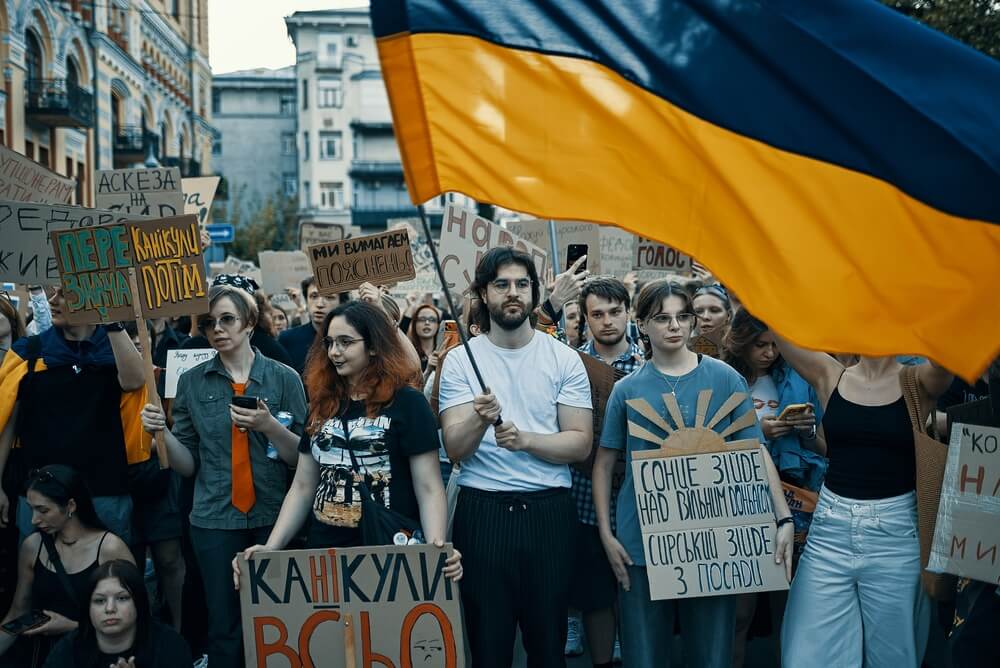 The protesters are not yet prepared to accept a solution in which Fedorov would be given a new post without full control of the Ministry of Defence
Research by the Rating Group agency showed that 55 per cent of Ukrainians support Syrskyi’s removal, 15 per cent oppose it and 19 per cent have no definite opinion. The same survey showed that 72 per cent of respondents did not support Fedorov’s removal, while only five per cent approved it.
This relationship allowed the president to present the change of commander-in-chief as a response to dissatisfaction with the conduct of the war and the stalling of reforms.
The return of Fedorov would be much harder to separate from the admission that the cabinte reshuffle was poorly prepared and that the president dismissed the minister without first securing a parliamentary majority for his successor.
On 23 July, before the announced protest without a time limit, Fedorov publicly rejected Zelensky’s offer to take another post, including that of deputy prime minister for defence innovation, arguing that none of the positions offered had sufficient real powers to carry out reforms.
According to him, only the president, the minister of defence and the supreme commander have a direct influence on the course of the war. The president confirmed that talks are taking place, indicating that he is trying to bring the former minister back into the state system without formally rescinding the 15 July decision.
Such a deal could grant broad powers over weapons production, drones and military technology, but the protesters in Franko Square are not yet prepared to accept a solution in which Fedorov would be given a new post without full control of the Ministry of Defence.
The conflict over how to wage war
The conflict between Fedorov and Syrskyi went far beyond their personal relationship. Fedorov called for faster decision-making, expanded decentralised drone production, closer cooperation with private companies, and a shorter administrative path between technological solutions and the units that use them.
Syrskyi defended the centralised command structure, the military hierarchy and the General Staff’s control over changes that could affect brigade organisation and the conduct of operations.
In that conflict, the question under discussion was whether the Ukrainian army can change the way it wages war quickly enough, or whether technological reforms will continue to depend on the slow adaptation of the existing system.
The new commander-in-chief must now continue operations at the front, implement changes to the command system, and renew cooperation with the Ministry of Defence
Drapatyi was regarded as a commander who enjoyed the trust of frontline units and embraced many of the reform ideas advocated by Fedorov, making him a potential mediator between the two approaches.
The new commander-in-chief must now continue operations at the front, implement changes to the command system, and renew cooperation with the Ministry of Defence, which still does not have a confirmed minister.
If poor cooperation between Syrskyi and Fedorov was indeed the main reason for the personnel change, the appointment of Drapatyi addresses only the military side of the problem, while the department responsible for procurement, production and technological development remains in a temporary state.
Zelensky between the protesters and his own majority
This is the second time in a year that protests have forced Zelensky to reverse a decision taken during the war.
At the end of July last year, a law that weakened Ukrainian anti-corruption bodies triggered the first major anti-government demonstrations since the start of the full-scale Russian invasion, and Zelensky, under pressure, submitted a new law to the Rada that restored full independence to anti-corruption institutions.
That episode, according to subsequent analyses, seriously undermined confidence in his leadership.
Ukrainian civil society has once again shown that the state of war has not weakened the public’s ability to restrain executive power, which is also important for Western partners who, alongside military support, are increasingly monitoring the condition of democratic institutions in Ukraine.
At the same time, the current crisis shows that the president’s control over the parliamentary majority is weaker than it was in the earlier stages of the war.
Ten days after the cabinet reshuffle, Zelensky still avoids testing that majority with a formal proposal for the defence minister. He is therefore simultaneously trying to stop the protests, preserve his authority over military policy, and avoid a vote that could reveal open divisions within the Servant of the People party.
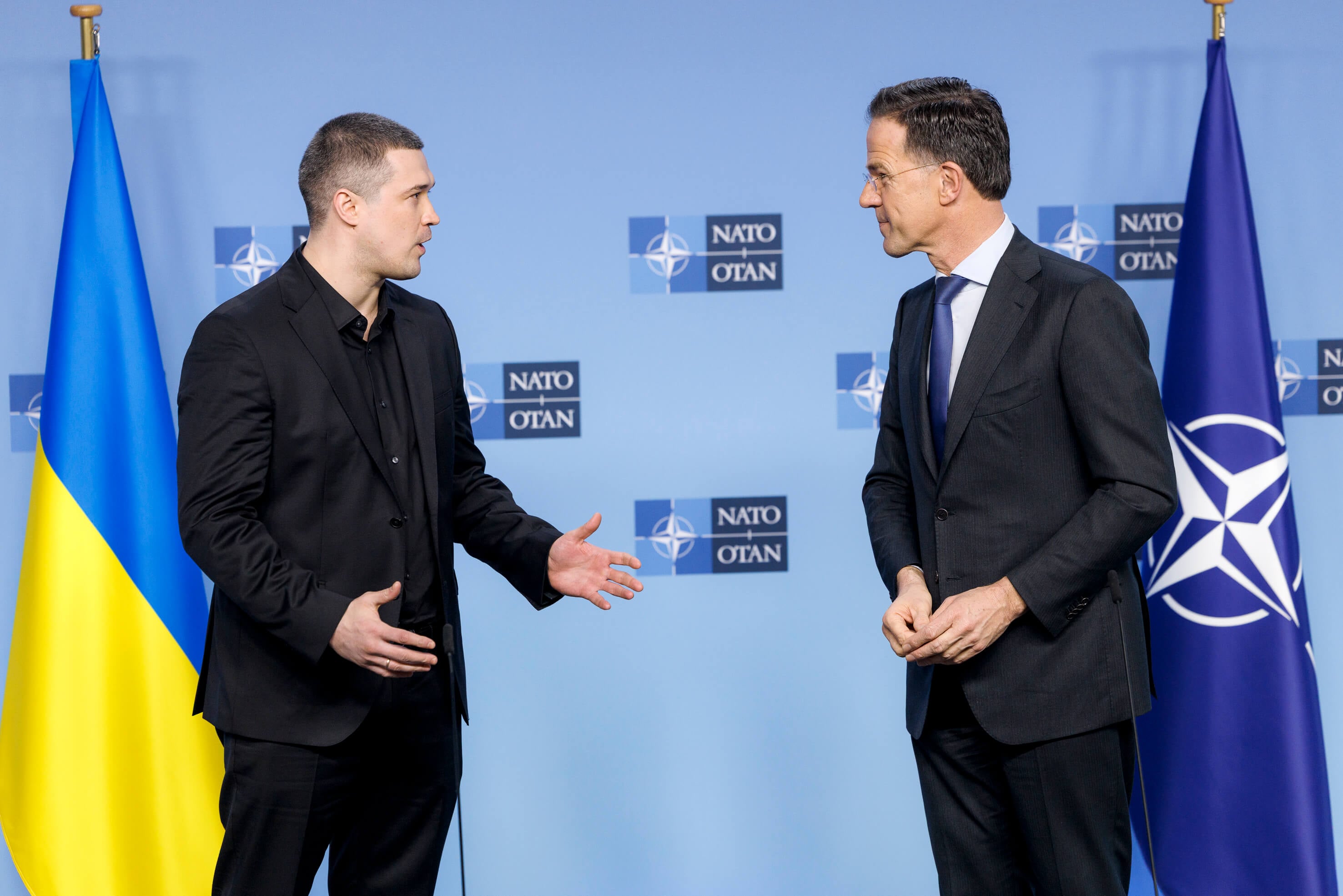 The Ukrainian army has a well-developed chain of command and staff procedures, making an immediate interruption of operations unlikely - Mykhailo Fedorov with Mark Rutte
Russia will exploit the political conflicts in Kyiv in its propaganda as evidence that the Ukrainian leadership is unstable and that Zelensky is losing legitimacy, even though personnel changes in the capital do not, for now, have a decisive impact on the fighting in the Donetsk region.
More important for Western partners is whether changing the supreme command in the middle of active operations will slow decision-making and disrupt continuity of planning at a time when Ukraine is negotiating with Raytheon on the joint production of interceptors for Patriot systems and receiving new aid packages, including a €125 million package announced on 23 July by Irish Prime Minister Micheál Martin.
The Ukrainian army has a well-developed chain of command and staff procedures, making an immediate interruption of operations unlikely.
A bigger problem may arise during the transfer of authority, particularly at the intersection of operational planning, the deployment of new systems, the reorganisation of brigades, and the technological reforms that Fedorov has been trying to speed up.
Drapatyi is therefore taking command of the army at a time when he must maintain pressure on the front while simultaneously dealing with the consequences of the political conflict that cost his predecessor his position.
If Zelensky does not submit his candidate for permanent Minister of Defence by mid-August, or if that candidate is not confirmed by the Rada, he will hardly be able to maintain the current interim arrangement for much longer.
A new post for Fedorov, with real powers over weapons, drones, procurement, and military technology, seems politically less risky than trying to impose Khmara on a parliamentary group unwilling to support him.
In that arrangement, Fedorov would be able to continue most of the work he carried out as a minister, while Zelensky would avoid formally withdrawing the decision to dimiss him.
Such a solution is likely to be proposed by the end of August, but its success will depend on whether Fedorov accepts it and whether protesters drop their demands for his full reinstatement to the Ministry of Defence.
Each additional week of delay increases the political cost of the deal, as presenting Fedorov’s return to any position with real power as part of a planned reshuffle will become increasingly difficult.
By replacing Syrskyi, Zelensky has already shown how far he is prepared to go to quell discontent. If the protests continue, the title of Fedorov’s future position will matter less than the fact that the president had to return the power he took from him on 15 July.
