Saudi Arabia, Turkey and Pakistan decided on 5 October, at an extraordinary meeting in Riyadh, to turn the joint defence agreement their leaders had signed in Mecca on 7 August into an actual military presence on Saudi territory.
Under that agreement, which gave rise to the Mecca Joint Defence Agreement, the three states undertook to treat an attack on any one of them as an attack on all three.
The meeting took place a day after the Yemeni government, supported by Saudi aviation, launched an offensive to recapture all areas held by the Houthis, a rebel movement which, with Iranian backing, has controlled northern Yemen and the capital, Sanaa, for 12 years.
On the same day, Houthi missiles and drones struck facilities belonging to the Saudi oil company Aramco and airports in the south of the kingdom.
The joint statement says that the agreed forces and weapons will be rapidly deployed to Saudi Arabia, but does not say how many soldiers will come, what they will do or who will command them, merely noting that everything will be done in accordance with the laws of each of the three countries.
How far Ankara and Islamabad will go in fulfilling their commitment depends on this reference to the laws of the individual states.
Turkey, which has NATO’s second-largest military, and Pakistan, the only Muslim country with nuclear weapons, have pledged to defend the kingdom, which is also at war with its Iranian ally in Yemen.
Both countries border Iran and, since spring, Pakistan has been the main mediator between Washington and Tehran in the war that the United States and Israel began with attacks on Iran at the end of February.
Riyadh's decision thus raises a question that none of the three governments has publicly addressed: how long Ankara and Islamabad can defend Saudi territory without becoming parties to a war they have avoided for years.
The Turks and Pakistanis defend the kingdom
Riyadh turned to Ankara and Islamabad after failing to involve the United States in the war against the Houthis.
Defence Minister Prince Khalid bin Salman, on the eve of the offensive, again requested American assistance, but the US military command for the Middle East regards the war in Yemen as a distraction from Iran.
The kingdom has been a target of Iran and its allies since the start of the war, and although direct Iranian attacks largely stopped after the 8 April ceasefire, Tehran-backed groups in Yemen and Iraq have continued to target Saudi territory.
Turkish and Pakistani soldiers are shifting the balance of power in this war even if none of them crosses the Yemeni border.
In April, Pakistan sent about 8,000 troops, a squadron of JF-17 fighter jets, which it co-produces with China, and China’s HQ-9 long-range air defence system.
Pakistani officials claim that there are between 30,000 and 40,000 of their troops in the kingdom
Pakistani officials now claim that there are between 30,000 and 40,000 of their troops in the kingdom, guarding land borders and helping to shoot down missiles and drones.
Turkish officials are announcing that they are deploying pilots and jets to intercept Houthi drones and missiles, as well as units to guard Riyadh, the holy cities, and the western section of the pipeline that carries Saudi oil from the Persian Gulf to ports on the Red Sea.
Through that pipeline, Saudi Arabia exports oil past the Strait of Hormuz, where Iran continues to attack ships, so oil prices on the world market depend on its security.
Every time Turkish or Pakistani soldiers take over a city’s air defence or the guarding of a stretch of border, the Saudi army can send the units that were performing those tasks to the front in Yemen.
Foreign soldiers defending Saudi Arabia thus enable the Saudi offensive, even though they do not participate in it themselves.
The Houthis and Iran, which backs them, are therefore likely to see them as participants and legitimate targets, despite Ankara and Islamabad claiming they are only defending the kingdom.
The people who rejected Riyadh in 2015 are now sending the army there
Pakistan has faced such a decision before, with the same people at the head of diplomacy and defence.
When Saudi Arabia launched a military intervention in Yemen in the spring of 2015, it asked Islamabad for fighter jets, warships and ground troops, and the then Defence Minister Khawaja Asif brought the request to parliament.
After a five-day debate, on 10 April, MPs unanimously adopted a resolution in which Pakistan declared itself neutral in the Yemeni war, while promising to defend Saudi Arabia if its territory was attacked.
The text of the resolution was read by the then Finance Minister Ishaq Dar, now Deputy Prime Minister and Foreign Minister, who sat at the table in Riyadh on 5 October, while Asif is again the defence minister.
How attacks on the Houthis would affect Pakistan's mediating role in relations with Iran
Both still advocate the 2015 solution, under which Pakistan defends the kingdom but stays out of the war in Yemen.
Minister Asif says that Pakistan is providing Saudi Arabia with all the help it needs and that the fighting is being carried out only by Saudi forces.
A few days before the meeting, Minister Dar refused to say whether military intervention based on the agreement would require parliamentary approval, or how attacks on the Houthis would affect Pakistan's mediating role in relations with Iran.
In 2015, Pakistan did not have tens of thousands of soldiers on Saudi soil or a written obligation to defend Saudi Arabia as its own country, so with a parliamentary resolution it could draw a clear line between helping an ally and entering the war. Today, it is much more difficult to maintain that line.
Ankara leaves the last word to MPs
Turkey has more room to limit its participation, because according to Article 92 of the Turkish Constitution, the parliament, the Grand National Assembly, decides on sending the army abroad.
Turkish officials say a 2010 military training agreement with Saudi Arabia allows only a limited presence of experts and equipment, and that Turkey has had technical teams, air defence systems and equipment to jam enemy radars and communications in the kingdom since last year to protect energy facilities.
A larger deployment requires a parliamentary decision, which is expected this month.
Ankara does not intend to intervene in Yemen
The same officials say that Ankara does not intend to intervene in Yemen and that it still relies on diplomacy.
With the parliamentary decision, President Erdoğan’s government can determine exactly how far Turkey’s obligation goes, and it is almost certain that this will be limited to the defence of Saudi territory.
The military in Saudi Arabia threatens Pakistan’s mediation with Iran
For Pakistan, the diplomatic risk is greater than the military one. In April, Islamabad brokered a ceasefire between the United States and Iran, hosting their direct talks, which led to an interim agreement signed in June.
Soon afterwards, the two sides resumed hostilities and have remained at an impasse ever since.
Saudi Arabia is not outside the conflict with Iran either, because it carried out a series of unannounced attacks on Iranian territory in the spring in retaliation for attacks on the kingdom.
Tehran leaves room for Islamabad only as long as Pakistan’s presence can be presented as the protection of holy sites and Saudi borders
The two countries then informally agreed to calm relations, so Turkish and Pakistani forces will be deployed in a country whose peace with Iran rests only on that understanding.
Pakistan’s moves in Tehran are being followed with close attention. The spokesperson for the Iranian Foreign Ministry, Esmaeil Baghaei, expressed the hope that reports of Pakistani soldiers being sent to Saudi Arabia are untrue and warned that such an intervention would further complicate the situation in the region.
The Foreign Minister, Abbas Araghchi, advised Minister Dar to talk to the Houthis instead of attacking them, claiming that Iran has nothing to do with them.
Tehran thus leaves room for Islamabad only as long as Pakistan’s presence can be presented as the protection of holy sites and Saudi borders.
The first fallen soldier as the true test of the alliance
The Mecca agreement moved from signing to deploying troops within two months, but the real test is yet to come, because almost every day the Houthis target Saudi airports, oil facilities and military positions in the border provinces – precisely the places that Turkish and Pakistani units are supposed to defend.
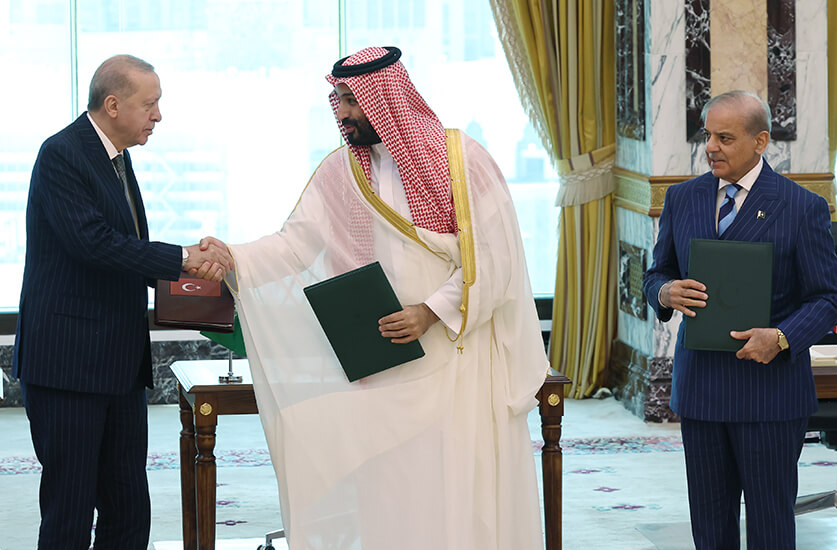 The Mecca agreement moved from signing to deploying troops within two months, but the real test is yet to come
When the first Turkish or Pakistani soldier is killed by a Houthi missile, the governments in Ankara and Islamabad will come under pressure to strike back at Yemen, and invoking their own countries’ laws will then be the only obstacle to their entry into the war.
Neither Ankara nor Islamabad is likely to send ground forces to Yemen, and the Turkish parliament will almost certainly approve the deployment of troops this month with the explicit restriction that they serve only to defend Saudi territory.
Such a mandate will provide sufficient protection for Turkey, because its position in the region does not depend on Tehran’s goodwill.
Pakistan is in a much more difficult position, as its international importance this year depends on being accepted as a mediator by both Washington and Tehran.
Iran will probably not cut the channel that runs through Islamabad, but it will increasingly send its most sensitive messages to the United States through Qatar, through which it already submitted its proposal to end the war last month.
Riyadh has received military assistance from Ankara and Islamabad that Washington currently refuses to provide in the war against the Houthis, and Pakistan risks paying for this by weakening the mediating role that has brought it significant international prestige this year.
