The deadline Israel has given the UK to close its Consulate General in East Jerusalem expires on Thursday 8 October.
Behind the administrative wording lies a dispute far more serious than another deterioration in relations between London and the Israeli government.
Britain formally recognised Palestine on 21 September 2025, and the government led by Prime Minister Andy Burnham went much further on 8 September this year.
Foreign Secretary Ed Miliband told the House of Commons that, from that day, London officially regards the Israeli occupation of the West Bank as illegal, whereas previously it had held such a position only in relation to the settlements, and that it accepts the 2024 advisory opinion of the International Court of Justice.
On that basis, he announced a ban on the import of goods from Israeli settlements, which will take effect in six to nine months, and sanctions against those who provide construction and financing services to the settlements.
On the same day, Israel ordered the British consulate to be closed within 30 days.
The choice of target gives this conflict particular weight. Britain appointed the first consular representative in Jerusalem in 1838, more than a century before the creation of Israel, and today’s Consulate General in the Sheikh Jarrah district manages the United Kingdom’s relations with the Palestinians in Jerusalem, the West Bank and Gaza.
Since 1950, London has not recognised the sovereignty of any state over the whole of Jerusalem until its final status is agreed, recognises Israeli de facto authority in the western part of the city, and considers East Jerusalem to be territory under Israeli occupation.
The consulate’s decades-long existence was a practical expression of that policy.
The settlement dispute is not separate from the city, as the E1 project, for which Israel issued a tender for more than 1,200 apartments in August, envisages a settlement between East Jerusalem and the rest of the West Bank. When the Israeli government responds to British action by closing the consulate, it uses its control of the city to increase the cost of another country’s foreign-policy stance.
Sanctions for settlement, retaliation in Jerusalem
Israel has the right to challenge the British sanctions, to consider them unfair, and to make it clear to its partners that such a policy will not go unanswered.
Foreign Minister Gideon Sa'ar described the British measures as morally depraved and a gross interference in the internal affairs of a sovereign state and in its electoral process ahead of the 27 October elections.
He explained the closure of the consulate on the grounds that a united Jerusalem is the capital of Israel, under its full sovereignty, and that any foreign activity in the city must take place through authorised and agreed channels.
Sa'ar's argument should be taken seriously because the two countries have cooperated closely on security for years and, even when they disagreed, resolved their differences through the usual diplomatic channels.
In the same speech in which he announced the measures against the settlements, the Foreign Secretary, Mr Miliband, also introduced new sanctions against Iran and said that security cooperation with Israel would continue.
In doing so, Israel chose Britain, even though Britain did not act alone. France and Canada announced a ban on trade with the settlements on the same day, and nine other European countries expressed readiness for further measures, among them Sweden which, like France, has a consulate in Jerusalem. So far, Israel has not taken similar steps against any of them.
The deadline for closing the British consulate falls 19 days before the Israeli elections on 27 October
The deadline for closing the British consulate falls 19 days before the Israeli elections on 27 October.
Prime Minister Benjamin Netanyahu is going into those elections as the head of a government which, according to British government data, has approved more settlements in four years than Israeli governments did in the previous 20 years.
In Israel's campaign, a conflict with Britain, which ruled Palestine until 1948, scores far more political points than a dispute with Canada or Sweden.
Conservative Shadow Foreign Secretary Tom Tugendhat also warned of this danger in the House of Commons, arguing that British measures help the most radical Israeli candidates more than the moderate ones.
Israel could have responded to the sanctions in many ways but chose to close the consulate, which exists precisely because London does not consider East Jerusalem part of Israel.
Expelling a diplomat from Tel Aviv, limiting bilateral programmes or imposing reciprocal trade measures would be conventional, if harsh, responses.
By closing the consulate in the occupied part of the city, Israel brings into the dispute a territorial issue that London regards as unresolved, using its control of the city to make Britain pay the price for its position that East Jerusalem is not part of Israel.
Alliances allow room for deep disagreements, but control over disputed territory does not give any government grounds to expect political obedience from its partners.
An admission that has started to cost money
Britain’s recognition of Palestine last year was presented as an attempt to preserve political space for a two-state solution at a time when that space was rapidly disappearing.
The government of the then prime minister, Keir Starmer, did not claim that recognition would change the situation on the ground overnight.
Its value rested on the assumption that British diplomacy and trade policy towards the territories captured in 1967 would remain aligned with the view that Palestine’s future could not be predetermined by unilateral changes on the ground.
The dispute is now testing how well that assumption can withstand pressure, and the consulate is not the only target.
The measures remove Britain from places where it has had direct influence on the Palestinian issue
British representatives at the US-led Gaza coordination centre in Kiryat Gat and a British team training Palestinian police in Ramallah were ordered to leave the country within seven days, and 12 British citizens, including 11 MPs, were banned from entering Israel.
Together, the measures remove Britain from places where it has had direct influence on the Palestinian issue, from Jerusalem and the West Bank to the mechanism overseeing the Gaza ceasefire.
At that point, the symbolic capital of recognition comes into contact with the administrative and police power of the state that controls the territory.
Power over the city does not confer the right to control the politics of others
In an advisory opinion issued in July 2024, the International Court of Justice found the Israeli presence in the occupied Palestinian territory, including East Jerusalem, to be illegal and called on states not to recognise the situation created by that presence.
The opinion is advisory, there are legal disagreements over parts of the reasoning, and Israel rejects it.
 Israel can make the work of the consulate difficult and virtually non-functional, just as it could with a foreign mission in Tel Aviv - Gideon Sa'ar
However, on 8 September the British government accepted the court's conclusions, and since then London has officially regarded the Israeli presence in East Jerusalem as illegal.
Israel is not using this instrument for the first time. After Spain recognised Palestine in 2024, it ordered the Spanish consulate in Jerusalem to stop providing services to Palestinians from the West Bank.
In 2019, the United States closed its consulate general in Jerusalem, which had been its main channel to the Palestinians for 175 years, and transferred its affairs to the embassy.
When President Biden’s administration later announced it would reopen the consulate, the Israeli government opposed the move, and the US State Department told the Senate that it could not proceed without Israel’s consent.
Sa'ar's demand that foreign missions work through agreed channels, in fact, calls for the same consent rule that Washington accepted when it wished to open a new mission to be applied to a mission whose presence in the city predates the State of Israel itself.
Israel can make the work of the consulate difficult and virtually non-functional, just as it could with a foreign mission in Tel Aviv.
However, this possibility does not give it the political or legal right to determine the status of East Jerusalem at its own discretion, nor to decide with whom, and from where, other states conduct relations with the population under occupation.
Twenty-seven for twenty-seven
British National Security Adviser Jonathan Powell travelled to Israel last week, without public announcement, in an attempt to prevent the closure of the consulate, but no deal was reached.
The British Ambassador to Israel, Simon Walters, then told the Israeli side that if the consulate were closed, London would expel 27 Israeli diplomats, one for each British diplomat working in the consulate.
The British government has not commented on this, while Israeli diplomatic sources say that any move against Israel will receive an appropriate response. Expulsions on this scale would seriously hamper the work of the Israeli Embassy in London.
If London accepts the closure of the consulate without a serious response, it will give the impression that its views on East Jerusalem are valid only until Israel challenges them
A serious foreign policy carries its full weight when a country is prepared to bear the consequences of its own decisions, including when those decisions become costly.
Britain has good reason to be cautious, as security and intelligence cooperation with Israel remains important to London, and an impulsive break in relations would not be in Britain’s interests.
The argument that a sharp conflict would reduce British influence in Gaza and the West Bank loses force when Israel is already curtailing that influence through its own actions.
If London accepts the closure of the consulate without a serious response, it will give the impression that its views on East Jerusalem are valid only until Israel challenges them.
Reciprocal expulsions would settle the question of cost, but the question of function would remain open.
British diplomats who remained in Sheikh Jarrah without diplomatic status after 8 October would be dependent on decisions by the Israeli authorities.
Ramallah offers no way out, as British officials have been ordered to leave there as well.
Moving dealings with the Palestinians to the embassy in Tel Aviv would mean that London, against its will, had adopted the model that Washington introduced in 2019 and that the Israeli government is now imposing on others.
After Madrid and London, Paris and Stockholm
France and Sweden, through their consulates in Jerusalem, also maintain relations with the Palestinians.
If the British consulate is closed in retaliation for its policy on settlements, European capitals will receive a clear signal that their presence in the city may come under pressure whenever their policies diverge from the position of the Israeli government.
The European position, based on non-recognition of the annexation of East Jerusalem alongside continued cooperation with Israel, has persisted, with the most serious disagreements expressed through votes in international institutions and limited sanctions.
A common European ban on trade with settlements was not adopted, so individual countries proceeded with national decisions
The longer-term consequence of this dispute could be the opposite of what the Israeli government intends to achieve.
A common European ban on trade with settlements was not adopted, so individual countries proceeded with national decisions.
States that see their bilateral channels restricted whenever their policies become unacceptable to the Israeli government will have increasing reason to transfer disputes to joint European decisions and legal proceedings, where Israeli pressure on individual capitals is much less effective.
Address of British politics after 8 October
The expulsion of 27 Israeli diplomats would be justified and is likely to follow, but it does not answer the question of where Britain will take its relations with the Palestinians after 8 October.
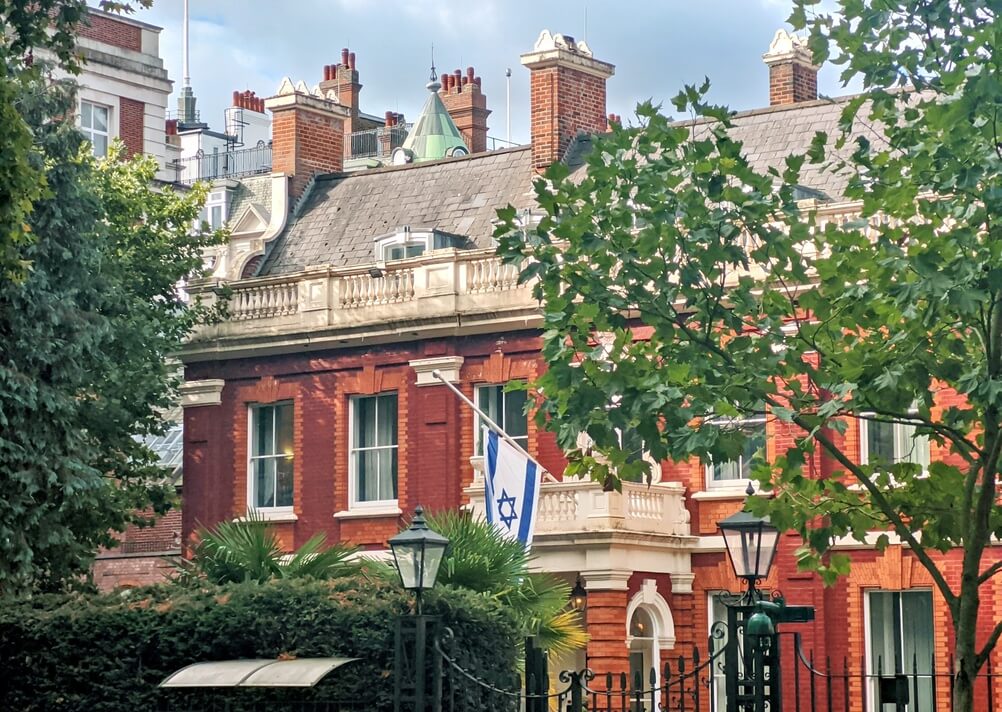 The expulsion of 27 Israeli diplomats would be justified and is likely to follow
Our assessment is that, after a period of improvisation, the channel will ultimately be located in the embassy in Tel Aviv, exactly as the Israeli government wants.
Britain will continue formally to challenge Israel's sovereignty over East Jerusalem, but it will be left without a mission that asserted that position daily in the city itself, and that will be a more lasting loss than any retaliatory measures taken by London.
The outcome of the Israeli elections on 27 October changes that somewhat. When President Biden's administration tried to reopen the US consulate in 2021, it was rebuffed by the centrist government of Naftali Bennett and Yair Lapid, which believed that any foreign mission to the Palestinians in Jerusalem would challenge Israel's sovereignty over the city.
For any Israeli government, whoever wins, the closed British consulate will not be a concession returned in exchange for better relations with London.
Palestinians from the West Bank, who need an Israeli permit to enter Israel, will be able to reach the diplomats of the state that recognised Palestine only if Israel allows them to do so.
