Turkey is increasingly promoting its own vision of a regional security system in the South Caucasus, which could potentially serve as an alternative to Russia-led security mechanisms.
Turkish Foreign Minister Hakan Fidan has raised the possibility of establishing a unified security architecture for the countries of the region.
According to Fidan, such a concept could be implemented once relations between Azerbaijan and Armenia have been fully normalised and a peace agreement has been signed between the two countries.
At the same time, Fidan emphasised that this is currently a strategic prospect rather than an issue on the agenda for immediate negotiations.
The immediate priority remains the completion of the Azerbaijani-Armenian peace process.
Turkey’s approach is based on the close military and political partnership between Ankara and Baku, which has taken on a strategic character in recent years.
The two countries coordinate their actions in the security sphere and maintain a high level of military cooperation.
At the same time, Turkey and Azerbaijan support the normalisation of relations with Armenia, viewing the conclusion of a peace agreement as a key prerequisite for a more stable regional environment.
An alternative framework for security cooperation
The weakening of Russian influence, caused by Moscow’s concentration of a significant portion of its military, political, and economic resources on the war against Ukraine, has created additional space for Turkey to strengthen its position.
Fidan’s initiative demonstrates Ankara’s ambition to move beyond predominantly bilateral influence and towards a more active role in shaping the regional agenda.
By proposing a broader security system involving the states of the South Caucasus, Turkey is effectively seeking to establish itself as one of the key centres of regional stability.
If implemented, this concept would enable Ankara not only to strengthen its own position but also to offer the countries of the region an alternative framework for security cooperation that is less dependent on Moscow.
Armenia’s potential participation in the new regional security system proposed by Fidan could further reduce the scope of Russian influence
An important factor in this transformation is the willingness of Baku and Yerevan to address the issue of a peace settlement without direct Russian mediation.
This points to a significant shift in the traditional balance of power in the South Caucasus.
Disillusioned with the effectiveness of Russian security guarantees in protecting its interests, Armenia is gradually reducing its engagement with Russian security structures and distancing itself from traditional pro-Russian frameworks.
Under these circumstances, Armenia’s potential participation in the new regional security system proposed by Fidan could further reduce the scope of Russian influence.
If Armenia ultimately reorients its security policy towards diversifying its partnerships, Moscow risks losing one of its last institutional footholds that have enabled it to influence regional processes.
The transport and economic dimension
Ankara and Baku support the process of normalising relations with Yerevan, viewing a peace agreement not merely as a political compromise but also as the foundation for a new phase of economic integration in the South Caucasus.
The transition from decades of confrontation to direct dialogue creates conditions for restoring transport links, developing regional trade routes, and expanding economic cooperation.
In this context, the security architecture is becoming increasingly interconnected with the development of transport and energy infrastructure.
The stable operation of new routes will require mechanisms for their joint protection, which in turn will increase the need for coordination among the countries of the region.
It is precisely at the intersection of security and economic interests that Turkey could find additional opportunities to strengthen its regional influence.
The reduction in Russia’s presence could potentially limit Moscow’s ability to influence the implementation of future transport projects
The formation of a new security system is also unfolding against the backdrop of a reduction in Russia’s military presence in Armenia.
Yerevan has consistently sought to reduce the role of Russian security structures at key facilities – from Zvartnots Airport to certain sections of the Armenian-Azerbaijani border.
This process indicates a gradual reduction in Russia’s instruments of influence over regional security and transport infrastructure.
The reduction in Russia’s presence could potentially limit Moscow’s ability to influence the implementation of future transport projects, particularly routes associated with the Zangezur corridor.
At the same time, it creates additional room for Turkey and Azerbaijan, which aim to turn the South Caucasus into an important component of regional transport and trade networks.
Military partnership between Georgia, Azerbaijan, and Turkey
Alongside diplomatic initiatives, military and political cooperation among Georgia, Azerbaijan, and Turkey is also intensifying.
The main objectives of Eternity-2026 are to enhance the operational interoperability of military units, strengthen capabilities for planning joint defence measures, and practice responses to potential threats.
Of particular importance is the focus of the exercise on protecting strategically important economic and energy infrastructure, transport corridors, and other international projects.
The conduct of Eternity-2026 without Russia’s participation demonstrates the emergence of a separate mechanism for military cooperation in the South Caucasus.
Turkey’s participation facilitates the adoption of practices compatible with NATO approaches
For Georgia and Azerbaijan, cooperation with Turkey offers an opportunity to strengthen their own defence capabilities while simultaneously reducing their dependence on Russian security structures.
The use of computer modelling in the planning and conduct of the exercise also indicates the gradual adoption of more modern approaches to military planning, command and control.
Turkey’s participation, as a NATO member, facilitates the adoption of practices compatible with NATO approaches to planning, coordination, and operational interoperability.
For Georgia and Azerbaijan, this represents a gradual shift away from traditional Soviet and Russian models of military organisation and command.
The decline of the Russian security model
The Second Karabakh War clearly signalled of the limitations of traditional Russian instruments of influence over the regional security situation.
In its aftermath, Russia’s role as the main external guarantor of regional stability increasingly came into question.
This trend has been particularly evident in Armenia, which is reassessing the nature of its relations with Moscow and distancing itself from Russian security frameworks.
Yerevan has, in particular, effectively frozen its participation in the Collective Security Treaty Organization (CSTO), which has become one of the clearest manifestations of the crisis facing the Russian security model in the South Caucasus.
For Moscow, this means losing not only political influence but also important institutional mechanisms for maintaining that influence.
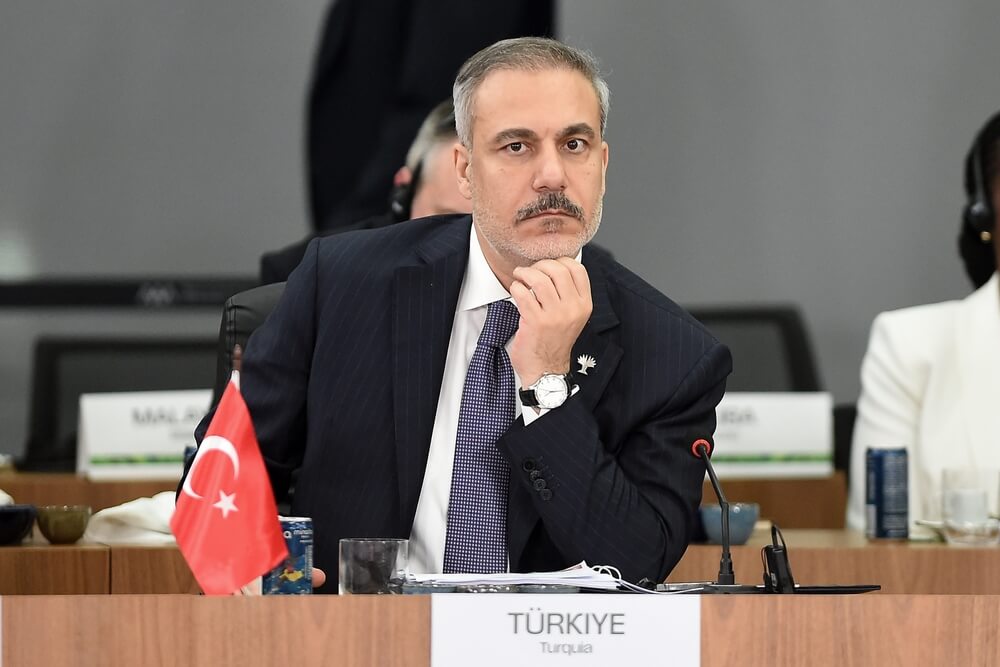 Hakan Fidan’s initiative reflects the emergence of a new regional balance in which Turkey is seeking to establish itself as one of the main centres of power
Whereas Russia previously relied on its military presence, alliance commitments, and multilateral structures such as the CSTO, these instruments are now gradually losing effectiveness.
In this context, Hakan Fidan’s initiative carries broader significance than that of an ordinary diplomatic proposal.
It reflects the emergence of a new regional balance in which Turkey is seeking to establish itself as one of the main centres of power, while Russia is gradually losing its dominant influence over security processes.
The strengthening of military cooperation among Georgia, Azerbaijan, and Turkey, the normalisation of Azerbaijani-Armenian relations, and the reduction of Russia’s military presence are creating conditions for the emergence of a fundamentally different security architecture.
Its key elements could include regional coordination, protection of transport and energy infrastructure, military interoperability and diversification of external partnerships.
The South Caucasus is therefore gradually moving from a model in which Russia played a dominant security role towards a more competitive and multipolar environment.
Turkey is seeking to capitalise on this transition by turning its military and political partnerships with Azerbaijan and Georgia into the foundation of a broader regional system.
If Armenia joins this process following the completion of the peace settlement, Moscow’s ability to restore its previous level of influence in the South Caucasus could be significantly reduced.
Oleksandr Levchenko, a former Ukrainian diplomat, is a professor at the State University (Kyiv) and a member of the Academy of Geopolitics and Geostrategy (Kyiv).
