In the last five years, six youth-led, anti-establishment uprisings have fundamentally reshaped South Asia’s political landscape.
The movements had much in common: they all reflected young people’s aspirations, digital savvy, economic frustrations, and disillusionment with governing elites.
But the political systems in which they unfolded process grievances in vastly different ways, leading to sharply divergent outcomes.
The story begins in Myanmar, where the military’s February 2021 overthrow of a democratically elected government triggered popular protests.
Unconstrained by concerns about democratic legitimacy, the new regime launched a violent crackdown.
With the peaceful restoration of democracy off the table, a generation of young people had little choice but to form civilian defense forces alongside armed ethnically based organizations. The result was a grinding civil war.
Sri Lanka’s March 2022 Aragalaya movement arose from economic collapse. Dry fuel pumps, prolonged power cuts, and sovereign insolvency destroyed the legitimacy of the Rajapaksa dynasty, which had ruled for the better part of two decades.
Protests roiled the island, with demonstrators eventually occupying the presidential palace. Yet, unlike Myanmar, Sri Lanka did not face surging violence, let alone a prolonged armed conflict.
Instead, President Gotabaya Rajapaksa submitted to popular pressure and resigned within the constitutional framework.
Pakistan, Bangladesh, Nepal, India
In Pakistan, riots erupted in May 2023, following the arrest of former Prime Minister Imran Khan.
This was a case of a populist movement mobilizing behind a charismatic leader to challenge the military’s dominance—and it was met with a troop deployment, an internet shutdown, and the dismantling of the opposition’s formal party structures. The “hybrid” regime was preserved, at the cost of persistent political alienation.
Bangladesh’s July 2024 uprising demonstrated how a narrow policy dispute—in this case, student opposition to a skewed quota system for civil-service jobs—can turn into a revolution.
As protests against Prime Minister Sheikh Hasina’s autocratic regime escalated, Hasina deployed troops to enforce a curfew—with an order to shoot violators on sight. When the military ultimately refused, Hasina’s hold on power collapsed.
She fled the country, opening the way for an interim government to take over.
In Nepal, the September 2025 protests targeted not a single leader, but an oligarchic political class, which had been playing a decade-long game of prime ministerial “musical chairs” while most Nepali youth struggled with soaring unemployment and a lack of opportunity.
For a frustrated Gen Z, a government ban on major social-media platforms was the last straw
For a frustrated Gen Z, a government ban on major social-media platforms was the last straw: using VPNs and alternative apps, Nepal’s youth organized a massive protest.
The authorities attempted to crush it by force, but the protesters fought back, driving the elites out without destroying the parliamentary framework. Nepalis went on to elect a 35-year-old prime minister.
Finally, this summer, India experienced widespread student-led protests, sparked by leaks of university entrance examinations and fueled by growing anxiety over jobless growth.
Far from threatening the constitutional order, however, the movement confirmed that order’s resilience, as the government offered critical concessions, accepting the education minister’s resignation and proposing administrative and policy reforms with a view toward redirecting protest energy back through established democratic channels.
A potent combination
These six cases show that hyper-connectivity and economic and political alienation are a potent combination.
The first fully digitally native generation, Gen Z uses platforms like TikTok, WhatsApp, and Discord to bypass entrenched party structures and orchestrate mass mobilizations.
But that is not all that stands out about Gen Z’s protest style. Unlike their predecessors, today’s protesters are motivated by a sense that they have nothing to lose.
It is not hard to see why: with their economic prospects drastically diminished, despite high educational attainment, what today’s young people see are not flawed institutions in need of reform, but a predatory system robbing them of a viable future.
This imbues their protests with a visceral, existential urgency and makes them resistant to state co-optation.
Unimpressed by incremental concessions, they are willing to confront institutional repression head-on.
For all they have in common, these six cases also underscore the difference institutional structures make.
In closed regimes that treat power as non-negotiable, such as Myanmar and Pakistan, popular discontent inevitably results in political fragmentation or chronic instability
In closed regimes that treat power as non-negotiable, such as Myanmar and Pakistan, popular discontent inevitably results in political fragmentation or chronic instability.
In rigid civilian autocracies like Hasina’s Bangladesh, protest is either repressed or revolutionary: the system is unmovable until a single crack—such as the military refusing an order—brings down the whole edifice.
Conversely, systems that allow for political transitions or administrative conciliation can survive generational shocks.
Sri Lanka achieved a peaceful electoral realignment, and Nepal engineered a political reset, which created space for “outsider” political forces.
India, for its part, showed how a robust multiparty democracy accommodates discontent before it metastasizes into systemic crisis.
Democratic accountability
These episodes hold several important lessons. For starters, celebrating aggregate macroeconomic growth but ignoring youth unemployment and systemic corruption is a recipe for instability.
Younger generations view economic opportunity as inseparable from political accountability—and they will, sooner or later, demand both.
Moreover, military-dominated governance is poorly suited for this era of hyper-connectivity.
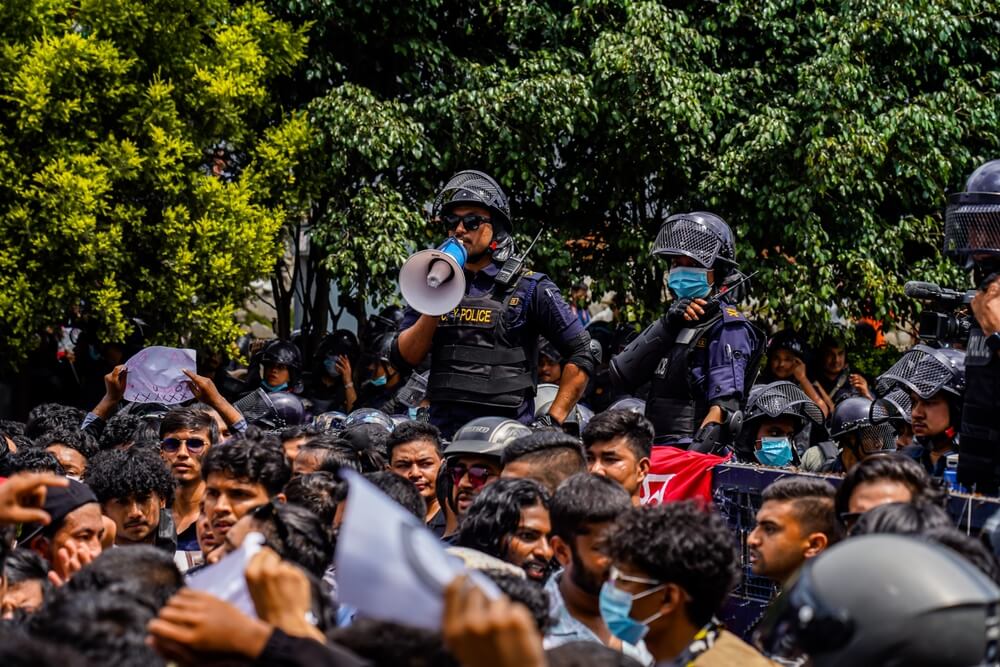 While crackdowns and coercion can suppress dissent temporarily, they destroy state legitimacy over time. Relying on them risks prolonged civil disorder
While crackdowns and coercion can suppress dissent temporarily, they destroy state legitimacy over time. Relying on them risks prolonged civil disorder.
Finally, dismantling systemic corruption is only the first step. Durable institutions, with democratic pressure valves and credible mechanisms for addressing young people’s aspirations, are also essential.
That is why India’s recent uprising reaffirmed its democracy, while Nepal and Sri Lanka, as well as Bangladesh, have faced considerable post-uprising instability.
The Arab Spring revolutions a decade and a half ago ultimately ended in military counter-revolution, autocratic revival, or institutional paralysis, owing to absent or fragile democratic legacies and ideological hijacking.
But many South Asian societies possess deep parliamentary traditions, vibrant civil societies, and functional constitutional mechanisms.
If South Asian countries can harness young people’s activist energy to deliver effective, responsive governance and job-creating reforms, they will put themselves on a path toward a brighter, more resilient, and more prosperous future.
And they will become a model for how the Global South can align demographic weight with democratic accountability.
Shashi Tharoor, a former UN under-secretary-general and former Indian Minister of State for External Affairs and Minister of State for Human Resource Development, is an MP for the Indian National Congress and Chairman of the Parliamentary Standing Committee on External Affairs.
