Exhibiting an apparently limitless ability to shrug off bad news, the US economy continues to motor ahead.
Real (inflation-adjusted) GDP grew at a seasonally adjusted annual rate of 2.1% in the first quarter of this year and, according to an advance estimate from the Bureau of Economic Analysis, by 1.5% in the second quarter.
Both figures are close to the US Federal Reserve’s own estimate of the economy’s long-run potential growth rate of 2%.
The economy has appeared resilient despite an exceptional series of adverse shocks, from the April 2025 “Liberation Day” tariffs and the ongoing tariff uncertainty to US President Donald Trump’s political attacks on the Fed.
Meanwhile, US-China tensions have depressed bilateral trade and investment; the US war against Iran has led to on-again, off-again closures of the Strait of Hormuz and spiking oil prices; and the Russia-Ukraine war has increasingly disrupted Russian energy supplies and refining capacity.
Topping it all off, global bond, equity, and foreign exchange markets have suffered multiple shocks just in the past few weeks.
So, why the resilience? Although Trump’s Liberation Day tariffs ranged as high as 50%, his administration soon made multiple tariff exceptions, exemptions, and reversals, bringing the effective US tariff rate down to 10–15%, on average, over the last year. While not favorable, this lower level is at least manageable.
Tariff-related uncertainty
The tariff-related uncertainty has been considerable, of course. An index of trade-policy uncertainty created by Fed economist Dario Caldara and his colleagues reached its highest level on record following Trump’s Liberation Day press conference.
Yet with an import-to-GDP ratio of only 14%, the US economy was already relatively closed.
Whatever the damaging effects of tariff uncertainty, they were always going to be less severe than for more open economies.
The negative impact on the US economy has been minimized by a rerouting of Chinese exports via Vietnam and Mexico
Similarly, the share of US imports coming from China has declined to barely 7%, but it had already fallen from over 20% to under 14% in the decade ending in 2024.
After surpassing $100 billion at its peak in 2016, Chinese foreign direct investment in the US has evaporated completely.
Despite these trends, the negative impact on the US economy has been minimized by a rerouting of Chinese exports via Vietnam and Mexico, and by America’s continued success at attracting FDI from other sources, notably Germany and Japan.
Energy shock
Then there is the latest energy shock. Crude oil futures spiked from $60 per barrel at the beginning of the year to above $100.
They are now in the neighborhood of $80 and will continue to fluctuate along with prospects for reopening the Strait of Hormuz.
More importantly, the crack spread, the cost difference between crude oil and refined products, has tripled since the start of the year as US refineries have been caught wrong-footed by shifting crude supplies.
The adverse effect has been limited, because the US economy is less energy intensive now than in the past
Still, the adverse effect has been limited, because the US economy is less energy intensive now than in the past, owing to a broader shift in economic activity toward services.
Finally, insofar as these factors have dampened US economic growth, their negative impact has been offset by strong investment in AI-related data centers, software, and research and development, as well as by consumption spending rooted in a robust stock market.
What could possibly go wrong?
What could possibly go wrong? In a word: everything. Despite court rulings striking down many of the administration’s tariffs, the tariff threat remains, with Trump invoking it in response to everything from Canadian wildfires to Brazilian elections.
Equally, the prospects for reopening the Strait of Hormuz remain uncertain, and US-China tensions are ratcheting up again, with China slapping trade restrictions on dozens of US entities in advance of President Xi Jinping’s upcoming trip to the United States. It is anyone’s guess what will happen after that trip is over.
Given reports that the US has expended many of the munitions and strategic resources that it would need to deter China from aggressive action in the South China Sea, an escalation in tensions cannot be ruled out.
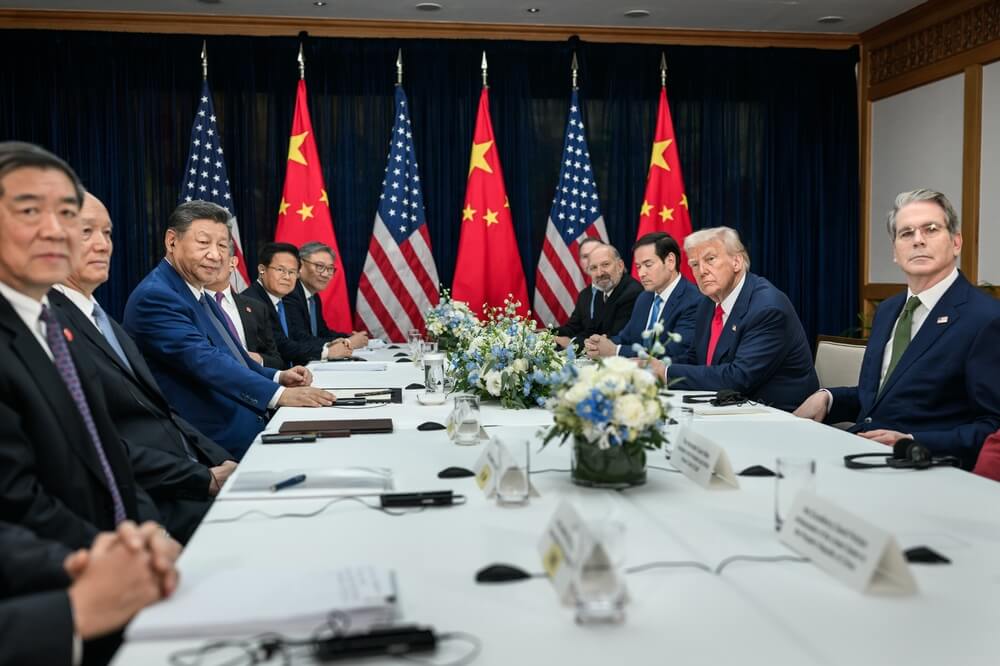 Given reports that the US has expended many of the munitions and strategic resources that it would need to deter China from aggressive action in the South China Sea, an escalation in tensions cannot be ruled out
Although the rise in oil prices has been moderated by drawdowns in Chinese and US petroleum reserves, the US Strategic Petroleum Reserve is now at a 45-year low, and half of what remains cannot be withdrawn without risking a collapse of the salt caverns in which it is stored.
Above all, there is the potential threat from financial markets. The combination of a richly valued stock market and rising long-term interest rates has historically been a toxic brew.
We saw in July how pessimism about the immediate returns to AI-related investments can lead to a sharp drop in AI company share prices, especially when those investments are debt financed and the cost of debt is rising.
If the share-price declines resume, the negative wealth effects on spending could be significant.
We also saw how such share-price movements can wrongfoot investors in the same trendy sectors, with ruinous implications when their bets are backed by leverage, and with potentially serious consequences for banks and others providing the credit.
Not every financial crash and crisis has been followed by a recession. But they are the best leading indicator we have.
Barry Eichengreen, Professor of Economics and Political Science at the University of California, Berkeley, is a former senior policy adviser at the International Monetary Fund.
