As global leaders gather for the United Nations General Assembly in New York, the world is facing the largest number of armed conflicts since 1946, with 65 ongoing in 35 countries.
There have been more battle-related deaths since 2021 than in the previous two decades.
This has put UN peacekeeping under pressure, while a new age of warfare, featuring drones, autonomous weapons systems, and AI-driven cyber tools, has further complicated the task of protecting vulnerable civilians and advancing political solutions.
US President Donald Trump’s administration has not helped matters. Despite paying $827 million in mandatory UN dues earlier this month ($725 million to the regular budget, and $102 million to peacekeeping), the United States still owes roughly $4.2 billion, including $2.9 billion for peacekeeping.
The resulting liquidity crisis has forced UN Secretary-General António Guterres to slash the peacekeeping budget by around 15% and withdraw one-quarter of peacekeepers from the field.
As of June, 44,208 uniformed UN peacekeepers were deployed globally, down from 60,081 in June 2024.
Moreover, in the UN Security Council, the US has advocated—albeit selectively—shutting down peacekeeping missions around the world as a cost-cutting measure.
As a result, the UN mission in Yemen concluded in March, while the drawdown of the mission in Lebanon will begin in December.
In November, the Security Council must decide whether to extend the mission in the Central African Republic; the US has expressed reservations.
But the Trump administration has been more than happy to promote operations that serve its interests, such as a Gang Suppression Force in Haiti (which is decidedly not a peacekeeping mission but has UN authorization) and an International Stabilization Force in Gaza.
The US has also thrown its support behind the 27-year UN mission in the Democratic Republic of the Congo, given its efforts to strike a strategic-mineral deal with the DRC.
Regional peacekeepers
With the vast majority of UN peacekeepers deployed in Africa (the DRC, South Sudan, the CAR, Abyei, and Western Sahara), the continent will bear the brunt of these cuts.
Security will increasingly fall to ill-equipped and poorly resourced regional peacekeepers.
As a July report by Guterres argues, UN peacekeepers “are not equipped to conduct sustained peace enforcement tasks.”
In that case, it seems unlikely that regional organizations—described in the same report as “fragmented” and “dysfunctional”—would be capable of enforcement responsibilities in complex conflict theaters.
The focus on a “networked approach” and “nimble adaptable” peacekeeping models suggests burden-shedding rather than burden-sharing
The focus on a “networked approach” and “nimble adaptable” peacekeeping models suggests burden-shedding rather than burden-sharing.
Perhaps more tellingly, Guterres’s report only briefly addresses the UN’s partnerships with African regional organizations, indicating a lack of political support for such a critical issue.
It praises the December 2023 resolution to fund African Union-led peace operations with UN assessed contributions on a case-by-case basis.
But the fact that the Trump administration is forcing the UN to wind down its support for the long-standing AU mission in Somalia shows that the resolution has become a dead letter.
UN Security Council
The underlying problem is the makeup of the Security Council. Guterres rightly calls for “a more representative Council.”
This will require addressing the “historical injustice against Africa,” which still has no permanent representation (and thus no veto power) on the Council, despite accounting for 28% of UN members.
But the US, China, and Russia may block efforts to expand the Council if it would result in a geopolitical rival gaining entry.
As a result, the five veto-wielding permanent members of the Security Council often break down along geopolitical lines, with Russia and China battling the Western bloc of the US, France, and the United Kingdom.
Such gridlock all but rules out implementation of Guterres’s recommendation to link peace operations with a viable political strategy that addresses grievances and the drivers of conflict.
In 2025, the Security Council adopted 44 resolutions, the lowest total since 1991
While necessary, it would require huge financial and military outlays and a level of great-power cooperation that does not exist.
In 2025, the Security Council adopted 44 resolutions, the lowest total since 1991, and has agreed on just 17 so far this year.
Given his lack of options, Guterres resorts to the fantasy that focusing on conflict prevention and peacemaking would be the most cost-effective way to ensure global stability.
But many of the world’s warlords are not open to negotiations, and mediation efforts have failed to resolve the Ukraine war and conflicts in the Middle East and Africa.
Between a rock and a hard place
Other proposals in his report—such as building a global partnership for peacekeeping, ensuring more focused and flexible peacekeeping mandates, maintaining strict impartiality, and crafting exit strategies—similarly reflect ideals rather than the reality of ongoing conflicts.
The idea of exit strategies, in particular, seems aimed at appeasing the US, even though it is highly impractical.
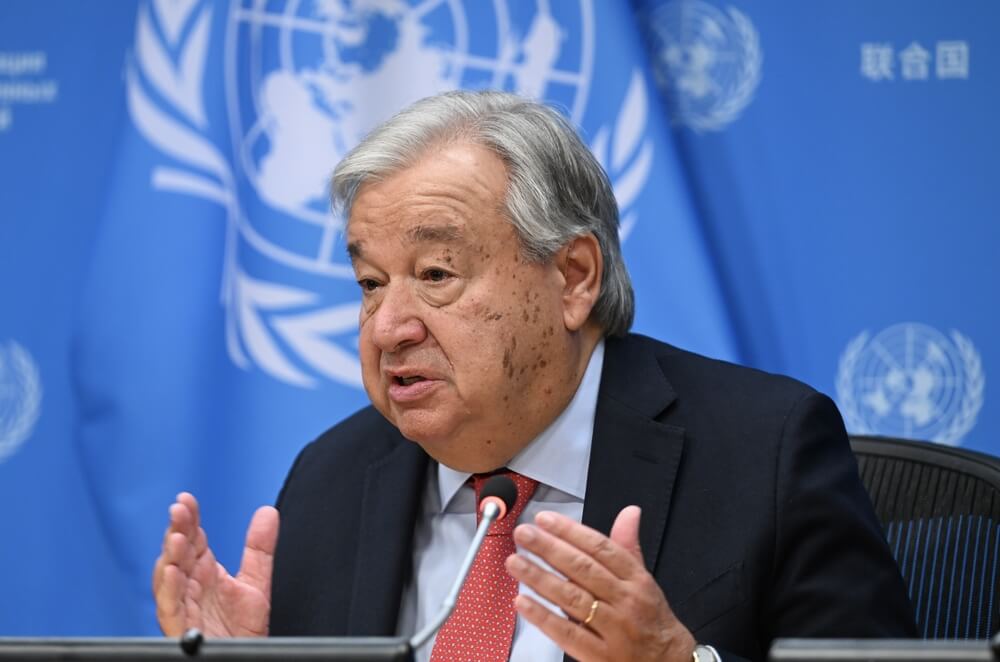 Antonio Guterres proposed unrealistic bureaucratic reforms such as using UN regional offices and underfunded, fractious UN agencies more effectively
Sustainable peace must reflect military realities on the ground and cannot be tied to arbitrary deadlines set for political convenience.
Guterres also proposed unrealistic bureaucratic reforms such as using UN regional offices and underfunded, fractious UN agencies more effectively, and rehashed a decades-old idea that emerged from the 1994 Rwandan genocide, urging UN Secretariat staff in New York to report independently to the Security Council.
Amid the Trump administration’s continuing assault on global peacekeeping, these proposals reflect how the UN has found itself between a rock and a hard place.
That does not bode well for fulfilling the organization’s primary mandate of saving “succeeding generations from the scourge of war.”
Adekeye Adebajo, a professor and a senior research fellow at the University of Pretoria’s Centre for the Advancement of Scholarship, served on UN missions in South Africa, Western Sahara, and Iraq.
