On 29 December 2025, Russian Foreign Minister Sergey Lavrov claimed an alleged attempt at a massive drone attack on one of Vladimir Putin’s residences.
According to him, during the night of 28–29 December, 91 unmanned aerial vehicles were launched at the residence, all of which were allegedly destroyed.
In this connection, Lavrov stated that the Russian side would “revise its negotiating position” and that the “targets and timing of a retaliatory strike have already been determined.”
At the same time, the minister accused Ukraine of organising the attack, without providing any evidence.
It is worth noting that no official or unofficial reports of a UAV threat in the area of Putin’s residence in Valdai were recorded that night.
Thus, Lavrov’s statement from the outset was accompanied by significant informational gaps.
Despite claims that Russia is “not withdrawing” from negotiations with the United States, Lavrov in fact acknowledged an intention to revise the negotiating position, citing an incident whose authenticity has not been confirmed.
Such behaviour is typical of the Kremlin: formally remaining within the negotiation process, Moscow in practice blocks its substance by putting forward increasingly rigid demands, stalling for time, and shifting the dialogue into an ultimatum-based mode.
The aim of this tactic is to control the negotiations and prevent the achievement of genuine peace.
An attempt to substitute the subject of the negotiations
Lavrov’s accusation of Ukraine of “state terrorism,” voiced without any evidentiary basis, appears to be an attempt to substitute the subject of the negotiations.
Instead of discussing a ceasefire and troop withdrawals, the Russian side seeks to impose a narrative about the need to “deter” Russia from a “punitive response.”
This approach is intended to legitimise possible future Russian strikes and to exert psychological pressure on international mediators.
The phrase that the “targets and timing” of a strike have already been determined effectively indicates blackmail as the primary instrument of Russian diplomacy.
Lavrov’s statement appears to be part of preparations for an information pretext for a new escalation
Lavrov’s statement appears to be part of preparations for an information pretext for a new escalation: first, an image of a “Ukrainian attack” and “terrorism” is constructed, which is then used as an argument to justify Russia’s retaliatory actions.
Given the rhetoric, this includes, in particular, the possibility of strikes against government facilities in Kyiv as symbolic and political targets.
U.S. President Donald Trump confirmed that Vladimir Putin had informed him of the alleged attack by Ukrainian drones on one of his residences.
Commenting on this information, Trump said he viewed such actions negatively and described them as “not good,” while acknowledging that he had no independent confirmation and could not rule out that such an attack may not have occurred.
The U.S. president characterised his conversation with Putin as “productive,” noting at the same time that unresolved issues remain regarding a peace agreement on Ukraine.
He also informed the Russian leader about certain outcomes of contacts with the team of Ukrainian President Volodymyr Zelensky.
Another instance of disinformation
Ukrainian President Volodymyr Zelensky refuted the Russian claims, calling them another instance of disinformation.
According to him, the Kremlin’s goal is to undermine progress in negotiations with the United States and to prepare an informational justification for future strikes on Ukraine’s capital.
He called on the United States and European partners to respond appropriately to Russian provocations and to strengthen security measures for Kyiv.
The details released by the Russian Ministry of Defence also raise serious doubts.
According to their data, 49 of the 91 drones were allegedly shot down over Bryansk Oblast, approximately 500 kilometres from Valdai; another was downed over Smolensk Oblast (about 350 kilometres away); and the rest within Novgorod Oblast, which is quite large and could place the intercepts roughly 80–100 kilometres from the residence.
It is unclear on what basis the Russian side asserts that the drones’ ultimate target was specifically Putin’s residence
Under these circumstances, it is unclear on what basis the Russian side asserts that the drones’ ultimate target was specifically Putin’s residence, rather than other directions, such as Saint Petersburg or Pskov, which have previously been targets of attacks.
By comparison, Russian drones regularly attack Kyiv, flying over the city centre and in close proximity to the residence of the President of Ukraine.
There have also been known cases of Russian cruise missiles striking buildings of Ukrainian government institutions.
The contrast between intercepting targets hundreds of kilometres away and striking directly in a government district is telling.
Diplomacy of fear
The history of similar Kremlin information operations is not new. In October 2022, then Russian Defence Minister Sergey Shoigu claimed that Ukraine was allegedly preparing to use a “dirty bomb.”
These assertions were later recognised as unfounded and were viewed as an attempt to divert attention from massive Russian missile strikes on Kyiv and as an element of intimidation amid a difficult situation for Russian forces.
Moreover, at that time the Russian side was preparing to use tactical nuclear weapons against Ukrainian forces that had encircled 30,000 Russian soldiers on the left bank of the Dnipro River.
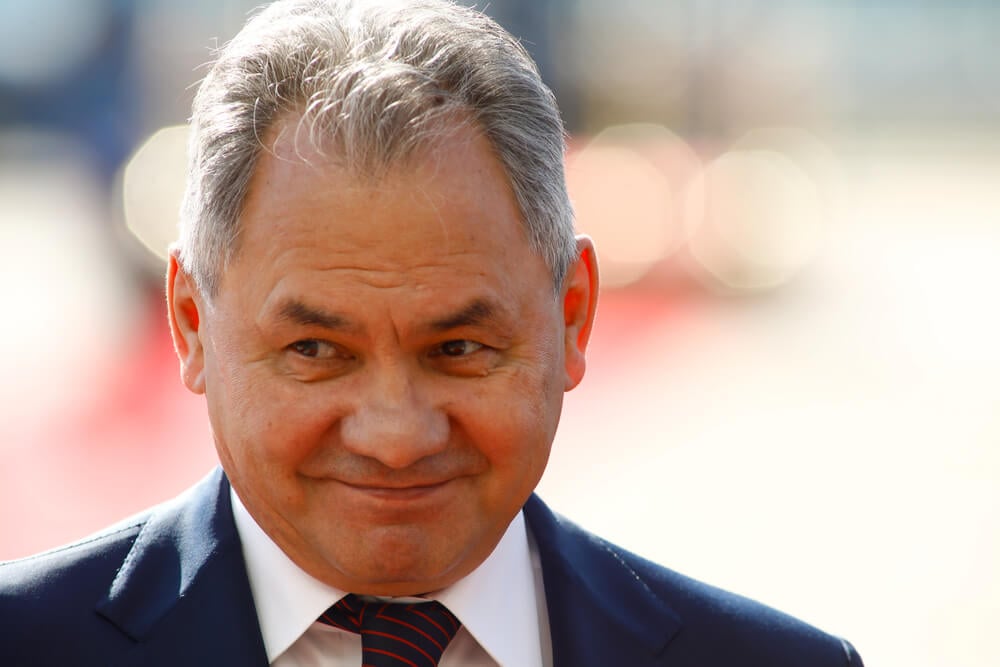
In October 2022, then Russian Defence Minister Sergey Shoigu claimed that Ukraine was allegedly preparing to use a “dirty bomb”
A U.S. presidential envoy flew to Kyiv to persuade Zelensky to allow these troops to cross the bridges to the right bank of the Dnipro and not be fired upon. This was done.
The Russians deliberately invented the story about Ukraine’s “dirty bomb” in order to have a justification in case tactical nuclear weapons were used.
Lavrov’s current statement fits into the logic of so-called “diplomacy of fear,” in which negotiations are replaced by ultimatums: either acceptance of Russian terms or the threat of escalation, which Moscow itself announces.
Russia systematically uses negotiation formats to buy time while continuing military pressure.
It is indicative that even during a period of active contacts and discussions of possible peace solutions in December of this year, Russia carried out three large-scale air strikes against Ukraine.
This demonstrates that the Kremlin is not moving towards peace but is using the war as a bargaining tool.
Finally, the number of drones cited by Sergey Lavrov exceeds the total number of targets reported by Russian air defence systems across the entire territory of the Russian Federation that evening.
Reports of an “attack on the residence” were also effectively refuted by local residents of Novgorod Oblast, who stated that they heard no sounds of air defence activity. This once again points to the falsity of the official Russian version of events.
Oleksandr Levchenko, a former Ukrainian diplomat, is a professor at the State University (Kyiv) and a member of the Academy of Geopolitics and Geostrategy (Kyiv).
