The prolonged war against Ukraine and the Kremlin's economic policy miscalculations have led to a sharp deterioration in the financial condition of Russia's corporate sector.
In the first half of 2026, Russia recorded a rapid increase in corporate bankruptcies.
According to media reports, the number of companies officially declared insolvent rose by 10.8% to 3,550, while the number of corporate supervision procedures initiated increased by 20.9% to nearly 3,000.
The causes of this trend are systemic and arise from the cumulative financial pressure placed on businesses throughout 2024–2025.
The Russian Central Bank's high key interest rate has significantly increased borrowing costs and triggered an acute liquidity shortage.
At the same time, tax burdens, labour costs and inflation-related expenses continued to rise.
As a result, a substantial share of enterprises lost their financial resilience and exhausted the reserves accumulated in previous years.
The situation deteriorated sharply in the second quarter of 2026. The number of corporate bankruptcies increased by a further 21%, while new supervision procedures rose by almost 25%, indicating that the insolvency crisis has entered an active phase.
Business behaviour has also changed markedly. According to information from the Federal Resource, the number of notices of intent to initiate voluntary bankruptcy proceedings increased by 43% compared with 2025 and by 83% compared with 2024.
This suggests that an increasing number of companies are opting for controlled voluntary bankruptcy as a mechanism to minimise losses and avoid the risks of subsidiary liability.
A large-scale liquidity crisis
The underlying causes of the current crisis are directly linked to the war against Ukraine.
The unprecedented expansion of military spending has overheated the financial system and accelerated inflation.
By the end of 2024, the Central Bank of Russia was forced to raise its key interest rate to a virtually prohibitive level of 21% per annum.
An additional blow came from increasing the standard VAT rate to 22%
For the civilian economy, this led to dramatically more expensive borrowing, the effective collapse of mortgage lending, and a substantial decline in consumer demand.
This combination of factors created a large-scale liquidity crisis that fully materialised in 2026.
Businesses deprived of affordable financing and burdened by steadily rising taxes exhausted their financial reserves.
An additional blow came from increasing the standard VAT rate to 22% and abolishing preferential social insurance contributions for small businesses, effectively eliminating the remaining profitability of a significant number of enterprises.
The illusion of resilience disappeared
The small and medium-sized business sector proved particularly vulnerable.
Companies that had previously operated on the brink of profitability were forced either to move into the shadow economy or to sharply increase prices for their goods and services.
Without access to affordable credit, and with a significant share of working capital absorbed by increased fiscal pressure, entrepreneurs effectively lost the ability to cover cash-flow gaps.
Under these conditions, bankruptcy increasingly became the only means of preventing further accumulation of debt.
Mass bankruptcies have become an indicator of a deep structural crisis
The illusion of resilience that still existed in 2025 disappeared completely once businesses’ financial reserves were exhausted.
Mass bankruptcies have become an indicator of a deep structural crisis affecting entire sectors of the Russian economy.
Fiscal authorities have sought to seize debtors' assets as quickly as possible before they lose value or are transferred by their owners.
This practice has effectively deprived companies the opportunity for financial recovery or voluntary debt restructuring.
In these circumstances, business owners are increasingly abandoning attempts to save their companies and are initiating bankruptcy proceedings themselves.
Sharp decline in demand for tourism services
The systemic economic crisis is becoming increasingly evident in the tourism sector as well.
During the first half of 2026, approximately 2,700 tourism companies ceased operations in Russia – 52.3% more than in the same period a year earlier. The primary reason was a sharp fall in demand for tourism services.
Domestic tourism has continued to lose popularity, and international destinations have failed to offset the decline.
Even consumers who continue to travel are increasingly choosing lower-cost options, significantly reducing the revenues of travel agencies.
Tour operators were forced to refund customers for cancelled trips
According to Travelata.ru, the number of package tours booked within Russia fell by 31% in the first half of 2026.
Tour operators' expectations of growing demand for international travel also proved unfounded.
Due to the deterioration of the security situation in the Middle East, tours to several destinations were effectively suspended and air connections significantly restricted.
Tour operators were forced to refund customers for cancelled trips, which experts estimate cost the industry more than RUB 19 billion (USD 243 million). Similar financial losses later resulted from the mass cancellation of trips to occupied Crimea and Sochi.
Fuel shortage
Another factor deepening the economic crisis has been the sharp rise in logistics costs. According to media reports, the cost of road freight transport in Russia has increased by 28.8% year-on-year and by 17.5% since the end of May alone.
The principal cause was an acute fuel shortage, which forced transport companies to shorten routes and spend increasing amounts of time waiting in queues at filling stations. Freight rates on certain routes increased by more than 50%.
Export transport orders declined by 19% during the second quarter
Logistics companies are increasingly abandoning long-haul transportation in favour of urban and suburban routes, where the risk of running out of fuel is lower.
At the same time, export transport orders declined by 19% during the second quarter.
Strikes on Wildberries' logistics hubs
Ukraine's long-range drone strikes on the logistics infrastructure of Russia's largest online marketplace, Wildberries, have dealt a serious blow to the country's e-commerce sector.
According to media reports, the company's distribution centres in Elektrostal, Kotovsk, and several other cities suffered significant damage.
As a result, thousands of entrepreneurs selling goods through the platform found themselves in a critical financial situation.
Experts estimate that approximately 15% of the company's warehouse capacity was damaged.
Neither Wildberries' standard compensation programme nor its voluntary insurance policies covered losses caused by drone strikes, effectively shifting the entire financial burden onto sellers.
The loss of the Elektrostal distribution centre was particularly significant, as it was the company's second-largest logistics hub in Russia.
Merchandise belonging to thousands of sellers was destroyed, leaving many almost instantly without working capital
A substantial share of Wildberries' more than 20 million daily orders passed through this facility.
Its destruction led to significantly longer delivery times, extensive financial losses, and serious disruption across the company's logistics network.
The strikes on Wildberries' logistics hubs in Kotovsk and Elektrostal alone caused losses exceeding RUB 100 billion (USD 1.28 billion).
Merchandise belonging to thousands of sellers was destroyed, leaving many almost instantly without working capital.
The absence of an effective compensation mechanism has threatened the continued existence of a significant proportion of small businesses engaged in e-commerce.
Government support has been limited to allowing businesses to defer loan repayments for six months, a measure that does not compensate entrepreneurs who have effectively lost their inventories, working capital, and primary sources of income.
Growing structural imbalances
The war launched by the Kremlin against Ukraine has become one of the principal drivers of Russia's deepening economic crisis and has led to a large-scale contraction of entrepreneurial activity.
According to media reports citing data from the audit and consulting network FinExpertiza, the number of newly registered commercial enterprises in Russia fell to its lowest level in 17 years in the first half of 2026.
Only 66,700 new companies were registered over the six-month period, a decline of 23.6% compared with the same period in 2025.
Entrepreneurial activity has now been declining for the third consecutive year. During the same period, 118,700 businesses ceased operations, meaning that the number of liquidated companies exceeded new registrations by nearly 1.8 times.
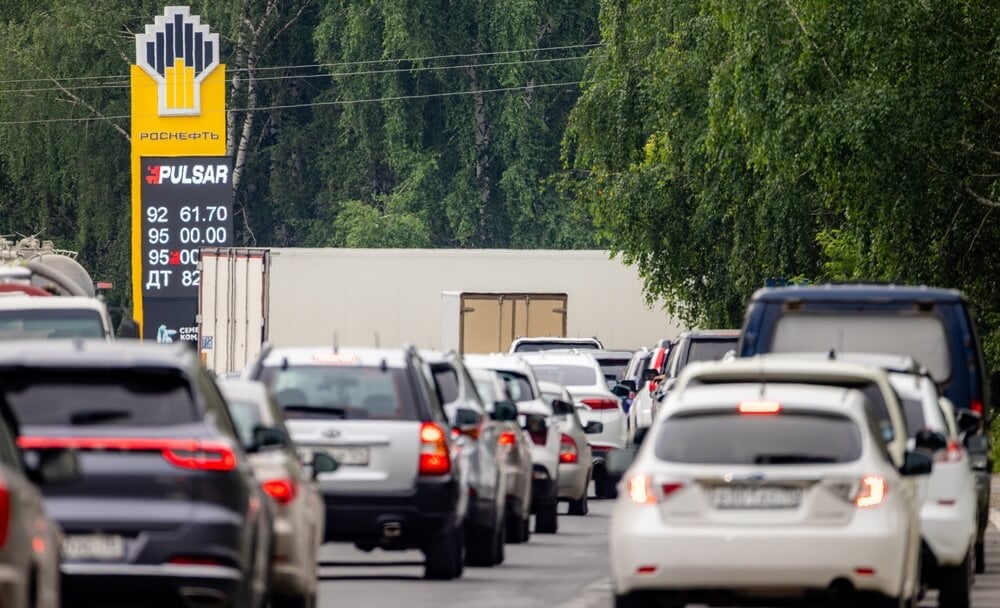 A significant acceleration in fuel price growth was recorded in 49 Russian regions
Inflation continued to accelerate across numerous Russian regions. Fuel prices increased particularly rapidly: in Sevastopol, they rose by almost 80% year on year; in the Republic of Tuva, by more than 65%; and in Kamchatka, by 18.5%. Overall, a significant acceleration in fuel price growth was recorded in 49 Russian regions.
In addition to sharply higher logistics costs, inflationary pressure was intensified by the depreciation of the ruble and rising telecommunications costs.
According to Russia's financial regulator, the ruble depreciated by 10% during June alone, automatically increasing the cost of imported goods and industrial components.
The gasoline shortage also triggered a sharp rise in the price of liquefied petroleum gas (LPG), with retail prices increasing by a further 12%.
Prioritising financial resources for military expenditure instead of supporting the civilian economy has intensified inflationary pressures.
These developments highlight the growing structural imbalances within the Russian economy and the authorities' limited capacity to maintain macroeconomic stability and safeguard the country's broader economic interests.
Oleksandr Levchenko, a former Ukrainian diplomat, is a professor at the State University (Kyiv) and a member of the Academy of Geopolitics and Geostrategy (Kyiv).
