Last week, US Treasury Secretary Scott Bessent launched an “economic D-Day” program, intended to cut Iran off from all trading partners.
So far, this intensified economic blockade has only contributed to an escalation of the US-Iran war, rather than moving it toward a conclusion.
That probably will not change, because China is unwilling to cooperate. And this is the reality that US policymakers must now face: Most possible paths to lasting peace run through China.
Wars end because one side gives up, or because influential people on both sides grow tired of the losses and want to move on, or because a powerful third party imposes peace.
Seen through this lens, the US-Iran conflict could last for a long time.
Hardliners on both sides are now deeply entrenched. Iran is not about to surrender, the US will not risk a full-scale invasion, and China, the only third party with enough clout to make a difference, seems inclined just to watch.
Bessent’s economic isolation campaign is unlikely to prove decisive without the support of Iran’s most important trading partner.
If China continues to do business with Iran, the current Iranian leadership will most likely survive.
Any US threats against China remain non-credible, given China’s leverage over the supply of critical minerals needed by the sectors driving economic growth in the United States and other major countries.
No critical minerals means no computer chips—and no AI-led investment boom for the US.
China is one of the least sensitive countries to the current crisis
Iran and the US agreed to a ceasefire in June, and this was quickly followed by a memorandum of understanding (MOU).
But none of this has led to real peace. Iran is still effectively limiting passage through the Strait of Hormuz, and the US is still turning away most vessels associated with Iran. The MOU looked good on paper, but it was never fully implemented by either side.
China turned out to be one of the least sensitive countries to the current crisis
When the US and Israel attacked Iran in late February, and Iran responded by closing the Strait of Hormuz, some strategic thinkers believed that China would press for a quick resolution of the conflict, primarily because, until recently, as much as 60% of its oil imports passed through the Strait of Hormuz.
But this turned out to be a miscalculation. China had more than 1.2 billion barrels—200 million above its usual reserves—when the conflict began, and still holds more than 1.15 billion barrels today.
At the same time, the disruption and increase in global oil prices have accelerated demand for renewables and electric vehicles, which has helped China’s exports.
Ironically, these sectors are the same ones in which China has huge excess capacity. In that sense, the current crisis has postponed the financial losses in these sectors.
Overall, China turned out to be one of the least sensitive countries to the current crisis.
This should be an important consideration in any future calculations by US policymakers and rules out instability in the Middle East as part of the toolkit for containing China.
The main loser is the broader Middle East
The main loser from this war is the broader Middle East. The world economy is learning how to survive with oil and gas exports from the region at around half of their prewar level.
Of course, it is a relatively costly adjustment, but the longer this crisis continues, the less sensitive the world economy may become to disruptions in the Middle East.
This may not be good news for the region’s oil-exporting countries, and they are likely to lose market share over the medium term.
Countries in the region have learned that reliance on US security may not work as well as they thought
Countries in the region, especially Saudi Arabia, the United Arab Emirates, and Qatar, have also learned that reliance on US security may not work as well as they thought.
Saudi Arabia is trying to increase its reliance on other regional allies, while Qatar and the UAE are talking directly with Iran and using economic incentives to buy some security for themselves.
These shifts support the argument that regional economic integration must be part of the solution to the current impasse.
The nuclear issue
At first glance, more diplomacy by regional players may strengthen the case for the US washing its hands of the issue and leaving the problem to Iran’s neighbors.
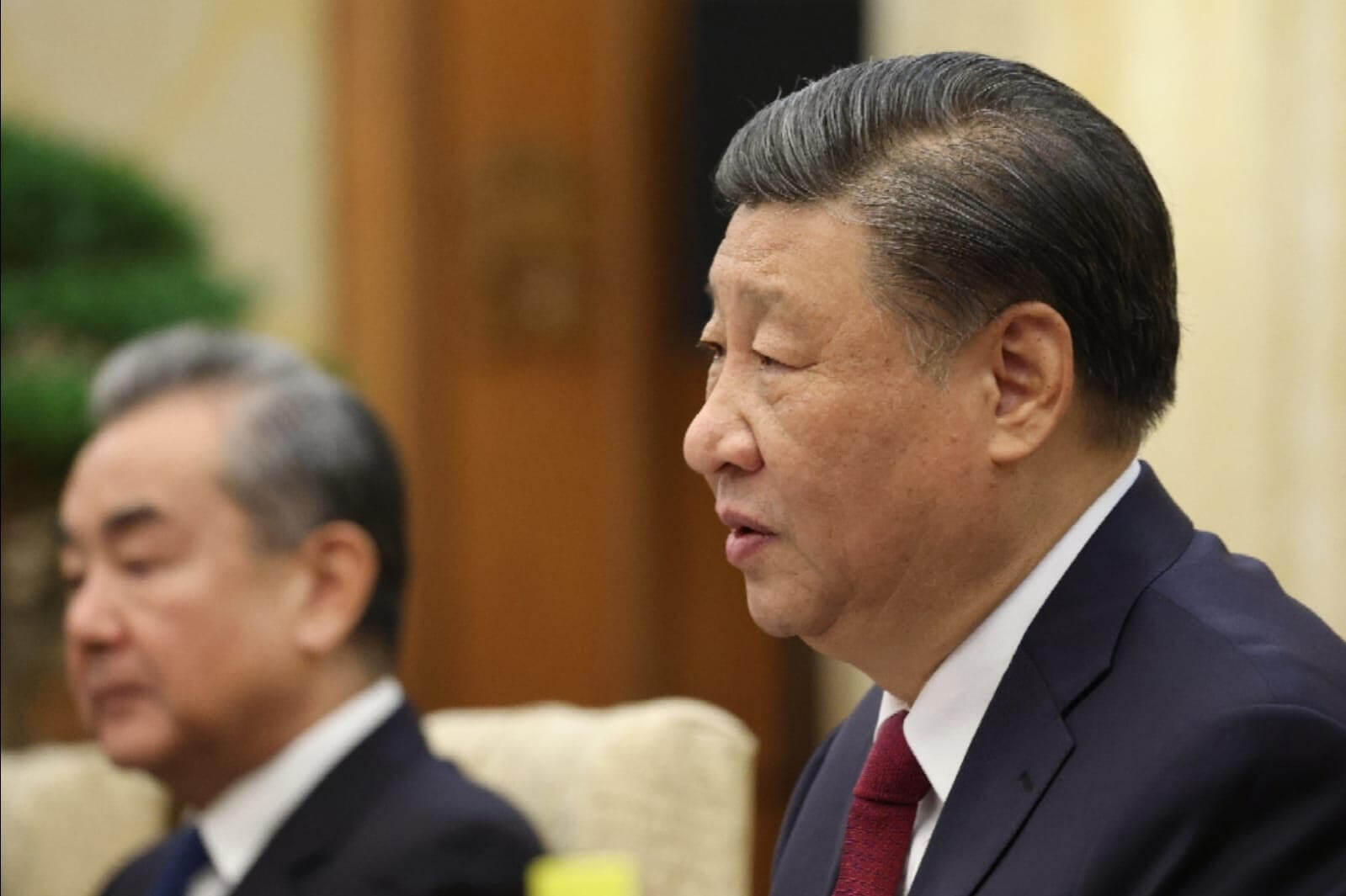 Chinese President Xi Jinping is due to visit Washington at the end of September
But it is very hard to see how the nuclear issue would be addressed in this scenario, and without addressing that concern about Iran, it may be very hard to make any long-term plans or even achieve partial economic integration in the region.
The only stable solution to this crisis is one that involves China and increases economic integration in the region, as well as addressing the nuclear issue by integrating Iran’s program into a regional civilian electricity production supply chain led by China.
Chinese President Xi Jinping is due to visit Washington at the end of September.
Perhaps the US-Iran conflict can be resolved in the context of a broader discussion with President Donald Trump. Or perhaps China will be content to watch and wait.
Simon Johnson, a 2024 Nobel laureate in economics and a former chief economist at the International Monetary Fund, is a professor at the MIT Sloan School of Management, Co-Director of MIT’s Stone Center for Inequality and Shaping the Future of Work initiative, Co-Chair of the CFA Institute Systemic Risk Council, and an AI Ambassador for the UK.
Amir Kermani, Professor of Finance and Real Estate at the Haas School of Business at the University of California, Berkeley, is a research associate at the National Bureau of Economic Research.
