The European Union badly needs to regain its mojo if it is to avoid results such as last weekend’s ‘no’ vote in Iceland on reopening accession talks, or worse in terms of its geopolitical heft and ultimately its sovereignty and freedom of action.
Even in a situation where Donald Trump’s US is casting a threatening shadow over their part of the world, Icelanders didn’t find the EU an attractive enough offering, or at least felt they could easily prolong their free-rider status vis-à-vis the union.
It’s entirely possible that even in a world where the EU was performing better economically, politically, technologically, security-wise, etc. Iceland would still have chosen its fisheries and agricultural nationalism over the much larger benefits of accession.
But a more coherent, combative and confident EU could at least have made a better case. Going one step further, a truly determined EU as a global power player would have put the squeeze on, both in economic and security terms, to get the result it desired.
Iceland’s wealthy but relatively small economy allows it to retain its status as partly in and partly out through its participation in the European Economic Area, EEA.
One argument bandied about in the run-up to the referendum was that the island had no need for EU membership, as it had outperformed the EU economically since the financial crisis.
What in fact happened is that Iceland faced a huge banking meltdown during that crisis and exported its liquidity problem to the EU through questionable loopholes that have now been closed, buying itself almost a decade of recovery time.
Still, apart from the direct Iceland-EU economic comparison, it’s clear that the EU has not recovered the financial spring in its step as well as some other parts of the world.
The effective end of remarkable EU confidence
The financial crisis marked the effective end of a period of remarkable EU confidence and rapid expansion.
EU enlargement in the 1990s and early 2000s made the bloc seem like an unstoppable force. It became the largest single market and established itself as a regulatory heavyweight, the ‘Brussels effect’ becoming a byword for the EU setting the agenda.
It was also the period when most member states adopted the euro, giving the impression both of even more economic heft and of the permanence of the arrangement.
In hindsight, it’s possible to see that this expansion brought with it a whole new range of tensions and resentments, among others over ‘sovereignty’ and the free movement of people, that eventually gave rise to the current far-right anti-EU backlash, including Brexit.
While the US probably didn’t manufacture the 2008 financial crisis for the purpose, it did effectively export the consequences abroad
Internationally, it spurred rivals to curb the EU’s rising influence. While the US probably didn’t manufacture the 2008 financial crisis for the purpose, it did effectively export the consequences abroad, particularly and pointedly to the EU.
The geopolitical squeeze tightened further with Moscow’s aggression towards Ukraine and the eventual need to stop relying on Russia’s energy supplies.
America’s ‘pivot to Asia’ and subsequent manipulation, particularly under Trump, of the energy supply and the geostrategic defence alliance, including NATO, further undercut Europe.
The change in China’s position in the global markets, ending its reliance on Western imports and becoming a huge exporter to the EU of not only cheap consumer articles but also of more advanced products that compete with core European industries, further undermined the EU position.
COVID-19 intervened almost like a deus ex machina to add to the already considerable debt burden.
The fragmentary nature of the internal EU structures
All of these developments, apart from COVID, exploited and were predicated on the fragmentary nature of the internal EU structures and processes.
The Euro, for example, was adopted without a common treasury. Energy dependence came about through individual countries’ choices and the absence of common EU-wide policy.
The EU members’ decision to reduce defence spending after the Cold War and rely on the US umbrella made the bloc geopolitically vulnerable. And the absence of a unified position on China, even now, allowed Beijing to flip the script.
The single market’s freedom of movement clauses and the Schengen free-travel zone were not backed up by sufficient border control, internal enforcement and EU-wide solidarity mechanisms and became an easy target both for popular resentment and foreign manipulation.
The EU is scrambling to keep up with more centralised yet nimble opponents while itself being held back by a mostly reactive structure
One of the founding fathers of European integration, Jean Monnet, once famously said that “Europe will be forged in crises, and will be the sum of the solutions adopted for those crises.”
Yet, that formula no longer holds. While the EU has developed much-needed mechanisms through the crises of the past two decades, it has not regained its momentum.
Simply put, the post-WWII reality of Jean Monnet, with its overwhelming Western dominance and American optimism, its lingering European advantage and its unification urgency, as well as its clearly defined blocs, is no more.
In its place, the EU is scrambling to keep up with more centralised yet nimble opponents while itself being held back by a mostly reactive structure.
It is floundering amid a global turn away from multilateralism and towards more autocratic and self-interested major players striving for dominance rather than partnership.
The old ideals of a rules-based international order
There’s a lot of political thinking going on to address this conundrum, both in the EU and elsewhere.
The clearest example of this is Canada’s Mark Carney and his call for new and more effective cooperation by so-called middle powers.
This sounds particularly attractive to some in the EU and the UK who imagine this as an opportunity for the continent to lead such a new alliance, which would rally around the old ideals of a rules-based international order.
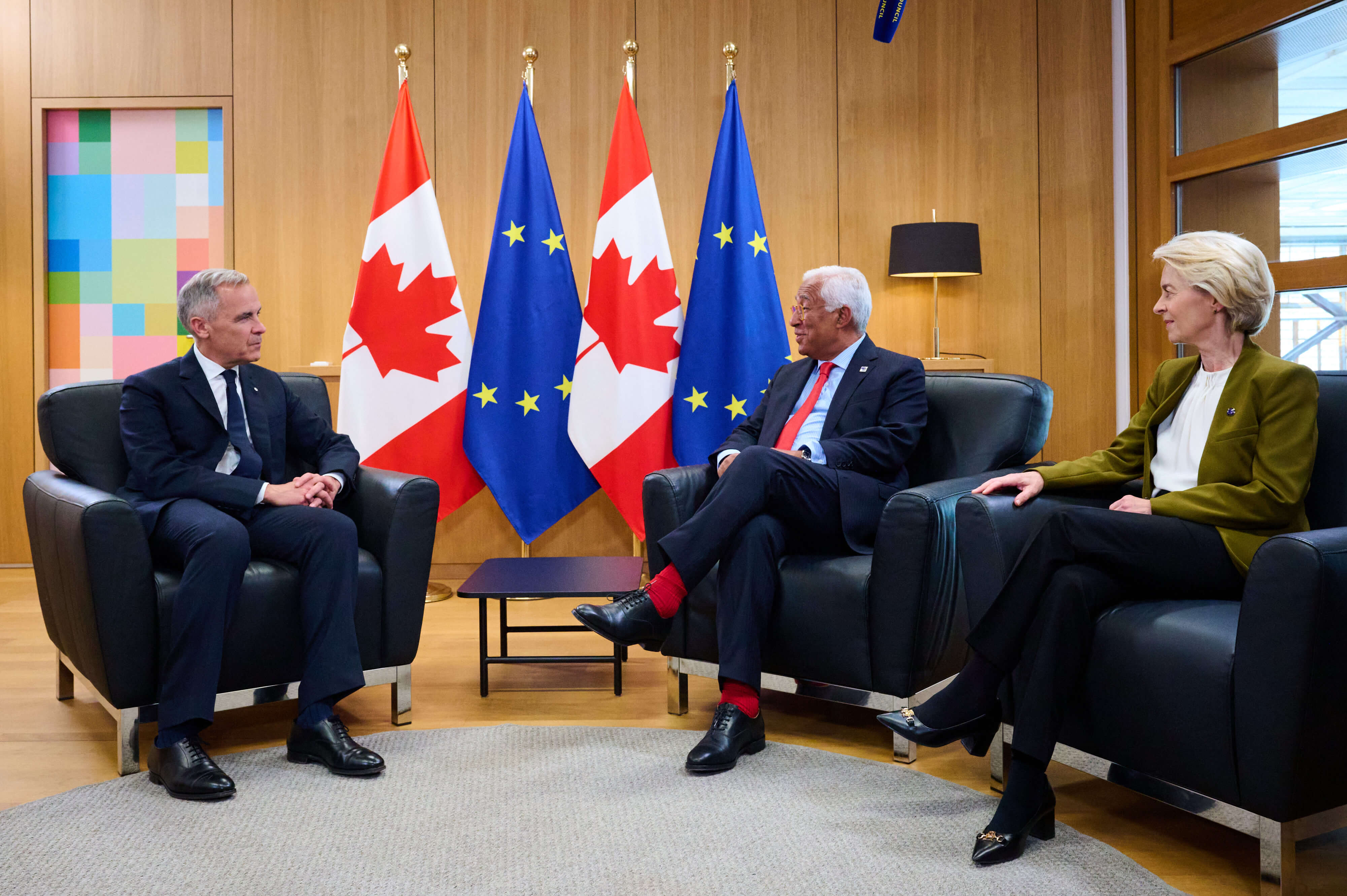 The odds of Carney’s proposed middle power alliance being able to make a difference at all on the world stage are extremely slim
But this would not offer a panacea to either the EU or the UK for all the existing European problems.
The main question for the EU is now whether to more effectively integrate, one way or another, or double down on national sovereignty, maybe not a full dissolution but at the very least member states turning back the clock, as is happening already with the Schengen border rules.
In the latter scenario, some of the bloc’s larger nations could conceivably decide to prioritise a potential new middle power alliance at the expense of EU integration.
While such an alliance sounds alluring, it would face even worse problems coordinating its actions and making them count than the EU does today.
Realistically, the odds of Carney’s proposed middle power alliance being able to make a difference at all on the world stage are extremely slim, especially if existing international structures, such as the UN and the WTO, are degraded.
Re-energise a cooperative international system
Only a resurgent EU has the heft to counter the current global centrifugal forces, and only the EU has the inbuilt tendencies and democratic pedigree to re-energise a cooperative international system.
The EU is far from being the ungovernable, bureaucratic, hidebound disaster that its opponents make it out to be on the one hand, while on the other depicting it as an elitist, power-hungry, overarching hegemon.
Given the EU’s current shortcomings and the threat of a far-right takeover of the bloc, the ‘no’ vote should not have come as a surprise
Yet, it has undeniably thus far fallen short in meeting a completely new set of challenges, causing more damage by spewing high-minded rhetoric while failing to rise to the occasion, be it on security, the economy, green transition, human rights, etc.
A country such as Iceland might always guard its independence, but given the EU’s current shortcomings and the threat of a far-right takeover of the bloc, the ‘no’ vote should not have come as a surprise.
