The results of the referendum on whether to resume negotiations on Iceland’s EU membership will be awaited on Saturday evening in Brussels with at least as much impatience as in Reykjavik, if not more.
Alongside the Icelandic camps advocating one of the two options in the referendum – for or against resuming negotiations with the EU – the leaders in Brussels appear as a separate, third interested party.
As with any other national vote, the EU maintains that it will not seek to influence voters in Iceland.
However, the past few months have painted a different picture: there has been a veritable influx of European leaders and Brussels officials on the Atlantic island, clearly aimed at backing the option of reactivating membership talks.
Iceland had already embarked on this path in 2009 but broke off negotiations with the EU four years later under a conservative government. This time, the government in Reykjavík is led by pro-EU Social Democrat Prime Minister Kristrún Frostadóttir, the most influential advocate of returning to the path towards EU membership.
Since the start of the year, Iceland has hosted a number of MEPs from several EU member states, the Commissioner for Fisheries, Costas Kadis, the French Foreign Minister, Jean-Noël Barrot, and, finally, the President of the European Commission, Ursula von der Leyen, in mid-July.
Even the pro-EU government in Reykjavik has found this excessive and has urged the EU to stay away and not interfere in the referendum.
This shows that the EU cannot be indifferent to the outcome of the vote in Iceland. It recognises that this is a rare opportunity to secure much-needed global confirmation that its influence and importance remain vital, despite the numerous crises that have shaken the bloc.
Enlargement as evidence of power
The accession of new members has always been compelling proof of the EU’s power, as an attractive project capable of providing economic and social prosperity to all who wish to join.
The golden days of the great enlargement of 2004, when the EU absorbed almost the entire Eastern Bloc behind the former “Iron Curtain”, have long passed.
They were followed by years of crisis for the European project – from the migrant wave in 2015 and 2016 and Brexit in 2016 to the Covid-19 pandemic and, finally, the war in Ukraine.
For 13 years since Croatia’s accession, the European Union has not taken in a single new member
The internal weakening of the EU during these crises has been accompanied by serious economic challenges, such as the financial crises in southern Europe, an unresolved response to constant waves of illegal migration, and growing vulnerability to the security tests to which it is increasingly exposed.
However, for 13 years since Croatia’s accession, the European Union has not taken in a single new member. This is the longest pause in pursuing one of the Union’s most important strategic priorities, and it reveals the depth of the internal problems afflicting the bloc.
The European shift due to the war in Ukraine
The Russian invasion of Ukraine in 2022 changed the mood among European policymakers, who recognised that Russian aggression threatens continental security, and that the response must be to accelerate the enlargement of the Union.
Over the four years of the war in Ukraine, a number of countries on the European periphery have taken advantage of the change in Brussels’ strategy. Ukraine, Moldova, and Bosnia and Herzegovina gained candidate status for membership in 2022, with Georgia following a year later.
The Western Balkan countries, which have been in the accession process for more than two decades, were given a fast track to Brussels in 2022, and Montenegro and Albania are already nearing the end of that process.
Iceland is once again considering EU membership, riding the same wave of the revised strategy in Brussels and the renewed mood among Europeans regarding the admission of new members
In this context, Iceland is once again considering EU membership, riding the same wave of the revised strategy in Brussels and the renewed mood among Europeans regarding the admission of new members.
Russia’s aggression against Ukraine has significantly reduced earlier European scepticism about admitting new members, so that, after a long period, more than half of EU citizens (56%) now want to see new countries join the club.
At the same time, security considerations and the need to bring the continent together as a community of shared values and policies are the main motives behind Icelanders’ renewed interest in joining the Union.
Continental security as an EU offer to Iceland
European politicians are also playing that card, which is why, during her July visit to Iceland, Ursula von der Leyen primarily discussed with the government there the Security and Defence Partnership Agreement concluded in March 2026.
Iceland has been a member of NATO since 1951, and in this sense security issues should not, at first glance, play an important role in citizens’ thinking about whether or not to join the European Union.
However, the increasingly strong sense that the Alliance, due to the unpredictable and often conflicting behaviour of the United States towards its European allies, is compelling people to consider additional security options that would continue to guarantee the island’s security and stability.
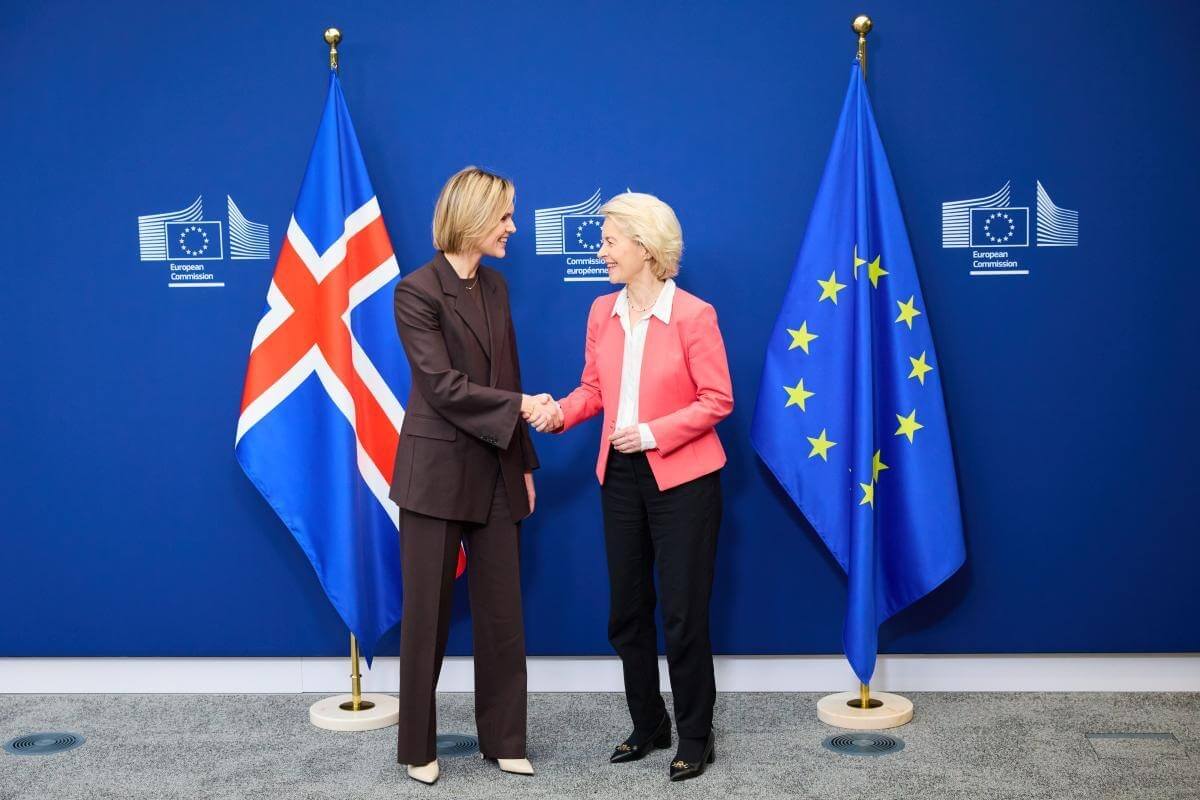 By returning Iceland to the accession track, the EU would take an important step forward in strengthening its industrial and, in particular, strategic and security autonomy - Kristrún Frostadóttir, Ursula Von der Leyen
The aggressive behaviour of Donald Trump and his administration towards Greenland, in particular, sounded the alarm among Icelanders, who rightly sensed that their national independence, achieved relatively recently in 1944, could also be threatened.
Europeans recognise these concerns and therefore emphasise EU membership as an important, even existential, aspect of their offer.
“Through our new partnership, we will be able to cooperate more closely on hybrid threats that we see, on civil protection, but also on the whole topic of cybersecurity,” said Ursula von der Leyen during her visit to Iceland.
The EU offers Iceland other attractive options, such as participation in the SAFE (Security Action for Europe) defence instrument, worth EUR 150 billion, through which members can take part in the procurement of security equipment (Iceland does not have an army) and receive support for the security-related industry.
By returning Iceland to the accession track, the EU would take an important step forward in strengthening its industrial and, in particular, strategic and security autonomy.
Iceland’s geographical position is uniquely important to the European security architecture, and including Reykjavik in decisions on common security strategies would complete European influence across the wider North Atlantic and Arctic areas.
Icelanders will not decide on joining the EU on Saturday; they would have to hold a separate referendum on that later. However, a positive answer to the question on the continuation of accession negotiations would be an almost certain indication that formal accession to the Union is likely.
In Brussels, there is an awareness that the stakes are already high and that a possible failure of the pro-EU option would leave Iceland outside the Union in the long term.
It would also be a symbolic blow to efforts to position the EU globally as an actor that has overcome crises, particularly its internal turbulence, and is ready for a new enlargement as proof of its renewed vitality.
