Nuclear weapons made wars of conquest between great powers unthinkable. After 1945, nuclear powers could still confront one another, but only indirectly, through proxy conflicts and peripheral crises.
However bloody, these conflicts were not expected to approach the violence of the 20th century’s two world wars.
Russia’s 2022 invasion of Ukraine shattered that certainty. By ordering an attack on a country whose independence and security Russia had guaranteed under the 1994 Budapest Memorandum, President Vladimir Putin undermined a foundational assumption of the postwar order.
The war in Ukraine has demonstrated that under the cover of its nuclear arsenal, a major power can wage a full-scale conventional war of conquest without triggering nuclear escalation or crossing the line that was once thought to separate limited war from catastrophe.
The notion of a clear nuclear threshold, therefore, no longer corresponds to reality.
What exists instead is a zone of uncertainty: an intermediate space in which hostile acts can accumulate without automatically triggering nuclear escalation.
Rival powers begin to test the limits of what is possible
Deterrence, however, depends less on weapons themselves than on stable expectations regarding their use.
Once that stability erodes, rival powers begin to test the limits of what is possible, and the threshold of the intolerable rises.
This shift, in turn, creates opportunities for revisionist powers to reshape the rules of the international system to their advantage, including by force.
The inviolability of borders, a cornerstone of the United Nations order, begins to look less like a rule than a conditional norm, valid only when someone is still willing and able to enforce it.
The most significant strategic ruptures of the past five years have come from nuclear powers themselves
Notably, the most significant strategic ruptures of the past five years have come from nuclear powers themselves.
Russia attempted to subjugate Ukraine, then annexed several of the country’s provinces before settling into a war of attrition.
Israel, an undeclared nuclear power, responded to Hamas’s October 7, 2023, attack with military operations of unprecedented scope, striking targets in Gaza, Lebanon, Syria, Yemen, and Iran.
Far from remaining the guarantor of the system it helped build, the United States has fueled its destruction.
President Donald Trump’s barely veiled threats to take over Greenland were one sign of that shift. Then came the intervention in Venezuela and abduction of its president, followed by the war with Iran, launched without a UN mandate or meaningful congressional consultation.
Lowering the cost of aggression
These episodes do not simply pile up; they reinforce one another. Over the past four years, Russia has demonstrated that economic sanctions can be absorbed, that Western war efforts face industrial and political limits, and that nuclear cover allows for more ambitious land grabs than previously believed.
This shift radically alters the incentive structure, lowering the expected cost of aggression and increasing the anticipated reward.
The result is not a sudden global conflagration but a proliferation of local conflicts that refuse to stay local.
World War III, in that sense, might unfold entirely below the nuclear threshold, setting off an uncontrollable chain reaction of conventional violence.
Today, conflicts are increasingly interconnected, with each new hotspot amplifying others
Electrical engineering offers a useful metaphor. During the Cold War and the subsequent period of unchallenged US hegemony, conflicts unfolded in parallel within the international order.
One could erupt without necessarily implicating the others. A short circuit in one place did not bring down the whole system.
Today, conflicts are increasingly interconnected, with each new hotspot amplifying others and increasing the strain on the system as a whole.
Under such conditions, wars no longer remain separate but can converge into a single strategic crisis.
The French sociologist Raymond Aron recognized this problem decades ago. In his prescient 1951 book The Century of Total War (Les Guerres en chaîne), he argued that American strategists had imagined two futures: armed peace without direct confrontation, or total war culminating in nuclear exchange. In doing so, they overlooked a third possibility: “limited hot wars.”
The outbreak of the Korean War exposed that blind spot. Yet even the Cold War’s hot wars remained contained.
Soviet and Chinese support to North Vietnam, for example, had to remain discreet or defensive. Nuclear deterrence still succeeded in confining violence to limited theaters.
Security policy based on nuclear arsenals is no longer enough
But that capacity for confinement is now fading, partly because no single power can sufficiently regulate local conflicts.
The US, though still the world’s leading military power, can in practice sustain only one major war at full intensity.
Here lies the paradox of hegemony: the US must remain present everywhere, while its rivals need to dominate only their own regions.
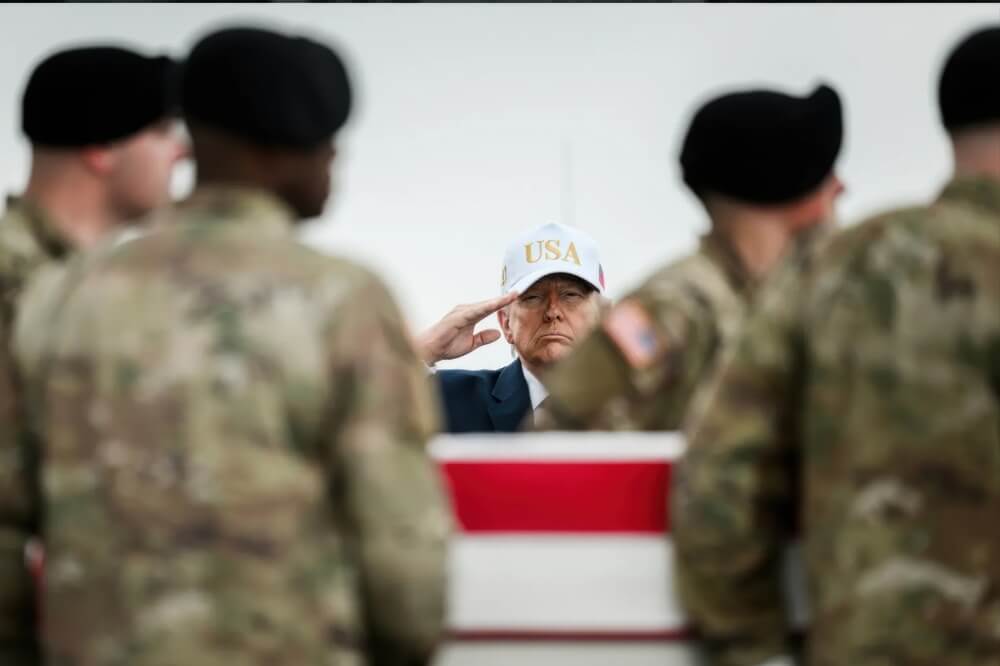 The US must remain present everywhere, while its rivals need to dominate only their own regions - Donald Trump
A crisis over Taiwan, or elsewhere, could be enough to produce strategic overload. Europe is not yet politically unified enough to fill that gap, and China, despite its growing clout, has shown little appetite for guaranteeing global order rather than defending its immediate interests.
In this environment, a passive security policy based solely on nuclear arsenals and defensive alliances is no longer enough.
To re-establish deterrence, liberal democracies must rebuild their collective defense mechanisms by restoring norms governing the use of force and constructing a new security regime that is based on regional balances and capable of functioning without a single guarantor.
As economic power becomes more widely distributed, the age of the US as an “indispensable nation” is coming to an end.
The international system is moving toward either what the French sociologist Jean Baechler called an “oligopolar world” – a balanced system dominated by a few powers – or a new bipolar order centered on the US and China.
Whether nuclear deterrence survives the transition will determine what comes next. If it fails, the real danger is not Armageddon, but a sustained buildup of violence that no one can contain.
Antony Dabila is a research fellow at CEVIPOF at Sciences Po.
