Europeans spent the first months of Donald Trump's presidency surprised by his and his associates' statements that they would withdraw from the traditional role as the main protector of European security.
That period, a little more than a year ago, raised the question among Europeans of whether security independence should also mean seeking an alternative to the American nuclear umbrella.
Faced with numerous existential problems that arose with the new Trump administration, European leaders mostly theorised about possible alternatives to nuclear deterrence.
However, the passage of time brought no relief; on the contrary. European leaders must now provide a quick and convincing answer to the questions of whether Europe should rely on itself and build its own nuclear defence system or continue to depend on increasingly uncertain American support, as the time for theorising is over.
If last year's speech by US Vice President JD Vance at the Munich Security Conference was an alarm for European nations, today it is only a faint echo from the time of verbal American warnings to Europeans.
In the meantime, Washington has adopted a National Security Strategy that is extremely harsh towards Europe, and last week also a National Defense Strategy.
American strategic withdrawal from European security is no longer the subject of conference speeches and television interviews; it is now official policy embedded in the most important strategic documents.
On top of that, the American president openly threatened to violate European sovereignty by announcing the takeover of Greenland.
A new reality
This is an entirely new situation for European leaders and their defence planners, and the issue of nuclear defence has returned to the top of the agenda, regardless of the many in Europe who may not wish to acknowledge it.
At the root of Europe's nuclear dilemmas – of which there are many – is the issue of trusting American allies.
Is the post-WWII promise to maintain an open nuclear umbrella over the continent, with its powerful arsenal of around 3,700 nuclear warheads, still valid?
"We’ve had this system of extended deterrence and the U.S. promise to allies that if they’re attacked with a nuclear weapon, the United States would respond. That has really kept nuclear weapons from spreading for decades. But the challenge right now is that it only works if allies believe that the U.S. commitment is real," Emma Belcher, an arms control expert, told NBC.
With Trump, we cannot calculate, and we cannot rely on the U.S - Roderich Kiesewetter
The first echelon of European leaders will not openly admit that such trust is lacking but will attempt to defuse one hot spot in transatlantic relations at a time, such as Greenland, or respond to Trump's accusations that the allies did not support the US in Afghanistan.
However, they will no doubt agree with the stronger statements coming from the second. "A trans-Atlantic alliance cannot be built upon surprises. With Trump, we cannot calculate, and we cannot rely on the U.S. Full stop. And we must be aware that he will come up with other surprises," said Roderich Kiesewetter, a lawmaker from Germany’s CDU party to which Chancellor Friedrich Merz also belongs.
Expectations are decreasing that the unpredictable American president could revert to the previous order and continue to serve as Europe's primary security guarantor.
Moreover, it does not even exist institutionally if we consider two recently adopted security strategies that oblige the US government to act according to them in foreign policy.
Reliance on France and the UK
Europeans must revisit all previous calculations regarding the strengthening of security autonomy, this time with much deeper projections on how to ensure nuclear security.
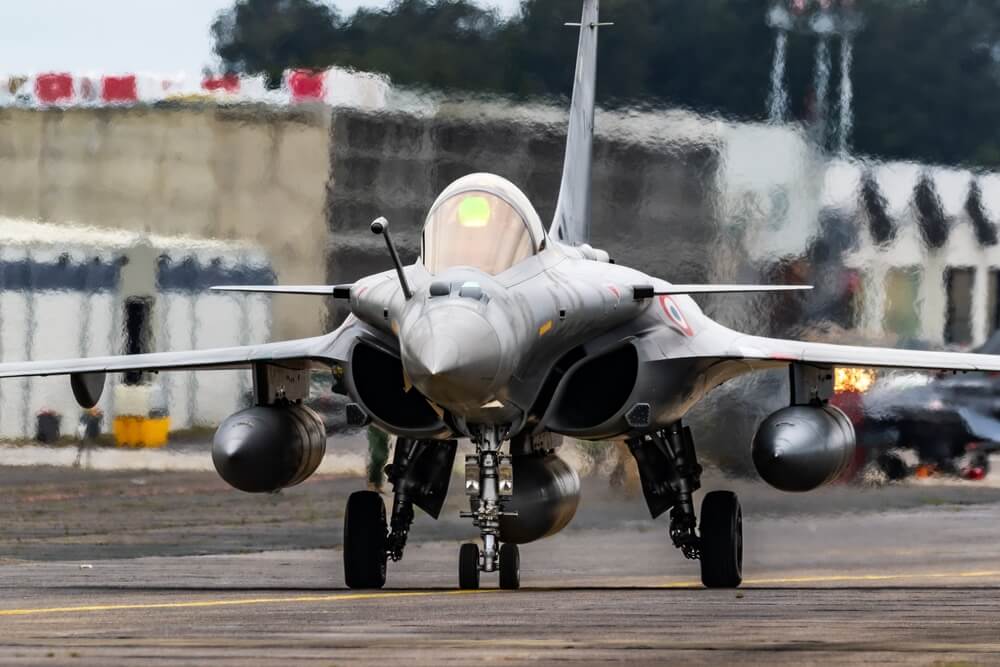 The most common alternative discussed so far is European reliance on the nuclear capabilities of France and the UK, the only two European states with nuclear arsenals - Dassault Rafale
The most common alternative discussed so far is European reliance on the nuclear capabilities of France and the UK, the only two European states with nuclear arsenals.
However, neither Paris nor London have shown any willingness to share their national nuclear potential with partners on the continent.
French President Emmanuel Macron did suggest last year that he might consider expanding France's nuclear deterrent to protect European partners.
However, after next year's elections, he will no longer be able to decide, and his main competitor, Marine Le Pen, and her supporters explicitly demand that the French nuclear arsenal be used solely for national defence.
Even if the two European nuclear powers adapt to new circumstances and agree to share their nuclear defences with their European partners, their arsenals—France's nearly 300 nuclear warheads and Britain's 225— are still insufficient to ensure the protection of everyone in Europe.
Development of national nuclear programmes
As an alternative, the accelerated development of military nuclear programmes in European countries is being considered. Most already possess the technical expertise and resources to develop nuclear weapons programmes independently.
However, once they reach the stage of producing highly enriched uranium, they will come into conflict with the Non-Proliferation Treaty.
For European democracies, and especially for politicians responsible for implementing this policy, this would pose a significant problem, as it would clash with deep-rooted anti-nuclear sentiment.
An even greater challenge would be securing funding for such expensive and long-term programmes, particularly as most European governments still struggle to justify increases in military budgets.
Europeans must first answer a prior question: whether to pursue nuclear autonomy or focus on strengthening conventional forces
European leaders must combine the available options to seek a swift and concrete response to the potential weakening of the American nuclear umbrella.
The UK-France Northwood Declaration from last July provides a solid framework for technological cooperation between the two European nuclear powers, aiming to reduce their dependence on American support.
This process can proceed in parallel with the strengthening of the technological capacities of other European partners in developing their own nuclear capabilities. UK and French assistance in this process is essential but will depend on domestic political support for such a step.
Even before deciding on one of these options, or a combination of them, Europeans must first answer a prior question: whether to pursue nuclear autonomy or focus on strengthening conventional forces.
