This year’s 9 May parade on Red Square became a kind of turning point in understanding Russia’s real situation. The Kremlin had hoped to use the military parade as another symbolic argument in future negotiations with Kyiv and Washington, but the effect turned out to be the opposite of Moscow’s expectations.
For the first time in two decades, Vladimir Putin did not dare to bring heavy military equipment onto Red Square for the traditional demonstration of Russian military power, limiting the parade mostly to marching infantry units.
Moscow feared possible Ukrainian drone strikes against concentrations of military hardware that could have been hit in front of millions of Russians accustomed to televised displays of the state’s “invincibility.”
For the first time, the Kremlin and Russian society experienced a sense of vulnerability on their own territory.
It became clear that the war no longer appeared one-sided – the danger could also affect Russia itself.
Another serious blow to the Kremlin’s image came from the statement by Ukrainian President Volodymyr Zelenskyy, who announced that Ukraine would refrain from striking Red Square and the site of the parade.
In practice, this looked like a demonstration of Kyiv’s control over the situation while simultaneously supporting US President Donald Trump’s initiative for a ceasefire on 9–11 May.
Moscow quickly agreed to the proposal because, until the very last moment, it feared possible disruptions to the celebrations.
Previous Kremlin threats of a “harsh response” in the event of Ukrainian drone attacks appeared more like signs of nervousness and weakness than confidence.
Manipulative interpretation
For decades, Moscow has sought to monopolise the victory in the Second World War, presenting it exclusively as Russia’s achievement.
The Kremlin managed to convince some Western politicians that without the Russians, victory over Nazism would have been impossible.
However, such an interpretation is manipulative. Without large-scale military, technical, and financial assistance from the United States and its allies, the Soviet Union would hardly have been able to withstand the confrontation with the Third Reich.
Moscow’s current claims to the exclusive right to symbolise victory appear increasingly unconvincing
The role of Ukraine was equally significant. Ukrainians endured some of the greatest human and material losses among the peoples of Europe.
Without Ukraine’s human and economic resources, the Soviet Union could not have withstood the Wehrmacht’s advance.
In this context, Moscow’s current claims to the exclusive right to symbolise victory appear increasingly unconvincing, especially given that modern Russia is now an aggressor state.
Resistance from post-Soviet neighbours
During his speech, Putin cynically portrayed Russia as a country allegedly fighting against “Ukrainian aggression.”
Such rhetoric no longer inspires trust among most of the international community, except for a narrow circle of authoritarian regimes.
Even the presence of the leaders of Kazakhstan and Uzbekistan at the parade was seen more as a pragmatic step driven by a desire not to provoke the Kremlin.
Moscow’s plan to restore post-Soviet influence is facing serious difficulties
At the same time, the absence of Armenian Prime Minister Nikol Pashinyan, who is increasingly oriented towards closer ties with the European Union, caused open irritation in Moscow.
Threats directed at Ukraine and Armenia failed to achieve their goal. In Kyiv and Yerevan, they were viewed more as signs of the Kremlin’s fear for its own future.
Moscow’s plan to restore post-Soviet influence – effectively a new version of the Russian Empire – is facing serious difficulties.
The Russian leadership is becoming increasingly nervous due to the lack of tangible successes on the battlefield and growing internal uncertainty.
Ukraine takes the initiative
Russia continues to suffer significant losses each month in the war against Ukraine, while its mobilisation capabilities are gradually being exhausted.
Ukrainian strikes against Russian military infrastructure, oil refineries, and defence industry facilities are increasingly reaching targets thousands of kilometres from the Ukrainian border.
The effective strike zone against Russian troops, warehouses, and headquarters continues to expand.
The Russian economy is entering a period of prolonged stagnation with signs of a systemic crisis
In the modern drone war, the initiative is increasingly shifting to the Ukrainian side.
At the same time, the Russian economy is entering a period of prolonged stagnation with signs of a systemic crisis.
Western sanctions continue to intensify, while financing the war is becoming an increasing burden on the Russian budget. Against this backdrop, Ukraine continues to receive large-scale financial and military support from Europe and its allies.
Putin is becoming weaker and more aggressive
Putin is becoming increasingly aware that time is not working in Russia’s favour. That is why, during the parade, hints were heard for the first time about the possibility of ending the war and a potential meeting with President Zelenskyy.
At the same time, the Kremlin is trying to preserve an image of strength, as any concessions could be perceived by Russian elites as signs of weakness.
Within Russia, the struggle over the future distribution of power is becoming increasingly visible. Competition among elites for influence in the post-Putin era is intensifying.
The Kremlin is trying to demonstrate complete control over the situation, but its nervousness is becoming increasingly apparent.
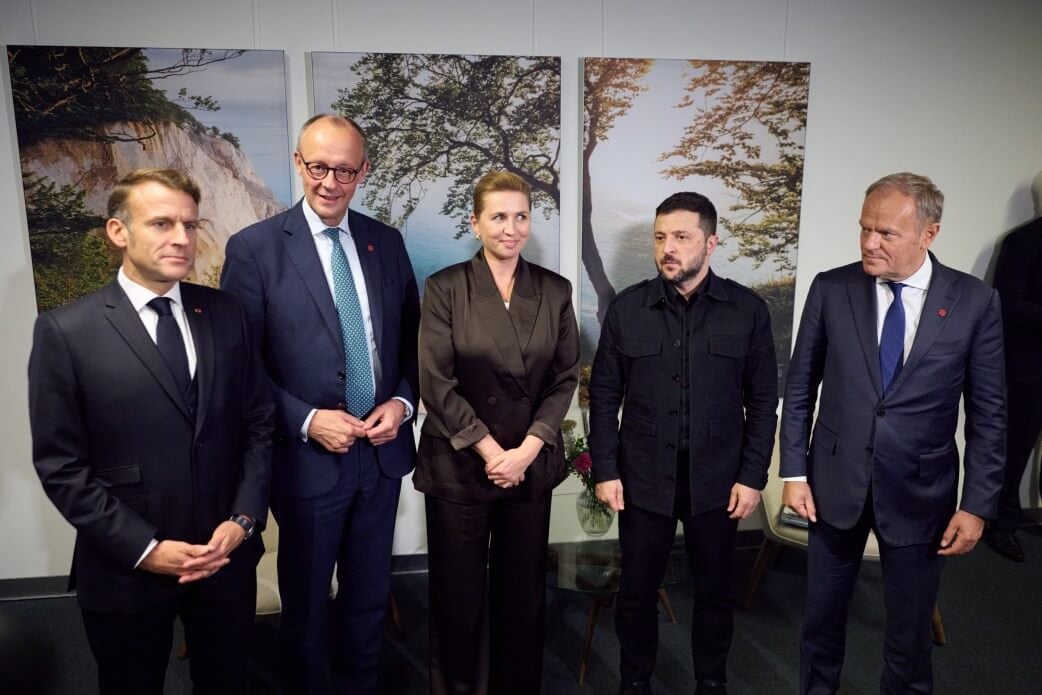 In Brussels, there is a growing understanding that direct responsibility for the continent’s security is increasingly falling on European states
Concerns are also growing about the possibility that Putin may seek to remain in power for many more years. For part of the Russian elite, this already appears to be a serious problem.
This is why the Kremlin may be interested in demonstrating rapid foreign-policy or military “successes.”
Potential risk zones are increasingly identified as the Baltic region and several post-Soviet states, including Armenia and Kyrgyzstan.
Even without an immediate concentration of troops, Russia retains the ability to rapidly build up forces if politically necessary.
The paradox is that Putin is weakening while simultaneously becoming more dangerous.
Russia is deepening cooperation with North Korea, which is prepared to increase weapons supplies and military support.
Further developments will also depend significantly on negotiations between the United States and China, where the war in Ukraine will remain one of the key elements of the global agenda.
At the same time, Europe is increasingly demonstrating a desire to act independently.
In Brussels, there is a growing understanding that direct responsibility for the continent’s security is increasingly falling on European states.
That is why the European Union seeks to become a full participant in negotiations aimed at ending the war.
To achieve stability on the European continent, the West continues to support Ukraine militarily, economically, and politically. European affairs can increasingly no longer be resolved without Europe itself taking part. Ultimately, the future of the continent should be determined by Europeans themselves.
Oleksandr Levchenko, a former Ukrainian diplomat, is a professor at the State University (Kyiv) and a member of the Academy of Geopolitics and Geostrategy (Kyiv).
