A few days ago, Tomorrow's Affairs put forward a key thesis in the article "A threat from the Pentagon, a response from the Vatican – a conflict Washington could not win": the conflict between the American executive and the Vatican is not a classical political dispute but a collision between two logics of power that operate in different time frames and with completely different sources of legitimacy.
The Pentagon operates through force projection and short-term objectives; the Vatican through moral authority and long-term consistency.
What happened in the meantime did not change that thesis. On the contrary, it has confirmed it in the crudest possible form.
On Truth Social, Trump called the Pope "weak on crime and terrible on foreign policy." He said the Pope "loves crime." He added, in a sentence that reflects egomania more than geopolitics, that the Pope would not be in the Vatican if Trump were not in the White House. When asked to explain, he said the Pope was not good at his job and was "a very liberal person."
The Pope replied that he has no fear of the Trump administration and will continue to state what he considers the mission of the Church. He was not seeking a confrontation, but he did not retract a single word.
Donald Trump's attack on Pope Leo XIV did not open a political debate. It exposed the limits of political power in the encounter with an institution that does not depend on elections, ratings or daily tactics.
More importantly, it revealed how willing the European allies are to recognise that boundary – and to clearly distance themselves from it when necessary.
An ally who began to measure words
Giorgia Meloni's response was not instinctive, but a decision made after assessing the political risk. She delayed reacting because she wanted to avoid a confrontation with Trump. She aimed to maintain distance and avoid direct alignment.
Only when it became clear that the attack on the Pope could not be downplayed in Italy without causing internal political damage did she take a clear stance: such statements are unacceptable, and the Pope's role is to call for peace and condemn war.
The significance of this wording lies not in the rhetoric but in who delivers it. Meloni is not a political opponent of Trump but his closest partner in Europe. When such a figure decides to draw a line publicly, it means the relationship no longer functions without cost.
Meloni judged that the cost of silence outweighed the cost of distancing herself
In the Italian context, this is not a matter of foreign policy but one of political legitimacy. The relationship with the Pope does not remain within the sphere of international relations but enters domestic politics, where silence is not neutral but is interpreted as a stance. Meloni judged that the cost of silence outweighed the cost of distancing herself.
This marks the beginning of a change in the relationship.
Trump did not wait long to respond to Meloni's comment about attacking the Pope.
"Do you Italians like the fact that your prime minister does nothing to secure oil? Is she popular? I cannot even imagine. She has surprised me. I thought she had courage, but I was wrong," Trump said in a telephone interview with the Italian newspaper Corriere della Sera. When asked whether he had discussed the matter with her, Trump said he had not, as she had told him that Italy did not wish to get involved.
The Vatican does not respond to Trump's words
Tomorrow's Affairs has already accurately identified the nature of this conflict. It is not a political dispute between two actors competing for the same space; it is a clash between political authority and an institution that does not depend on politics in the same way.
Trump entered the conflict as he always does: personally, directly, and without hesitation. This approach has brought him political success in many situations, but it does not work here.
The conflict has moved out of the space where Trump dominates
The Pope does not engage in the dispute as Trump attempts to conduct it. He does not respond to personal remarks, nor does he accept that the conflict be reduced to a political duel. This does not avoid confrontation but shifts it to a field where it cannot be won by political rhetoric.
In this context, the balance of power changes. In politics, the one who sets the pace and rules has the advantage. That is no longer the case here. The conflict has moved out of the space where Trump dominates and into a sphere where his usual methods are less effective. This is where the real problem for Washington lies.
When an alliance becomes a calculation
That is precisely why Giorgia Meloni's reaction carries extra significance. It is the clearest sign that Trump's European allies are beginning to show caution where previously they responded automatically.
The European right has cultivated a relationship with Trump as a political lever for years. This relationship was rational, providing political energy, ideological affirmation, and a sense of a united front against the liberal centre. However, it was never without limitations.
When an ally starts to react due to domestic pressure rather than foreign policy calculation, the relationship enters a new phase
The attack on the Pope strikes at the point where European political rationalism is no longer sufficient. In societies where Catholic tradition still holds influence, despite declining religiosity, an attack on the Pope is not an ordinary political statement. It is a signal that is interpreted differently.
Meloni responded because she was obliged to. Not because she changed her stance on Trump, but because she determined that inaction would have a direct political cost at home.
That is the difference that changes the situation. When an ally starts to react due to domestic pressure rather than foreign policy calculation, the relationship enters a new phase.
A problem that does not appear in the polls but is experienced during elections
At first glance, Trump does not face a serious domestic risk. His base remains stable, his communication style is unchanged, and conflict is part of his political identity.
However, elections are not won by the base alone.
The Catholic electorate in the US is distinctive. It is neither monolithic, ideologically uniform, nor politically stable. It has shifted several times in recent election cycles.
For some Catholic voters in the United States, the pope is not viewed as a political figure judged by party criteria. His authority does not stem from elections or ideological positions, but from the institution he represents.
Therefore, attacking the pope does not fit into a typical political conflict where sides are chosen; it is seen as crossing a boundary.
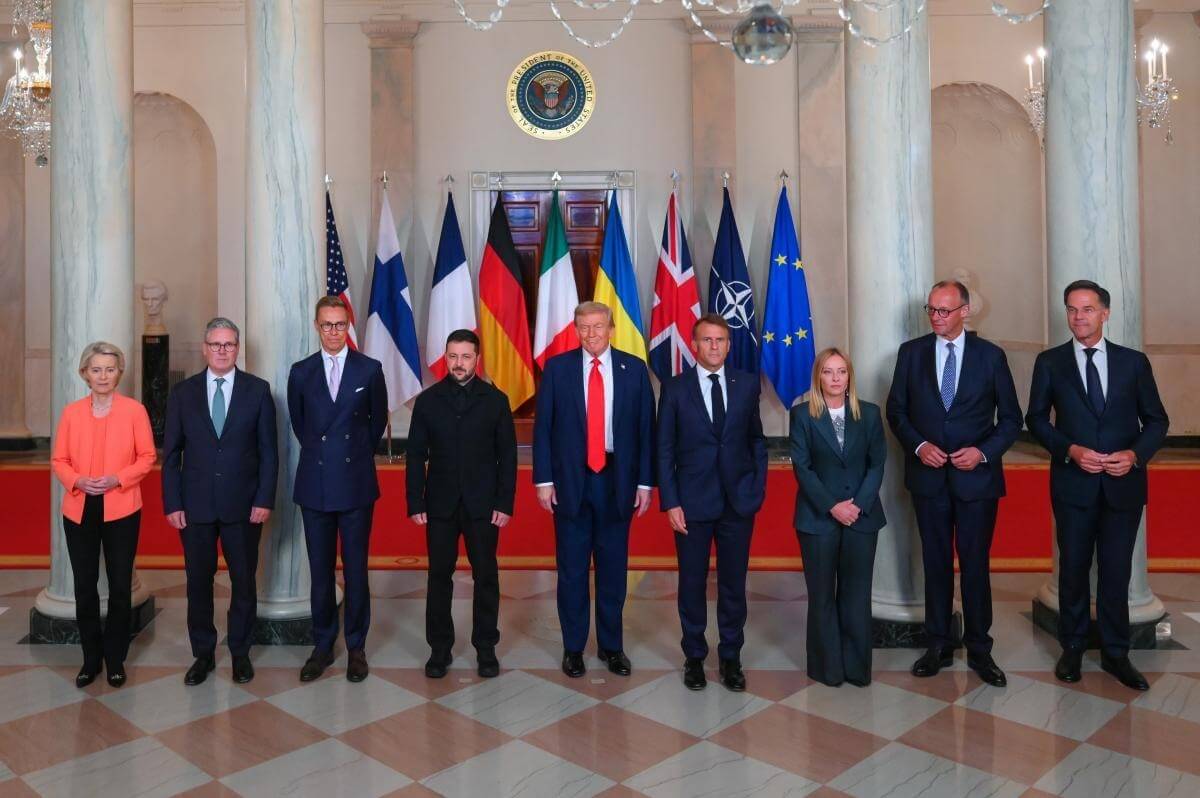 Trump is beginning to pay the first visible price, and it comes from those who, until yesterday, were his most reliable European supporters
Such situations rarely cause immediate political breakdowns, but they leave a mark on the leader's reputation. For voters who are not firmly committed to one option, this leads to a simple question: Is this the behaviour they expect from the president? When that answer changes, so does their willingness to support him again.
The greatest risk for Trump is not losing hard-line support; that will not happen. The risk lies in the silent shift in attitude among those who support him conditionally.
These voters do not react impulsively or switch sides because of a single statement; however, for that reason, they make a difference in close elections.
They do not leave the opponent's base or suddenly move to the other side. What they do is simpler and more politically dangerous: they reduce their willingness to vote for the same candidate again or to vote at all.
In the American electoral system, where key states are decided by very narrow margins, such a decline in mobilisation by a few percent is not a minor effect. It can be the difference between victory and defeat.
This conflict will not disappear. The Pope will not change his position; it is already defined and does not depend on political pressure.
Trump will not back down; his political logic does not allow retreat in such situations.
European allies will not sever ties, but they will begin to choose when and how they position themselves towards Trump. That is a key change. Until now, the relationship has been linear; now it is becoming selective.
As Tomorrow’s Affairs concluded in its analysis of the Pentagon-Vatican meeting: when a state begins demanding discipline from the pope for opposing war, the problem does not lie with the pope.
Trump has systematically crossed that line over several weeks. Now he is beginning to pay the first visible price, and it comes from those who, until yesterday, were his most reliable European supporters.
