When Kremlin spokesperson Dmitry Peskov appeared before reporters in Moscow and stated that America's new national security strategy is "largely consistent with our vision," it took many people some time to grasp the meaning.
For the first time since the Cold War, Russia publicly and almost approvingly supported a strategic document of the United States.
This regards the new National Security Strategy (NSS), which the administration of Donald Trump announced at the beginning of December, setting out foreign policy and security priorities for the coming years.
In the American system, the NSS is the overarching document under which almost everything else falls – from Pentagon doctrines to regional strategies.
The document is formally technical, but in practice it serves as a White House political manifesto.
The new version bears the mark of the Trump 2.0 era. It completely distances itself from the logic of the previous 2022 strategy, signed by Joe Biden, which identified strategic competition with China and Russia as the central challenge.
Now, the focus has shifted to the Western Hemisphere, immigration, trade balances, and redefining relations with Europe.
Flexible realism
The key term in the document is "flexible realism". The new NSS states that the US will no longer engage in long-term military missions abroad, especially not in "nation-building" projects such as those in Afghanistan or Iraq.
The document emphasises that, in foreign affairs, America will act with restraint, meaning it will not intervene automatically or routinely.
However, the right to intervene remains entirely open when vital American interests are deemed directly threatened.
The nation state is presented as the only reliable actor in international relations
At the same time, a clear political framework is introduced: the nation state is presented as the only reliable actor in international relations, while international organisations and broad multilateral structures are described as slow, ineffective, and often contrary to US interests.
In other words, the strategy suggests a return to a foreign policy based primarily on bilateral and power relations, rather than on international institutions or collective frameworks.
In this logic, a return to the old doctrine naturally follows. The document explicitly calls for a "revival of the Monroe Doctrine" – a 19th-century policy by which Washington declared the Western Hemisphere its sphere of influence.
In the new version, this means that the priority for military presence, security cooperation, and economic influence will be North and South America and the fight against migration and organised crime, as well as the protection of energy and technological value chains in its own "backyard".
The NSS and Europe
What makes this document truly radical is not just the shift in focus but the way it addresses Europe.
In a section titled "Promoting European Greatness", the NSS argues that the continent faces "the prospect of civilisational extinction" unless it changes course.
It cites migration, regulatory burdens, and alleged restrictions on free speech as key reasons why, warning that "some European countries may not have economies and militaries strong enough to remain reliable US allies in the coming decades."
The NSS does not speak of Europe as a partner to be strengthened but as a problem to be "corrected"
With this diagnosis, the NSS does not speak of Europe as a partner to be strengthened but as a problem to be "corrected."
The document states that the US goal is "to help Europe correct its current trajectory" and that Washington will work with "aligned countries that want to restore their former greatness."
This introduces into the formal document of American strategy a vocabulary that until now belonged to political campaigns, not to state policy.
Many European commentators have noted that the tone of the new NSS is unusually close to the rhetoric of nationalist and populist parties that oppose further integration in the EU and advocate closing borders, stronger national control, and the weakening of shared institutions.
Phrases about the "European path leading to weakening" and the need to "restore its former greatness" sound like political support for precisely those actors who have been challenging the European project from within for years.
That is why, in European analyses, the question is being asked more and more often whether Washington, with this document, intentionally or not, opens up space for forces that want a weaker European Union and stronger cooperation with Russia.
The NSS approach to Russia and Ukraine
Controversy also arises from the section of the NSS that addresses NATO. The document explicitly states that the US aims to "end the perception and prevent the reality" of NATO as a perpetually expanding alliance.
This signals that further enlargement could harm relations with other major powers and that European states must bear primary responsibility for their own defence.
This is no longer the usual American complaint about Europe's underinvestment in the military; it is a fundamental reassessment of enlargement policy, aligning with the Russian position that NATO expansion is a source of tension and should be halted.
The political significance of this becomes clear when the document is read alongside the section concerning Russia and Ukraine.
Unlike previous documents, which labelled the Russian Federation an "acute threat" or a "strategic adversary", the new NSS avoids language suggesting a direct threat.
Instead, it states that "re-establishing strategic stability" with Russia is a priority, and "ending the war in Ukraine" has been declared a "core US interest".
Ukraine becomes an object of negotiation rather than a subject of security policy
In practice, this means the war in Ukraine is no longer described primarily as Russian aggression altering the European order but as a conflict that obstructs a return to stable relations between major powers.
The NSS does not focus in detail on Russian responsibility for the war but rather criticises European governments for "preventing democratic processes" and failing to reflect the supposed desire of their citizens for a swift peace.
Within this framework, Ukraine becomes an object of negotiation rather than a subject of security policy.
This is followed by the Kremlin's response. In a statement to the state agency TASS and other media, Peskov said the new document is "largely consistent with our vision" and that they particularly welcome Washington's decision to stop describing Russia as a direct threat and instead view it as a partner for "strategic stability."
He also welcomed the language about ending perceptions of NATO as a "perpetually expanding alliance."
Noting that a "deep state" in the US still sees the world differently, Peskov made it clear that Moscow interprets the new NSS as a step towards a long-term agreement with the Trump administration.
Legitimising spheres of influence
What particularly concerns European analysts is the combination of three messages presented together in the NSS: Europe is depicted as a weakening continent that may no longer be a reliable partner; further NATO expansion is essentially suspended; and Russia is no longer identified as the main threat but as a country with which "strategic stability" should be established.
When these three ideas are combined, they create a framework in which the future European security order is once again discussed primarily between Washington and Moscow, while European capitals are relegated to a passive role.
This is precisely the angle that many in the European media are not yet willing to state openly.
The new NSS does not simply signal a change in American priorities; it effectively legitimises the concept of spheres of influence: the Western Hemisphere for the USA, Eastern Europe, and post-Soviet space as zones where "strategic stability" with Russia is sought rather than its suppression.
The American strategy introduces a new perspective on Europe, departing from the post-war principle that the fate of the continent should not be determined by secret deals between great powers
The American strategy introduces a new perspective on Europe, departing from the post-war principle that the fate of the continent should not be determined by secret deals between great powers.
Instead, the document suggests that the balance of power should be reconfigured through pragmatic arrangements among major players, with European countries deemed unable to maintain the current security model.
Added to this is the message that NATO need not expand further, making it clear that space is being created for a new type of negotiation on European security in which Washington and Moscow play the central roles, rather than European institutions.
A symptom, not the cause, of the crisis
For European states that have relied on Washington as the guarantor of their security, this strategy raises uncomfortable questions.
If Washington considers Europe’s "internal weaknesses" – from migration to identity disputes – a greater problem than Russian missiles, why should it invest in deterring Moscow in the long term?
If the aim is to "cultivate resistance" within Europe and strengthen forces advocating engagement with Russia, how can Brussels and key capitals maintain a unified stance towards Moscow?
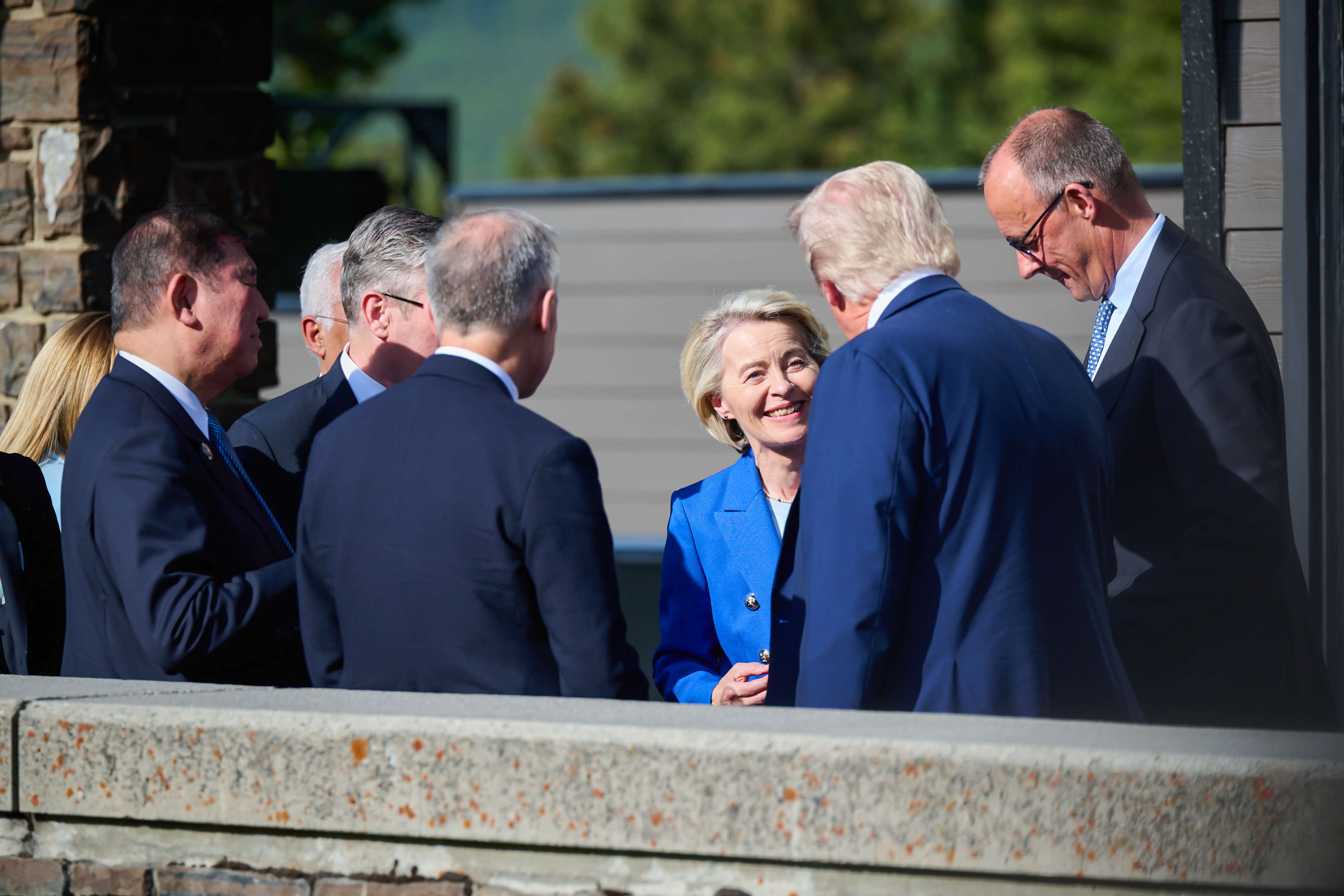 The American administration has made it clear that it is redefining its role in European security and is prepared to revise the principles that have underpinned the European order for over seven decades
And finally, if the NSS states that further NATO expansion should be "prevented", what does this mean for Ukraine, Georgia, Moldova, and the countries of the Western Balkans that still see membership in the alliance as the only real guarantee of their survival?
For now, responses are coming more from European commentary than from official statements.
Germany, France, and other key players express "deep concern" but limit themselves to standard phrases.
Meanwhile, Russian propaganda is already using the NSS as evidence that Moscow has "won" the narrative dispute: if America itself claims that the problem is European decline and NATO expansion, then, in Russia’s interpretation, the war in Ukraine is merely a symptom, not the cause, of the crisis.
With this strategy, the American administration has made it clear that it is redefining its role in European security and is prepared to revise the principles that have underpinned the European order for over seven decades.
This document marks the USA’s formal distancing from its previous role as the main guarantor of European security, shifting the focus to its own sphere and simultaneously opening the door to an agreement with Moscow.
When the Kremlin responds with such open satisfaction, it is not a compliment to America but a signal that the greatest European crisis since 1945 may be entering a new phase – one in which the fate of the continent will be renegotiated without Europe at the table.
