The Republican Party has spent a decade fearing Donald Trump. It may now have even more reason to fear what remaining loyal to him will cost.
The November 3 electoral bloodbath and the voters’ punishment exposed a political reality: Trump is no longer the man who can assemble the coalition that delivered Republicans the White House and Congress in 2024.
Republicans tolerated his excesses and surrendered their independence because he delivered victories. Little to nothing remains of that bargain now.
Trump appears oblivious to the transformation. On the eve of the midterms, after canceling several rallies in the final days before the elections, he held a press conference in front of the White House reflecting pool to discuss pipes.
The day after the election, he was talking about his ballroom. He then appointed Stephen Miller, affectionately known among Democrats as Voldemort, as his chief of staff, and ordered JD Vance to suspend all negotiations with Iran.
His preoccupations suggested a president who had lost the plot, seemingly oblivious to the political realities under which he must now govern.
Coalition of improbable bedfellows
Republicans need to remember what made Trump valuable in the first place. Democrats helped him by becoming entangled in what is called “third bathroom politics,” allowing cultural controversies to obscure economic anxieties.
Trump exploited their mistakes. He assembled a coalition of improbable bedfellows: working-class voters across racial lines, men without college degrees, younger men alienated from Democratic cultural politics, traditional conservatives and independents.
Hispanic voters, African American men and independents who had previously resisted the Republican Party were all duped by his false promises of emptying the swamp, restoring economic security and returning power to ordinary Americans.
Even politicians who despised him understood the arithmetic; those who did not paid dearly with their careers
They believed he represented a revolt against an establishment that had stopped listening.
This was the foundation of the Republican Party's transactional relationship with Trump.
He was embraced because he could win. Even politicians who despised him understood the arithmetic; those who did not paid dearly with their careers.
They tolerated his reckless strongman style of rule, governed by personal whims rather than institutional constraints, and his attitude of “I do what I want because I feel like it.”
As long as he remained the master of ceremonies, delivering victories and dispensing rewards, they indulged his excesses. Their submission was ultimately the price they paid.
The transaction has ceased to deliver
But the transaction has ceased to deliver. Upon returning to the White House, Trump squandered political capital with fascinating speed.
He plunged into war with Iran and tariff conflicts that unsettled businesses and consumers. He threatened NATO allies over Greenland, floating its purchase or annexation.
At home, he presided over an increasingly militarized immigration enforcement campaign, marked by indiscriminate raids, allegations of excessive force and operations in which American citizens were killed.
Voters who expected economic security, restraint abroad and attention to their everyday concerns were offered permanent turbulence instead.
Beyond the broader electoral coalition, Trump has also splintered MAGA, the supposedly loyal core of his base.
MAGA is no longer the cohesive political force it once appeared to be
America First noninterventionists clash with supporters of foreign military adventures, while economic populists, Christian nationalists and the billionaire right pursue conflicting priorities.
Dissent from figures such as Tucker Carlson, initially dismissed as insignificant, isolated acts of disloyalty, has exposed deeper fractures.
MAGA is no longer the cohesive political force it once appeared to be. Trump now struggles to hold together even the movement built around him.
Equally revealing is the speed with which Republican defeat turned into recriminations, finger pointing and infighting.
Within days, a party long accustomed to enforcing loyalty to Trump was arguing over who was responsible for the debacle.
The rapid descent into infighting is itself a measure of the gravity of the crisis: electoral success imposed discipline; defeat unraveled it.
The mythology of invincibility
The Trump of 2024 also benefited from circumstances that cannot be recreated.
The assassination attempt that left his ear bloodied gave him an image of defiance and survival.
Trump has lost more than his touch
The Democrats' mistakes gave him an opponent he could caricature. His outsider persona survived despite his previous failed presidency. Those conditions cannot simply be summoned again.
He is now an octogenarian with a penchant for incessant rambling and a conspicuous lack of focus, surrounded by recurring allegations of corruption and self enrichment.
The mythology of invincibility has been punctured. Trump has lost more than his touch. He has lost his luck.
Laying the foundations for 2032
Republicans in Congress must ask whether loyalty still serves any purpose beyond postponing confrontation.
Democrats won by substantial margins in previously difficult states. Legislators who once feared Trump's ability to end their political careers in a primary must now consider whether association with him could destroy them in a general election. The calculation sustaining his authority has changed.
A rebellion need not begin with a grand declaration. A handful of Republican senators and representatives could defy his anger, insist on congressional authority over war and spending, refuse to defend the indefensible and reject the notion that loyalty to Trump means loyalty to their party.
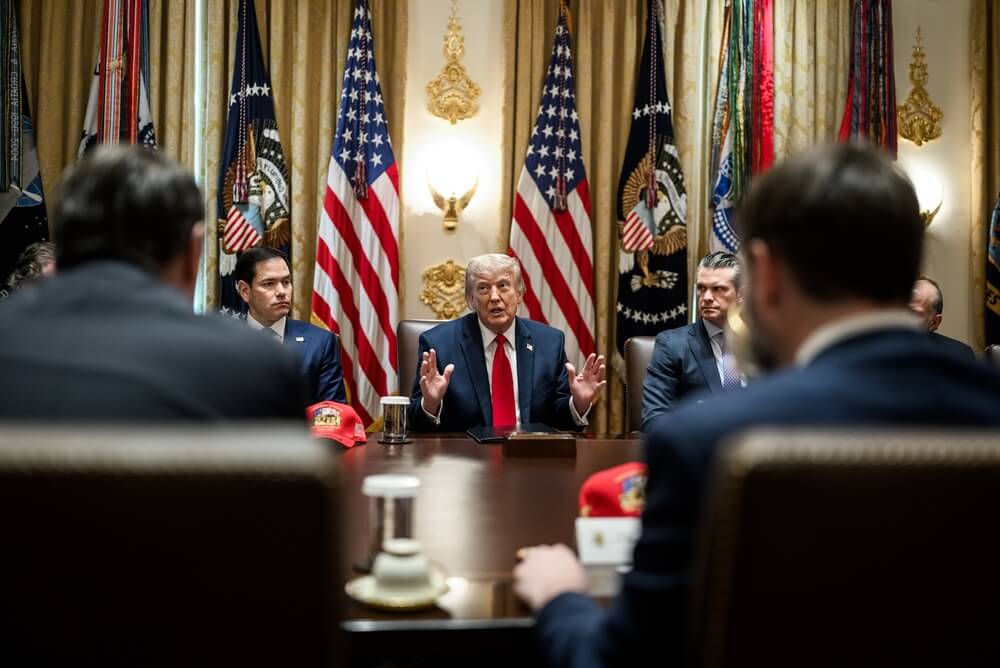 Trump once made Republicans winners. They are now bearing the consequences of their shortsightedness
His threats carry less force when obedience no longer guarantees electoral rewards. Their task now is to save themselves and their party.
The timetable is unforgiving. Republicans have two years to reclaim their independence from the strongman, not necessarily to prepare for a presidential victory in 2028.
The damage to their coalition may already have pushed that election beyond their reach.
Their task is to rebuild by 2030, restore their credibility in Congress and lay the foundations for 2032.
That requires a party capable of existing without Trump rather than simply waiting for him to leave.
Trump once made Republicans winners. They are now bearing the consequences of their shortsightedness, having entrusted their fate to the ambitions of one man and his family, his whims and his adventurism.
Their relationship was transactional from the beginning. That transaction has now run its course. One can only hope Republicans never again mortgage their future to a strongman.
Ahmad El Husseini is a political analyst and essayist who writes on Middle Eastern geopolitics, US foreign policy, and the evolving structure of regional power, with a particular focus on Lebanon, Iran, Saudi Arabia, the Arab Gulf, and the future of American influence in the region.
