A president repudiated by the voters can bend or he can show that he won’t. Donald Trump has chosen the second, and in doing so he has revealed something about his ultimate priorities that two chaotic years of “governing” had left unclear.
Vice President JD Vance blames the Republican Party’s massive midterm election losses on the Iran war, and adds living costs, inflation, and ties with Israel.
Trump concedes that “Iran was a piece of it.” Outsiders point to corruption, the spectacle of a family growing rich in office while the country paid more for fuel and food.
These accounts are not wrong. But Trump’s first act after the election suggests what administration officials have left unmentioned: voters did not reject what his administration did, but what it is.
To retaliate against their verdict, Trump appointed as chief of staff perhaps the most widely reviled member of an administration that does not lack for unpopular figures: Stephen Miller.
The appointment matters because Trump is not a president who governs. He presides, performs, and leaves the machinery to others.
The chief of staff of such a president is not an aide. He is a kind of prime minister. Susie Wiles ran the shop.
With Trump showing signs of becoming even less engaged than before, Miller could end up running the country, and he will run it as he ran his immigration crackdown: by executive command, with the law treated as an obstacle rather than a boundary.
Trump’s deporter-in-chief
Miller is not particularly associated with the Iran debacle, high prices, or corruption. He designed no tariff and sits on no crypto board.
He is Trump’s deporter-in-chief, the face of the campaign to track down and remove undocumented immigrants, and he made that campaign what it is. Miller set the quota of 3,000 arrests a day and pushed Immigration and Customs Enforcement (ICE) to seize anyone without papers, not just those with criminal records.
The result was a style of policing the United States had not seen in living memory: masked agents in unmarked cars seizing people on the street without identifying themselves and without warrants.
The campaign did not spare citizens: Renée Good and Alex Pretti were shot dead by federal agents in Minneapolis.
After Miller’s appointment, Senator Thom Tillis called it “the worst of all possible choices”
Hundreds of deportees were flown to African countries they had never seen and jailed there without charge.
This is the ravenous apparatus Miller built. Its zealous operator now holds the most powerful unelected office in the US.
The voters had judged that infernal machine. Six in ten told exit pollsters they disapproved of ICE.
Hispanic voters backed Democrats by nearly two to one. After Miller’s appointment, Senator Thom Tillis called it “the worst of all possible choices” and asked how so divisive a figure could be “the olive branch” to the new Democratic majorities, as if Trump wanted to offer one.
Trump did not miss this causal logic. He acted on it. Had he wanted to promote Miller without flaunting the affront to the electorate, he could have waited a month.
Instead, he made the appointment three days after the midterm rout, with the exit polls still on every screen. The timing was the message. Trump even said so: Miller, he explained, is “very good politically.”
The limits of Trump’s ‘transactional’ style
The damage to Republicans in the 2028 election is a foreseeable price. By paying it, Trump is telling the country how much the deportation rampage is worth to him: more than Congress, more than his party, more than the Hispanic voters he spent 2024 courting. Only a commitment this deep can carry a cost so glaring.
The proof came the same afternoon. Shortly before the announcement, Trump had told the news program 60 Minutes that the deportation policy “might be too tough” and floated a deal with Democrats to let long-settled workers stay. Then he turned the White House over to the architect of the policy he had just disowned. There was no contradiction.
The words were for the interviewer; the insult was for the voters. He conceded the diagnosis and rejected the cure, in that order.
The appointment of Miller was Trump's impulsive reply
The appointment reveals the limits of Trump’s supposed “transactional” style. A transactional politician cuts his losses. He drops an asset the moment it stops paying, and Trump has dropped many: generals, lawyers, cabinet secretaries, the chiefs of staff he burned through at a rate of one per year during his first term. In purely electoral terms, Miller is an asset that has stopped paying. Elevating him is not a transaction. It is not electoral politics at all.
Nor is it a calculation about the two years he has left. Trump lives in the news cycle, and on election night the news cycle was his humiliation.
The voters had told him, in the plainest language a democracy possesses, what they thought of his administration.
The appointment of Miller was his impulsive reply. He settled a score with the electorate—the one adversary he cannot fire, sue, or deport—in the only way he could, by showing them that their verdict had not changed him.
Miller has been called “the ideological id of the MAGA movement.” Trump did not promote a strategist. He promoted the id.
The citadel Trump will defend to the end
What, then, is Trump defending? Miller has told us. Immigration, as he sees it, imports alien cultures and belief systems, and unless deportations proceed by the millions, the country will be irrevocably transformed.
He has worked to narrow birthright citizenship, the constitutional guarantee that makes anyone born in the US an American.
The campaign he runs is not, at bottom, about who has broken immigration law. It is about who belongs in the US.
And its message reaches far beyond the people the government can legally remove.
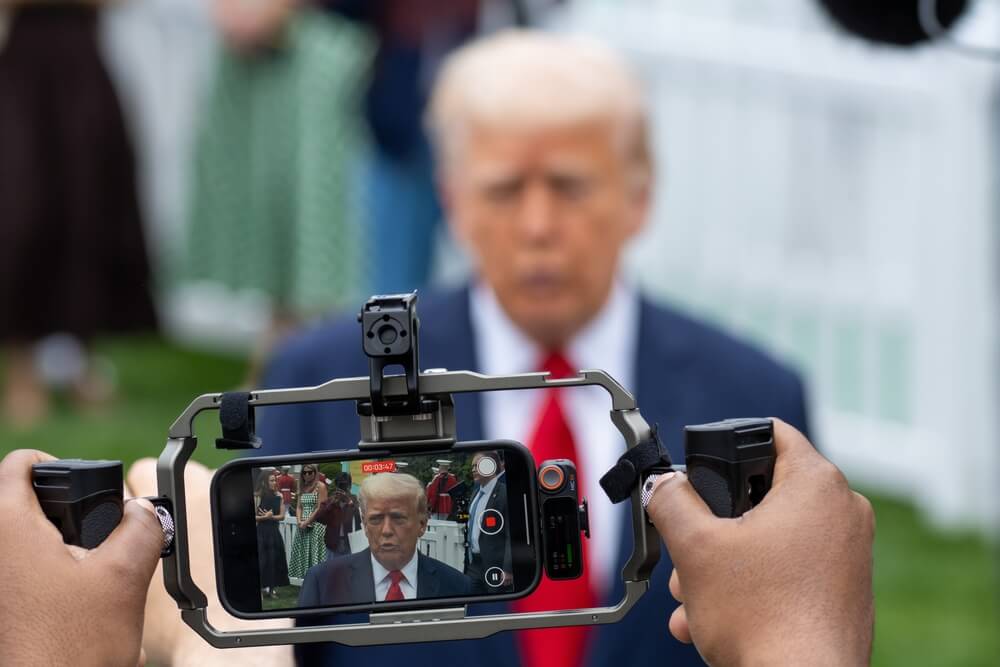 Trump has enthroned the architect of a violent campaign to dismantle the country’s multiracial democracy
Tens of millions of citizens are being told that their papers are in order but their claim to the country is not.
Trump is not deaf. Far from repudiating an appalling policy that the public has roundly rejected, he has enthroned the architect of a violent campaign to dismantle the country’s multiracial democracy.
The promotion of Miller also tells Republicans what their future is worth to him.
The late Lindsey Graham warned them earlier this year: “[T]o my colleagues who believe you can convince Donald Trump that Stephen Miller is a liability for him, good luck with that.”
To win in 2028, Republicans must recover the Hispanic voters who fled because of the man Trump has just made chief of staff. Trump will not be on a ballot again. They will. Good luck with that.
Bill Galston of the Brookings Institution called the Miller appointment a middle finger to the American public.
It is also a confession. In defeat, a man reveals what he cannot give up. Trump could, in principle, give up the war, the tariffs, even the money.
He could not give up the moral depravity. It is the citadel he will defend to the end.
Stephen Holmes is a Professor of Law at New York University School of Law and the Richard Holbrooke Fellow at the American Academy in Berlin.
