The Houthi attacks on King Khalid International Airport in Riyadh have exposed a fundamental reality of modern warfare: even the most sophisticated air and missile defence systems remain constrained by the laws of physics.
The reported strikes involving cruise missiles, ballistic missiles and one-way attack drones caused extensive damage and significant civilian casualties.
Their success raises an important question about the technological limits of modern defensive systems, rather than demonstrating any uniquely Saudi military weakness.
Saudi Arabia is larger than Western Europe, with defensive responsibilities extending across major cities, military installations, airports, oilfields, refineries and offshore energy facilities.
Protecting these geographically dispersed assets requires extensive surveillance networks, interceptor batteries, airborne platforms and integrated command-and-control systems.
Even the most advanced military forces cannot provide continuous defensive coverage for every approach corridor and strategic installation.
The Kingdom operates the world’s second-largest American Patriot air defence capability, employing PAC-2, PAC-3 and PAC-3 MSE interceptors.
It has also undertaken the acquisition of seven Terminal High Altitude Area Defense (THAAD) batteries, intended to establish the world’s second-largest THAAD capability after that of the United States.
These are complemented by the American Avenger and Stinger systems, the French Crotale, Shahine and Mistral systems, and the South Korean KM-SAM Block II procurement programme.
The Royal Saudi Air Defence Forces operate within an integrated architecture alongside the Royal Saudi Air Force, which possesses one of the world’s largest fleets of advanced 4.5-generation combat aircraft, including F-15SA and Eurofighter Typhoon fighters.
Airborne surveillance (AWACS) includes E-3 Sentry and Saab 2000 Erieye early-warning aircraft, supported by specialised reconnaissance platforms and ground-based radars.
This multilayered architecture provides considerable defensive capabilities, but its effectiveness remains dependent on the physical characteristics of incoming threats.
Physical constraint
Ballistic missiles, cruise missiles and one-way attack drones present fundamentally different interception challenges.
Ballistic missiles travel at extremely high speeds, with separating warheads and debris complicating terminal tracking, while cruise missiles operate at low altitudes that limit radar detection.
Small drones present additional difficulties because of their weak radar and thermal signatures, relatively slow speeds and resemblance to background aerial clutter.
The central physical constraint is the radar horizon. Because the Earth is curved, ground-based radar cannot detect a low-flying missile beyond its line of sight, regardless of technological sophistication.
Advanced technology can extend detection capabilities, but cannot overcome the geographical and physical constraints that govern surveillance
A radar positioned 20 metres above the ground observing a missile flying at 30 metres has a theoretical geometric horizon of approximately 36 kilometres, leaving less than three minutes before impact for a weapon travelling at 800 kilometres per hour.
That interval must accommodate detection, identification, tracking and interception.
Airborne early-warning aircraft extend surveillance beyond the horizons of ground-based radar, but their coverage depends on altitude, patrol geometry, aircraft availability and communications connectivity.
Maintaining continuous airborne surveillance over every potential approach corridor into Saudi Arabia would require an impracticable concentration of aircraft and supporting infrastructure.
Advanced technology can extend detection capabilities, but cannot overcome the geographical and physical constraints that govern surveillance.
Mixed attacks
The 10 October attack reportedly combined Samad-3 one-way attack drones, Quds-series cruise missiles and Burkan ballistic missiles.
Their different speeds and flight profiles permit staggered launches, bringing multiple classes of threat towards a defended installation within a compressed period.
Such mixed attacks complicate target discrimination, defensive prioritisation and interceptor allocation, particularly when defending systems must respond simultaneously to low-altitude and ballistic threats.
The Samad-3 is a relatively slow, piston-powered drone with a limited radar signature, while the turbojet-powered Quds uses inertial and satellite-assisted navigation to operate at low altitude.
Short-range systems, specialised radars, infrared sensors, and electronic warfare offer additional protection, but their effectiveness depends on local deployment and timely detection
Burkan ballistic missiles introduce high-speed trajectories and, some variants, use separating warheads that complicate interception.
These weapons exploit different vulnerabilities, making their combined use more challenging than attacks involving a single class of missile or drone.
THAAD is designed primarily for terminal ballistic missile interception, while Patriot can engage ballistic missiles, aircraft and certain cruise missiles and drones.
Neither provides a comprehensive or economical solution against large numbers of inexpensive, low-flying unmanned weapons.
Short-range systems, specialised radars, infrared sensors, and electronic warfare offer additional protection, but their effectiveness depends on local deployment and timely detection.
Airports are particularly vulnerable
Civilian airports are particularly vulnerable because they combine exposed aircraft, fuel installations, passenger terminals and continuous legitimate air traffic.
Even limited penetrations can cause extensive damage through blast, fragmentation and secondary fires, while falling interceptor debris presents additional hazards.
Protecting such installations requires not only missile interception but also effective civilian warning and emergency arrangements.
The regional confrontation has further demonstrated the vulnerability of surveillance infrastructure itself.
Despite defending a territory approximately one-hundredth the size of Saudi Arabia, Iranian ballistic missiles penetrated Israeli defences
Attacks on early-warning radars can degrade detection coverage and complicate coordination across an integrated defensive network.
The resilience of sensors and communications is therefore as important as the capabilities of the interceptors they support.
Israel offers a revealing comparison. Its defensive architecture incorporates Arrow-2, Arrow-3, David’s Sling and Iron Dome, supported by advanced surveillance systems, combat aircraft and direct American military assistance.
Yet despite defending a territory approximately one-hundredth the size of Saudi Arabia, Iranian ballistic missiles penetrated Israeli defences during the confrontations of 2024–2026, including attacks on strategically important military installations.
The same limitations apply to the United States, notwithstanding its unrivalled military resources.
It would be delusional to assume that American air defences could protect every major urban centre against coordinated, multi-wave attacks involving ballistic missiles, low-flying cruise missiles and drones.
The United States lacks a continuously overlapping nationwide defensive shield capable of guaranteeing such protection, and its geographical scale would create the same fundamental surveillance and interception difficulties that confront Saudi Arabia.
Limitations are universal
Since February 2026, Saudi Arabia has intercepted or otherwise interdicted approximately 85–90 per cent of incoming aerial threats originating from Yemen, Iraq and Iran, with effectiveness varying between ballistic missiles, cruise missiles and drones.
Nevertheless, even a high interception rate cannot prevent serious damage when a small number of weapons penetrate an otherwise effective defensive network. This is the operational reality of contemporary air and missile defence.
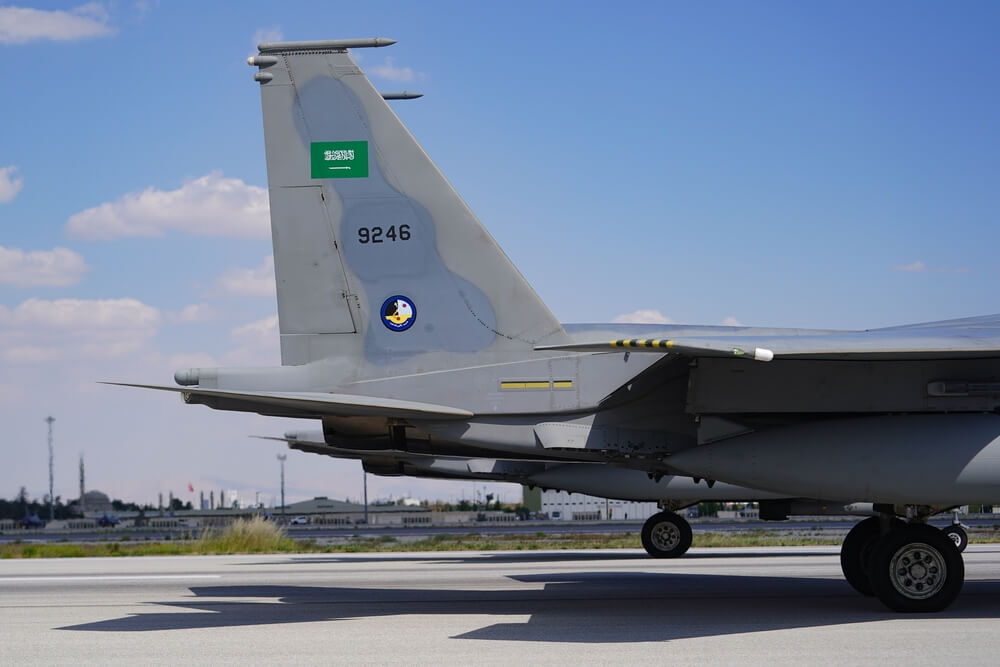 Saudi Arabia’s sophisticated defensive architecture can substantially reduce its vulnerability, but it cannot abolish the laws of physics
Intelligence collection, sensor integration, defensive deployment and civilian protection can always be improved.
However, technological advancement cannot eliminate the curvature of the Earth, guarantee uninterrupted surveillance or ensure that every incoming weapon is intercepted.
These limitations are universal, whether the defending country is Saudi Arabia, Israel or the United States.
The attacks on Riyadh therefore expose the growing imbalance between increasingly accessible offensive weapons and the physical constraints that govern their interception.
Saudi Arabia’s sophisticated defensive architecture can substantially reduce its vulnerability, but it cannot abolish the laws of physics.
Absolute air defence remains beyond the capabilities of every military in the world.
Dr Nawaf Obaid is a Senior Research Fellow at the Department of War Studies, King’s College London.
