One of the more puzzling aspects of the upcoming meeting between China’s President Xi Jinping and US President Donald Trump is why it is taking place at all. The two met as recently as October last year and agreed a trade truce that’s still in place. Why mess with that?
Europe as well as some of the world’s middle powers will be watching with anticipation as the two leaders, who more than most others epitomise the increasingly transactional approach to international relations, might well use them as mere exchange currency.
The Iran conflict and the Strait of Hormuz will definitely be a part of the agenda that deeply affects the rest of the world. Particularly Europe and parts of Asia suffer from the blockade and reduced energy flows.
Trump might try to get China to help resolve the conflict, but the meeting was already set before the US and Israel set off that conflagration, after which it was postponed for a month. So, Iran can hardly have been the reason for the summit.
Another motivation that can easily be dismissed is Trump wanting to upstage the endless parade of European leaders, as well as some other US ‘allies’ such as Canada’s Mark Carney, who over the last 18 months or so have all beaten a path to Xi’s door.
The American president doesn’t see these other leaders as his equal. He doesn’t feel the need to compete with them, nor is he likely to lose sleep over their attempts to use Beijing as a counterbalance to their fraying ties with his administration.
A meeting without clear purpose
Issues such as just prolonging the trade truce, heading off further economic escalation, recalibrating ties, Taiwan, AI, Russia-Ukraine, rare earth materials, energy flows, and fentanyl, were all mentioned as being on the agenda by a panel from the Brookings Institution.
Not one of them appeared entirely sure what the meeting was all about, with one analysis mentioning the low expectations and absence of much bureaucratic groundwork.
The Chinese are happy to add Trump to the long list of foreign leaders who are now seeking an audience in Beijing
As has become the norm over the past 18 months or so, Trump himself is probably the reason for the meeting to go ahead at all. He craves the limelight and takes every opportunity to project himself onto the world stage, even amid a war he started.
The Chinese, meanwhile, are happy to add Trump to the long list of foreign leaders who are now seeking an audience in Beijing.
The visits offer a highly visible validation to Xi, amid ongoing domestic economic troubles and lingering unease over political issues such as his perpetual anti-corruption campaign, the self-revolution drive, and his increasingly authoritarian and personality-centred leadership.
‘No-limits partnership’ with Moscow
Under normal circumstances, neither Trump nor the clutch of Western leaders – including most European ones – who have sought Xi’s favour over the past 18 months or so, would be so forthcoming towards a China that plays an increasingly aggressive international role.
Despite trying very hard to position itself as the ‘reasonable’ superpower and striving to take advantage of the havoc that Trump is creating on the international scene, China has in fact amped up its economic and geopolitical game of hardball.
Nothing exemplifies this more than Russia’s Vladimir Putin arriving mid-May, reportedly, just days after Trump leaves. Even if not interpreted as a snub to Trump, who gets along fine with Putin, it’s certainly a worrying signal to Europe.
Iran represents another dark chapter in China’s geopolitical playbook
China’s support for Russia in the Ukraine conflict has been nothing short of shameful. Yet Beijing will be glad of its ‘no-limits partnership’ with Moscow now that Russia’s extra oil is making up a large part of the shortfall caused by the war on Iran.
Iran represents another dark chapter in China’s geopolitical playbook. However irresponsible and ill-thought-out the Israeli-US attack on Iran was, the regime in Tehran, including its steady progress towards nuclear weapons, deserves to be isolated rather than encouraged.
In ‘normal times’ this should be more than enough for most Western leaders to shirk away from giving China any further diplomatic validation. But these times are far from normal, with the US doing more than most to undermine the international order.
A one-way street
China’s enormous economic heft is another reason, if not the main one, for all the foreign pilgrimages to Beijing. Here too, on trade and economic ties, China is relentlessly aggressive.
It is also an area where Trump and Xi can be expected to maintain the current fragile equilibrium, at the expense of some other parts of the international system, particularly Europe.
Whatever external factors might come into it, Trump has overseen a record drop in the US trade deficit with China in 2025, to $202.1 billion, the lowest in two decades.
In the meantime, China’s huge industrial overcapacity has to go somewhere, and that is mainly to Europe. The EU saw its trade deficit with China balloon to a record €359.8 billion.
The caveat, from a Trump-administration trade-hawk perspective, is that the total US trade deficit remained almost unchanged, and for the first time in decades, the American trade deficit with the EU was larger than the one with China.
China appears to be doubling down on its trade practices vis-à-vis Europe
But that doesn’t do much to address the EU’s growing imbalance with China and the latter’s inability or unwillingness to make changes.
On the contrary, China appears to be doubling down on its trade practices vis-à-vis Europe, including the UK, which has also seen a widening deficit.
Beijing has made clear in several instances that it has no problem with the relationship being largely a one-way street, as long as European consumers remain solvent enough to buy, often cheaper, Chinese wares.
It has emphatically protested and threatened retaliation against a raft of EU measures to preserve and rebuild the continent’s industrial and technological base.
This includes trying to strongarm the bloc into stopping the introduction of policies that Beijing itself has implemented for years, such as the recent ‘Made in Europe’ drive and rules that require technology transfer for market access in some cases.
Timing cannot be accidental
China has also imposed sanctions on European companies for ‘arms sales to Taiwan’ in what is seen as retaliation for the EU extending sanctions to Chinese companies dealing with Russia.
While the latter might be more in line with Beijing’s geopolitical posture than its trade tactics, the message that it is willing to wield its economic power is clear.
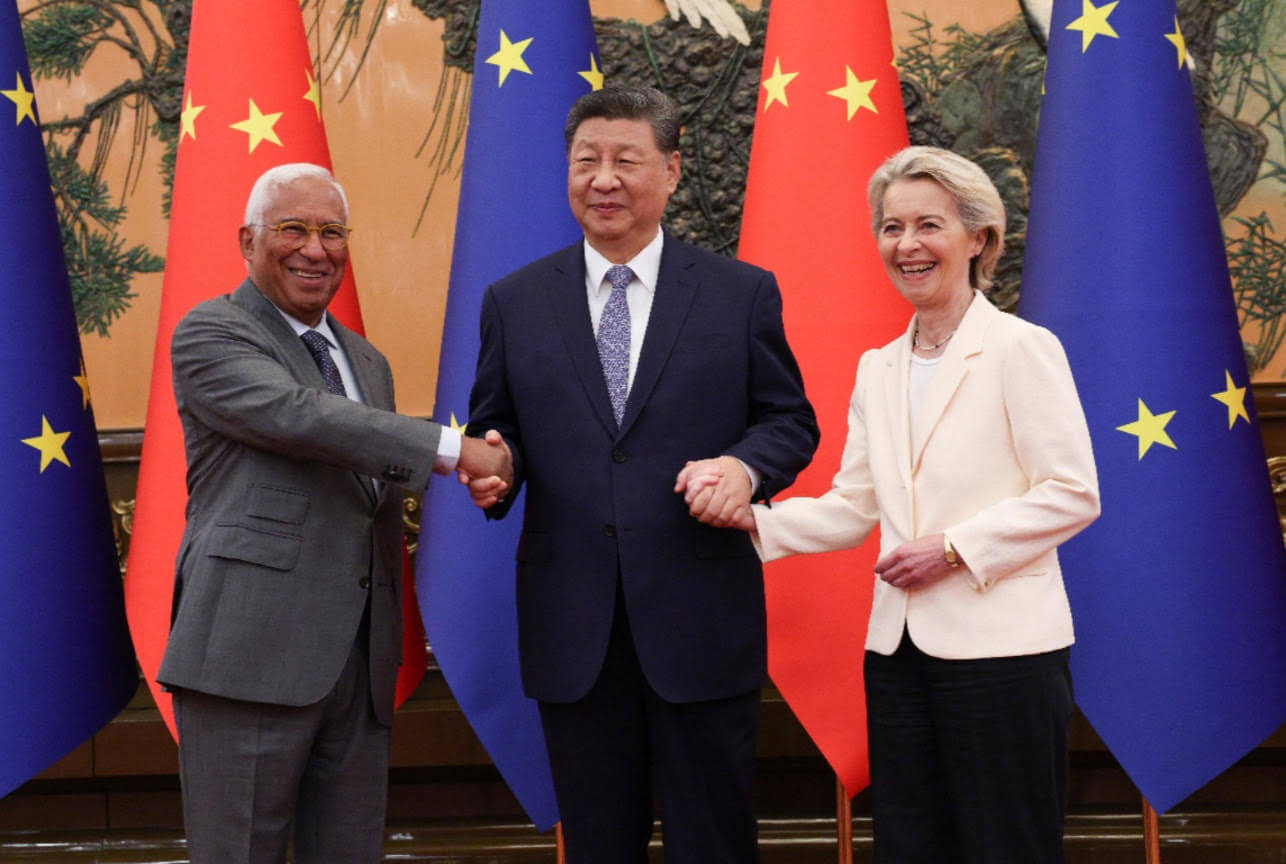 China has imposed sanctions on European companies for ‘arms sales to Taiwan’ in what is seen as retaliation for the EU extending sanctions to Chinese companies dealing with Russia
Trump, too, is confronted with similar messages, the timing of which cannot be accidental.
China last week invoked for the first time a so-called ‘blocking rule’, comprehensively banning cooperation with US sanctions on five Chinese companies that allegedly trade with Iran.
This comes on the heels of a decision last month to forbid the sale of Chinese AI startup Manus to Microsoft, even though the company is now incorporated in Singapore.
The incentives for Trump to gain China’s cooperation on a whole range of trade, technological and geopolitical issues will dominate his visit to Beijing. He has tended to either equivocate or make nice to those he cannot bully.
Stability in China-US relations is something to be championed all around. But with both superpowers having shown to be willing to ignore the interests of allies, trading partners and the international system, not everybody will benefit.
