It doesn’t take an Iran crisis to make clear that Europe suffers from both a lack of leadership and political direction, and that the two are closely connected, but it helps to throw it once more into sharp relief.
Europe’s major powers reacted in radically different ways to the American and Israeli attacks on Iran. France’s Emmanuel Macron ended up somewhere in the middle, Germany’s Friedrich Merz has cosied up to Trump, while the UK’s Keir Starmer is in the doghouse for limiting strikes from joint US-UK bases.
Inside the EU, the involvement of the president of the European Commission, Ursula von der Leyen, has sparked furious reactions and concerns about her carrying out yet another ‘power grab’ in the wake of her performance during COVID and on Ukraine.
Challenges facing Europe
After attending a two-day conference in Brussels that coincidentally started in the wake of the opening salvos in the attack on Iran, I cannot help but see Europe’s confused and ineffective reaction as symptomatic of some much larger issues.
The ‘Ideas Lab’ gathering of the Centre for European Policy Studies, CEPS, brought together EU commissioners and officials with a collection of heads of institutes, policy wonks, NGO representatives, diplomats and even a UK cross-bench Peer, who called himself, in a throwback to happier, pre-Brexit times, ‘the Brit in the room’.
Apart from European defence and issues such as digital policy and freedom of expression clashes with the US, there was a big emphasis on European competitiveness
In the spirit of the times, geopolitics took pride of place, with many discussions centring on the various challenges facing Europe from Russia, China and also the US.
Apart from European defence and issues such as digital policy and freedom of expression clashes with the US, there was a big emphasis on European competitiveness and the need for technological advancement.
Europe stuck on its most crucial geopolitical issues
What has all this to do with lack of leadership and political will? Well, taking a helicopter view of two days of discussions, it became quite clear that there are a great many things that Europe is stuck on and that these are some of the most important geopolitical issues facing the continent right now.
On the other hand, some of the things that one might argue are of secondary importance, even though sometimes crucial for creating the conditions to compete geopolitically, are being expedited.
I’d argue that this is because they align more closely with populist demands.
Another crucial issue, especially concerning Ukraine, is that EU enlargement is stuck
Surprisingly, especially given the huge amounts of money now being spent on it, one of the areas that’s stuck is a common European defence and security policy.
Yes, there’s the SAFE procurement mechanism and other projects that are important, but don’t expect this to translate into boots on the ground anytime soon, nor indeed a common command structure. Europe remains a paper tiger.
Another crucial issue, especially concerning Ukraine, is that EU enlargement is stuck. However important it might be to anchor Ukraine in the EU, whether in the context of a peace agreement or not, there’s just no political appetite for it.
When deregulation moves faster than reform
Deregulation, on the other hand, beloved of big business, economic conservatives and anti-EU populists alike, is moving ahead at breakneck speed.
Under the guise of ‘simplification’, the Commission is pushing through so-called omnibus packages that in one fell swoop negate crucial safety, consumer, environmental or rule-of-law guarantees that had been adopted previously.
All this in reaction to several warnings that Europe is falling behind. While the Draghi and Letta reports indeed call for a lower regulatory burden, they contain many other elements that don’t seem to have sparked the same urgency.
The famed EU single market has still not been completed, almost 40 years after it was initiated
In one session, for example, attended by Enrico Letta, it was noted that the famed EU single market has still not been completed, almost 40 years after it was initiated. A renewed drive to achieve it is predictably running into member states’ protectionist instincts.
Conversely, migration, the populist flagship cause, is another subject on which EU-wide progress is actually being made.
Again, on the other hand – and one would say very urgent right now – progress on a number of technological initiatives and digital issues, including standing up to US-dominated big tech, is jumbled at best.
A union still defined by national self-interests
It would be tempting to say that the vast gap in urgency and actual implementation between these many subjects reflects a democratic choice, an ordering of priorities according to what European voters want.
And sure, some surveys show very little appetite for either fighting Russia or allowing new members into the EU, including Ukraine. While cutting red tape and the ‘Brussels bureaucracy’ has a nice ring to it for many Europeans.
It was pointed out that the answers in these surveys tend to change quite dramatically depending on how the question is framed. And this is where the issue of leadership and political will comes in.
The EU ultimately is still a collection of individual states that jealously guard and promote their own self-interest
Several participants warned that if serious progress was to be made on prominent subjects, this needed to be achieved jointly by Europe’s heads of state and government, the European Council. If these leaders kicked an issue to the respective sectoral ministerial councils, that was a recipe for stagnation.
Likewise, the Commission is able to jump into certain gaps only with the blessing of the member states or where they allow a vacuum to exist.
It was ever thus, and it is a secret that many people work hard to keep: European unity is aspirational, maybe even a bit of a fiction.
The EU ultimately is still a collection of individual states that jealously guard and promote their own self-interest.
Europe’s leadership vacuum
Without very strong leadership on a national level, nothing will be achieved. And for quite a while now, there has been no strong national leadership in any of the EU countries or in the UK.
No leaders of the stature of Helmut Kohl, Margaret Thatcher and François Mitterrand, however one might disagree with them politically, are around to achieve the equivalence of pushing through German reunification in 1990.
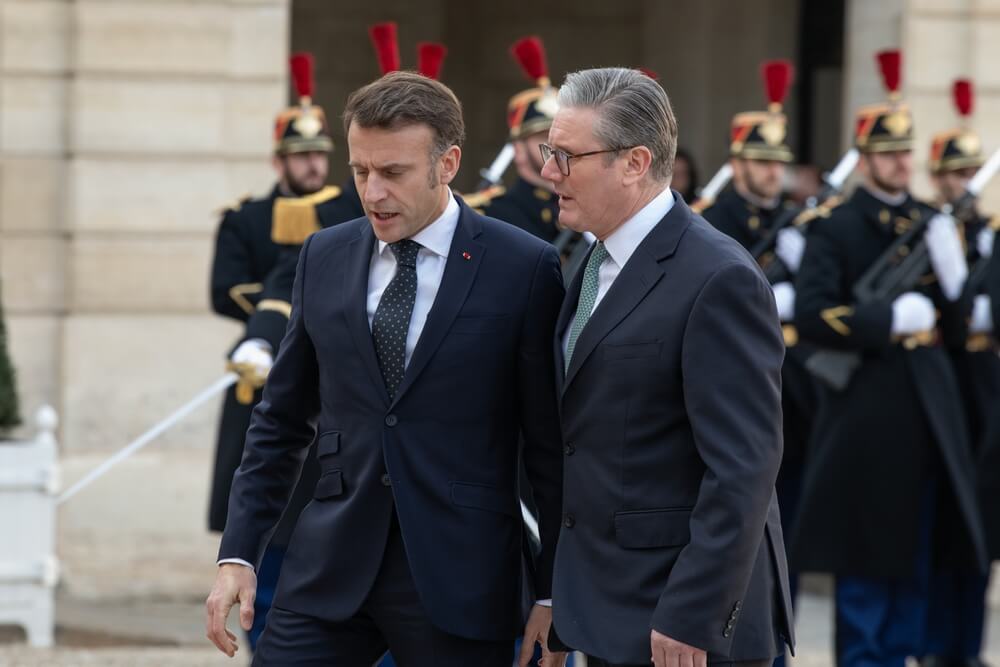 Macron and Starmer are both fatally weakened by populist advances on both wings of the political spectrum in their countries
That was not a foregone conclusion, as attested to by fears of a resurgent German military hegemon resurfacing on the continent now that Europe re-arms.
While German reunification offered many opportunities for the EU, the current moment is one of challenges, as Russia approaches from the East and the US is no longer a reliable ally.
Yet, a plethora of populist waves, or takeovers, in major European countries means that core issues are being ignored in favour of politically expedient panaceas.
Macron and Starmer are both fatally weakened by populist advances on both wings of the political spectrum in their countries.
Merz is floundering in a Germany that is unused both to being on the economic back foot and being relied on to provide geopolitical leadership.
Giorgia Meloni in Italy was at one time cited as a new type of leader, providing an alternative model for Europe. But her own populist instincts combined with the anti-EU roots of her constituency mean that very little of use has emerged from there either.
What Europe needs desperately is a new bunch of leaders who will chart their own course, rather than being overly preoccupied with surveys and electoral extinction.
Even if some of these leaders are completely opposed to European unity. At least their preference then becomes clear, and the public can make an honest choice.
Still, these challenging times cry out for leaders who can step up and drive forward united European positions. If there’s no agreement on all subjects, they should at a minimum take up those issues, such as defence, that are critical to the continent’s independent survival.
