Could the EU buy Ukraine? It sounds like a flippant commentary on the current geopolitical situation. It’s totally far-fetched. But is it?
To call it ‘buying’ is merely to grab attention, I admit. But that’s the way international diplomacy is now being conducted, isn’t it?
To follow the Trump-Greenland trajectory, Brussels should come in very high and then settle for something that it already has, like being allowed to keep supplying Kyiv with arms, plus a symbolic foothold. What really counts is that it throws its weight around.
Still, at the basis of the bizarre question lies the very serious tangle that the European Union is facing in its overall enlargement and accession policy.
The EU is trying to balance the need to bring in Ukraine with several other interests: other ongoing accession processes, its own internal structural and political integrity, and the huge financial demands that enlargement, especially with Ukraine, are likely to put on it.
The geopolitical urgency of formally anchoring Ukraine in the EU orbit has become obvious to many in Brussels. This has led, among others, to trial balloons being floated for the previously unthinkable: creating a two-speed EU and offering Ukraine ‘membership lite’.
The case for bringing Ukraine into the EU appears overwhelming. It will not only be a crucial part of its post-conflict reconstruction – and, by the by, position European companies well to participate in it.
It is also supposed, probably more importantly, to offer some form of assurance for the country that the EU will jump to its defence in case of further Russian encroachment, as per the EU common defence clause in Article 42(7) of the EU Treaty.
It could offer Ukraine and president Volodymyr Zelenskyy compensation for having to give up on NATO membership and deliver at least one significant win to take away from a peace plan that may well be forced upon the country by both the US and Russia.
Zelenskyy has in recent days stepped up his campaign to join, saying Ukraine will be ready in 2027, although most observers doubt that the country will by then meet all the EU’s criteria.
I’d argue that the best way around this is not a whole new membership-lite category but rather a bespoke, one-off deal that would focus on the most important geopolitical issues involved while delaying some of the more complex integration chapters.
Whether EU membership, in whatever form, should in fact make a difference to Ukraine’s defences against Russia is, of course, debatable and filled with moral and political booby traps.
Europe’s Achilles heel
Zelenskyy’s speech in Davos, castigating the Europeans for their continuing failure to wean themselves off the American security feeding bottle, might have sounded impolitic to some.
But it was also a calculated warning by Ukraine’s wartime president that his European backers are still not doing enough to help him fend off the Russian assaults that are, particularly this winter, devastating his army and civilian population.
The EU and Europe as a whole, including the UK, are doing a lot to finance and arm Ukraine, yet looking at the timeline, and what is at stake for them should that country fall, they should have done much more and much sooner.
The Russian annexation of Crimea is now some 12 years ago, as is the outbreak of violence in the Donbas. Trump’s first presidency and his threats to NATO, ten years ago. Russia’s full-scale invasion of Ukraine 4 years ago.
The issue of overdependence on the US is still the Achilles heel of any future European security guarantee
Ukraine’s wish to join the EU is understandable, but given the European track record, it’s at least questionable whether this in itself will do much to prompt a resolute European military deterrent.
Despite all the handwringing among European leaders and continued popular support for Ukraine, the conflict with Russia is still for many EU countries a remote or abstract threat.
In the final analysis, and even after the Greenland pyrotechnics, so is the EU’s security dependence on the US.
The issue of overdependence on the US is still the Achilles heel of any future European security guarantee. As NATO Secretary-General Mark Rutte said: “Keep on dreaming” about going it alone.
But that ignores that there has in fact been progress in Europeans replacing capacities that Ukraine relied solely on the US for until recently. Also, Ukraine’s own military production capabilities have grown rapidly.
Europe’s accession dilemma
Bringing in a country at war – or after a supposed peace deal still at heightened risk of being at war – while not completely prepared to defend it, poses considerable risk to the EU.
Still, not safeguarding Ukraine, including with EU membership, also poses risks. An EU that is forced to acquiesce to Russia’s agenda will very quickly lose its freedom of action in many areas.
In fact, Ukraine, with its increased military wherewithal, could add value to the EU’s defences, as it would in a plethora of other sectors, including energy.
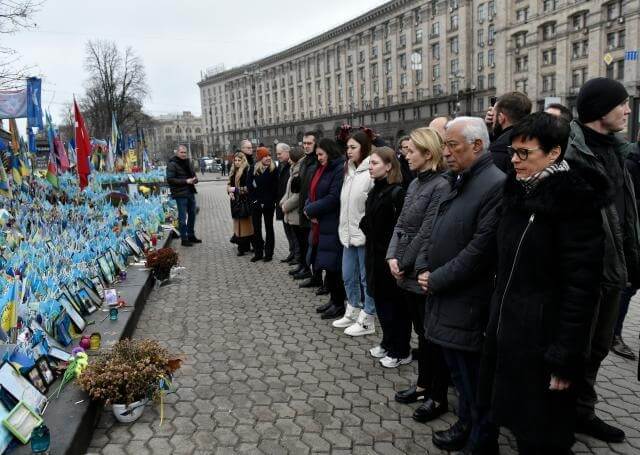 Brussels could simply ask any candidate countries that have started the accession process and that are in a state of war with a much larger neighbour to raise their hand
Enlargement in itself, not only with Ukraine but including other current candidates, first of all Montenegro, then Albania and also Moldova, which is usually linked to Ukraine, can send a signal that the bloc is still growing and that Europe is unified to an unprecedented degree. Further down the line are also Serbia and North Macedonia, and eventually Bosnia and Herzegovina.
Some of these were within the former Soviet sphere of influence, and many are or have been targets of attempted Russian infiltration. This both increases the urgency of bringing them in and poses challenges to keep this interference out of the EU system.
There are compelling reasons to speed up their accession, but then again, there are many arguments against it, or at least in favour of keeping up the stringent tests for these countries in order to be allowed to join.
Apart from the Russian angle, there are legitimate concerns in the EU over issues such as crime, corruption and accountability.
That is even before migration, especially of Albanians, the economic and financial costs, as well as the increasing unwieldiness of decision-making in an enlarged bloc, have been considered.
The debate now being waged over speeding up accession is often represented in black and white. Membership lite is said to both undermine the accession process and its criteria. Plus, it would bring with it the host of problems mentioned above.
But that seems a bit rigid for the current times. Yes, to change the accession and membership rules now, even though they might no longer be completely fit for purpose, could create more problems than it solves.
But Brussels could simply ask any candidate countries that have started the accession process and that are in a state of war with a much larger neighbour to raise their hand.
It should not be that difficult then to design a specific pathway, catered to a very specific, one-off emergency situation.
Given Europe’s existing commitments to Kyiv, it might not even be that much more costly in the long run compared with having to keep supporting it from the outside, and certainly cheaper than buying Ukraine outright.
