Nobody can accuse the European Union of taking major decisions with reckless alacrity, even when the stakes are high and the pressure is on.
And thus, leaders gather in Belgium this week for another ‘competitiveness’ debate, in preparation for a ministers’ meeting later this month, which itself is in preparation for a European Council meeting in March, and so on.
The EU’s seemingly sclerotic decision-making process is not the whole story. In fact, it takes a backseat to – and provides a cover for – deep political, ideological and economic rifts within the Union.
Some of these are relatively new, over (de-)regulation, some older, over frugality vs joint debt, and some even older – even reawakening fears of the age-old Franco-German rivalry.
Given the current moment, with the EU under so much pressure from the outside, think the US, China and Russia, it would seem that the cautious and frugal wing – led by Germany, the Netherlands and Austria – would be on the back foot.
Especially so since its adherents largely overlap with the traditionally more Atlanticist member states. These more US-oriented countries would be hard-pressed to keep defending their more open, export-driven model and their reliance on the US.
By contrast, France’s more sovereignty-driven, independence of action inclined model looks prescient. Not just because it can withstand the international upheavals somewhat better than its rivals.
In fact, France’s economy, despite its budget deficit and other tales of woe, has been performing admirably well over recent years.
It’s outperforming Germany not only in economic growth but also, crucially for a supposedly over-regulated bureaucratic backwater, in foreign direct investment (FDI) and the performance of its tech sector.
When German Chancellor Friedrich Merz counters Emmanuel Macron’s calls for joint European investment and debt with cries of ‘competitiveness’, it’s starting to sound hollow, as his own country is underperforming on that measure compared to France, even while remaining the larger and more industrialised of the two economies.
Europe’s competitiveness crisis
Competitiveness was the urgent subject of the much-bandied-about Draghi report of 2024 –yes, that was two years ago – but now it has also come to cover a new multitude of sins, or rather existential geopolitical and trade challenges.
While Draghi warned in 2024 about the “slow agony” of decline, developments since then have proved him wrong: Both Donald Trump’s first year back in the White House and China’s comparative success in dealing with him relative to the EU are pointing to a much more rapid and precipitous collapse than he had foreseen.
Draghi’s point about strengthening Europe’s own industrial, technical, entrepreneurial and investment base has become so much more critical since a series of crises made clear that the EU can no longer rely on the US and that China is in fact a predatory trading partner.
The latter was highlighted not only through the Chinese dumping of goods that it is ‘overproducing’. Much more significantly, Beijing almost choked off European car production in 2025 when it temporarily blocked the export of Nexperia chips after a dispute over its appropriation of technology and production.
Not incidentally, it was German carmakers that were hit hardest and most immediately by the threatened chip shortage. French manufacturers were slightly more diversified and had more stock.
Mitigating steps that German industry, especially carmakers, are taking are likely only to yield a temporary profit bump
In general, Germany is much more open to Chinese and US retaliation for some of the proposed measures that amount, according to some, to EU-wide protectionism but that others see as necessary measures to protect and rebuild the bloc’s industries.
France would like to focus joint European procurement, like the already existing defence spending programme SAFE, on ‘buying European’. It also advocates a ‘made in Europe’ label that would set a minimum level for EU-made components and labour.
Such initiatives would be viewed as hostile by both the US and China, even though both have implemented much more aggressive and restrictive practices. Still, Germany and quite a few other member states are very wary of trade wars.
The alternative, though, is to keep transferring technology to China, stay dependent on US tech companies and otherwise, incrementally lose whatever advantage and leverage the EU has left.
Mitigating steps that German industry, especially carmakers, are taking, for example ‘localising’ and producing in China, are likely only to yield a temporary profit bump, while accelerating the loss of know-how and supply chain in Europe.
Pro-debt vs frugalist divide
The other side of the coin of ‘protectionism’ is boosting European investment in the bloc’s own industries. This too is on the programme during the series of meetings leading up to the March summit.
Here, the old pro-debt vs frugalist divide is clearly on show. It’s a virtual replay of the debate during the Euro crisis of 2011-2012, where countries such as Germany, the Netherlands and Austria insisted on no common debt and strict austerity rules.
Only when the European Central Bank subsequently stepped in and basically promised to underwrite euro debt under the same Draghi’s slogan of “whatever it takes” was the crisis effectively averted, even if that backstop was never actually used.
One would think that this has convincingly won the debate for the pro-debt side: If you have one currency, along with a single market, customs union, etc., you need some level of common debt to stabilise the system.
Draghi, in his report, warned that this is not enough – the existential threats to the EU’s competitiveness necessitate a massive joint investment boost of €800 billion to €1.2 trillion a year.
The old frugalists are still opposing this and would prefer to channel whatever, if any, extra money that is made available through dedicated, targeted EU programmes, which would be easier to control.
Labour unions fear that all this deregulation and red-tape-cutting will come at the expense of workers’ rights and protections
Their panacea is EU-wide deregulation and cutting red tape instead. Especially from Germany, this is a bit of a stretch, as it is not performing well on that score itself.
Also, nobody realistically thinks that the boost to competitiveness can be achieved by such measures alone. In practice every bit of red tape that is cut creates new challenges elsewhere.
It’s no coincidence that European industry is closely involved with the discussions and feels that it has a golden opportunity to influence Brussels’ decision-making during this competitiveness drive.
Conversely, labour unions fear that all this deregulation and red-tape-cutting will come at the expense of workers’ rights and protections.
The position of some countries is interesting in all this. Spain and Italy, traditionally pro-debt, pro-protectionism and pro-regulation, are now shifting to being at least anti-regulation and anti-protectionism.
They are benefiting from stronger exports and things such as investment from Chinese carmakers.
They also say they want to protect their Small to Medium Enterprises (SMEs) from over-regulation.
Fragmentation instead of resilience
Alongside all this, Europeans find it difficult to unite to head off the threats they all more or less agree on.
Germany and France are increasingly adversarial, to such a degree that they are set to cancel the development of a joint fighter jet project, FCAS.
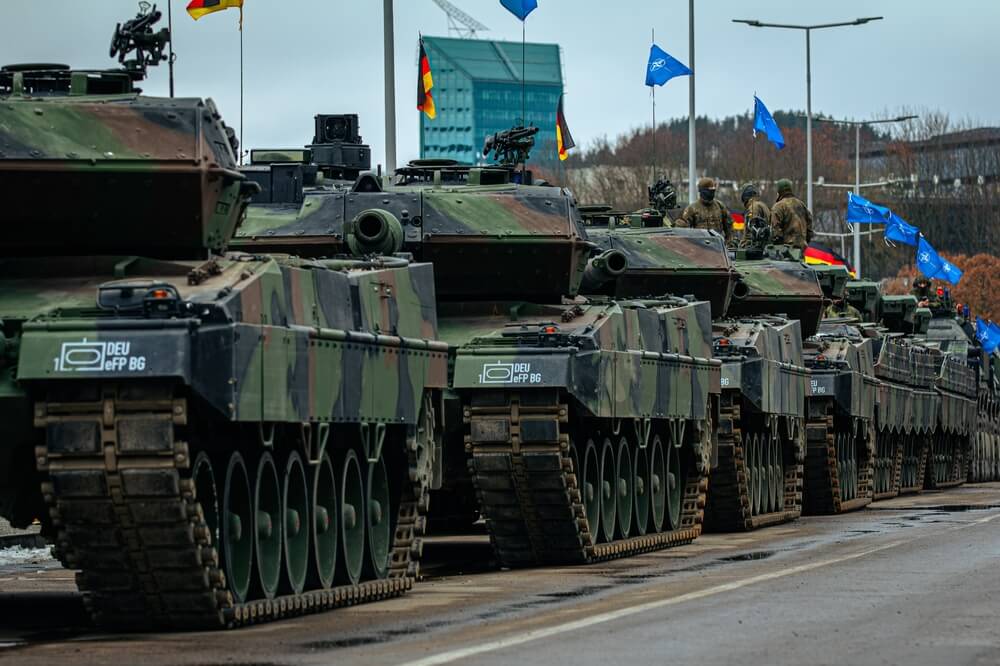 Germany’s rearmament drive, though very much desired by most European countries, reignites old worries and could eventually exacerbate tensions
Even steps they take to draw closer together, such as last year’s Franco-German economic agenda, underline their differences by being necessary at all.
Germany’s rearmament drive, though very much desired by most European countries, also reignites old worries and could eventually exacerbate tensions.
In such an environment, with the largest countries basically at loggerheads and some medium ones choosing alliances of convenience, it will be very hard to promote competitiveness, resilience and self-reliance across the bloc.
If the leaders do not agree on ambitious EU-wide measures, the current fragmentation might actually grow, rather than be diminished.
