Emmanuel Macron stated in Seoul on 2 April that a military opening of Hormuz is not a realistic option and that passage can only be restored through an agreement with Iran.
This summarises the assessment on which most European governments currently base their position. On the same day, Donald Trump called on his allies to secure the strait by force.
The difference is not merely in tone but in approach: Europe starts from the premise that without Iran there is no stable passage, while Washington assumes that passage can be imposed.
These two positions will determine the development and resolution of this crisis.
The war launched by the United States and Israel at the end of February did not establish control over the key energy passage. Iran has not closed Hormuz in the traditional sense. Instead, it has introduced a regime of selective passage.
Individual states and companies continue to use it, but not on the basis of a universal rule of free navigation but rather, through a combination of political judgement, tactical tolerance, and implicit arrangements.
Thus, the strait has ceased to function as neutral infrastructure and has become an instrument of influence.
This changes the nature of the problem for Europe. Hormuz is not only a security issue but also an energy and economic breaking point. Approximately a fifth of the world's oil consumption and a significant portion of global liquefied gas trade pass through it.
Any prolonged disruption to this flow directly affects energy prices, industrial production and inflation. European governments face pressure that is not abstract. It is measurable in fuel costs, transport, and political ratings.
This is why attempts to form a broad coalition to secure passage remain limited for now. The meeting of more than forty countries in early April in London demonstrated political will for coordination but did not provide an operational solution.
There is no common plan for the use of force, no clear mandate, and no willingness to accept the risks such an operation would entail while the war continues. Post-conflict options are being considered, but this does not resolve the current standstill.
The limits of military solutions
The French position in this context is not an exception but rather an indicator of a broader assessment. The idea of a military escort for commercial ships has limited value in an area where Iran holds a geographic advantage and possesses a range of asymmetric assets.
Hormuz is narrow, exposed, and under constant surveillance. Any serious escalation would turn commercial routes into a high-risk zone. The experience in the Red Sea already shows that a military presence does not automatically normalise commercial traffic.
The problem is not only military. Passage through the strait exists on paper and in practice, but these are not the same at present.
It is not enough for the strait to be "open"; there must be conditions that make it worthwhile to sail through
Ships do not set sail simply because a government declares the route open, but because they are insured, the crew accepts the risk, and the shipowner can bear the cost of the voyage.
This is not the case today. Premiums have soared, risk is high, and the market is responding by retreating or raising prices.
That is why some countries are already seeking ways to assume part of that risk themselves. India, for example, is considering government guarantees for ship insurance.
This clearly shows where the real limit lies. It is not enough for the strait to be "open"; there must be conditions that make it worthwhile to sail through. Without these, any political or military decision remains ineffective.
Between two unfavourable outcomes
In this area, Iran gains key leverage. Through a selective approach, it can influence the price of risk and signal to whom passage is available under acceptable conditions.
It does not require a formal agreement with the great powers. Establishing a practice that allows for passage with the tacit or direct consent of Tehran is sufficient. The more this practice spreads, the less it depends on formal declarations regarding freedom of navigation.
Therefore, Europe finds itself in a situation where the choice is not between principles and weaknesses but between two unfavourable outcomes. One involves a military attempt to impose passage, with high risk and uncertain results.
European governments lack the political or military capacity to enter a conflict in the Gulf that they did not initiate
The other involves an arrangement that does not alter the formal legal framework but, in practice, accepts that stable traffic is impossible without Iran’s consent. It is not a politically attractive choice, but it is becoming increasingly realistic.
Trump is telling allies to secure passage themselves or compensate for losses by buying American energy. This does not solve the problem but shifts it to Europe.
European governments lack the political or military capacity to enter a conflict in the Gulf that they did not initiate. At the same time, they do not have enough time to withstand a prolonged disruption in energy supply without serious consequences for their economies.
Therefore, the choice is not between a firm stance and easing up; it is between options that are all unfavourable. In such cases, decisions are based on what is effective, not on political messages.
No simple solution
The legal framework remains unchanged for now. Freedom of navigation through international straits remains the basic rule. However, the current developments create opportunities for practices that can undermine this without formal change.
If passage through Hormuz is restored through a series of partial, politically conditioned arrangements, a situation will arise in which the rule remains the same, but its application depends on one state. In the long run, this represents a more significant change than any single military action.
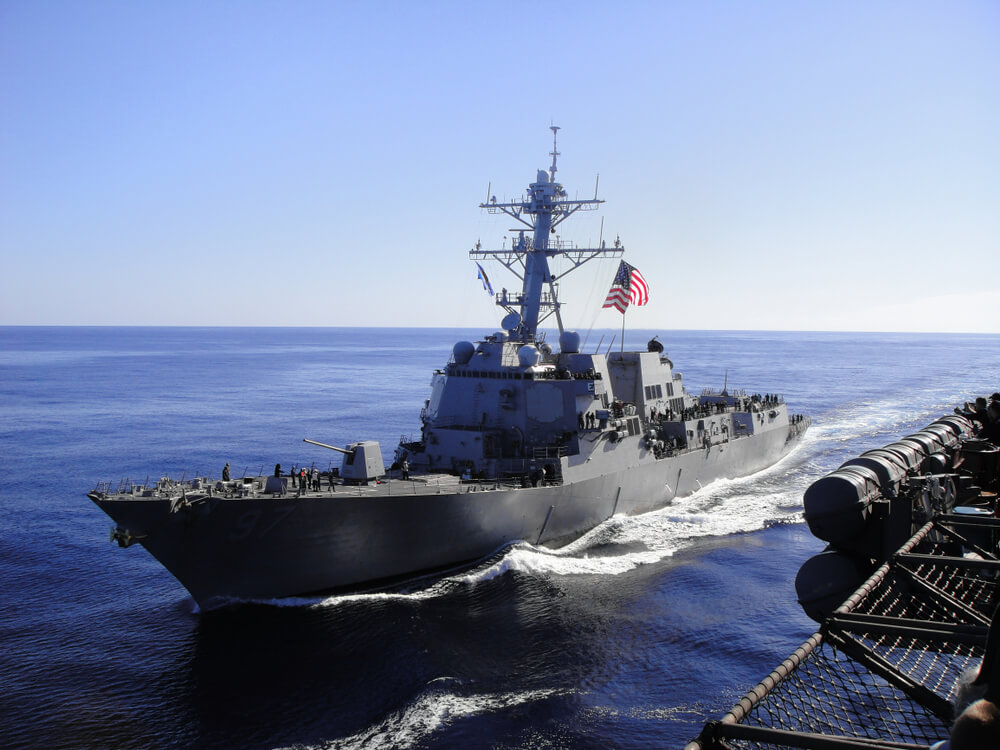 The United States will maintain a military presence, but with no guarantee of ensuring uninterrupted commercial flow
The regional context does not offer a simple solution either. The Gulf states lack a unified approach: some align more closely with the American position, others maintain channels with Tehran, and some attempt to balance between the two.
This further complicates the European position, as there is no regional framework to enable a quick and stable solution without Iran’s direct participation.
That is why the current crisis is not simply about who will control one strait. It reveals the limitations of America’s ability to produce a stable order through military escalation, as well as the limitations of European autonomy regarding the energy flows on which its economic system depends. In such circumstances, the outcome will not be formally defined as a victory for either side.
A more likely scenario is less tidy and more politically unpleasant. The Strait of Hormuz will remain an international strait in legal terms, but its functionality will depend on relations with Iran.
European governments will continue to defend the principle of free navigation but in practice will have to operate within the limits imposed by realistic control of the area. The United States will maintain a military presence, but with no guarantee of ensuring uninterrupted commercial flow.
In this arrangement, Tehran does not require a traditional military victory to achieve its strategic goal. It is sufficient to establish a pattern in which it becomes indispensable.
If this pattern takes hold, the consequences will be long-term – not only for the Gulf, but also for how the relationship between military power, markets, and political control of key global routes is understood in the future.
