On 28 February, about an hour after the start of US-Israeli strikes on Iran, Iran's Revolutionary Guard began sending warnings via standard VHF channels to merchant vessels in the Persian Gulf, stating that transit through the Strait of Hormuz was not permitted.
No attacks on merchant vessels were recorded, nor were mines laid or tankers intercepted. Nevertheless, by the morning of 1 March, approximately 70 per cent of normal shipping traffic through the Strait of Hormuz had been suspended.
The cause was not a physical threat at sea but an assessment of unacceptable risk by shippers and insurers.
An official from the European Union's maritime security mission Aspides confirmed to Reuters on 28 February that ships in the region were receiving Iranian VHF no-passage messages.
The UK Maritime Trade Operations (UKMTO) issued its own warning, noting that such messages are not legally binding under international maritime law.
That is formally correct. Iran is not a signatory to the United Nations Convention on the Law of the Sea. Oman, which controls the southern coast of the strait, is a signatory to the United Nations Convention on the Law of the Sea.
However, legal status does not eliminate operational risk. Shippers do not make decisions based on legal theory but on insurance and liability.
Several major shipping companies have suspended transit through the Strait of Hormuz. Hapag-Lloyd suspended passage, while Nippon Yusen ordered its fleet to avoid the area. Oil and LNG companies have stopped deliveries.
Lloyd's of London and international war risk insurers increased premiums by about 50 per cent. The rise in premiums led to the withdrawal of insurance cover for a significant part of the fleet, making transit operationally unsustainable.
The strategic limits of the Strait of Hormuz
Approximately 20 million barrels of oil and oil derivatives pass through the Strait of Hormuz each day, representing about one-fifth of global consumption.
Around 20 per cent of the world's liquefied natural gas exports are also transported via the same route, almost entirely from Qatar.
The Saudi East–West pipeline (Petroline), which leads to the Red Sea, and the United Arab Emirates pipeline to the port of Fujairah can together divert a maximum of 2.6 to 3.5 million barrels of oil per day.
This capacity covers less than one-fifth of the usual volume transiting the Strait of Hormuz. The remaining volume cannot be diverted due to limitations in the existing transport infrastructure.
Prolonged restriction of transit increases the probability of activating mechanisms for forced reduction of consumption in the European Union
The structure of spare production capacities further limits the possibility of mitigating shocks. About 70 per cent of global reserve capacity is located in Saudi Arabia and the United Arab Emirates.
These capacities, which are used in crisis situations to stabilise the market, enter the market through the same passage, which is now operationally uncertain.
In the case of liquefied natural gas, the restrictions are even more pronounced. Qatar has no export infrastructure that bypasses the Strait of Hormuz. More than 90 per cent of Qatar's LNG exports must go through that route.
At the end of winter, European gas storage facilities were between 37 and 44 per cent full, below the multi-year average.
In such conditions, prolonged restriction of transit increases the probability of activating mechanisms for forced reduction of consumption in the European Union.
Why Tehran avoids closing the Strait of Hormuz
Iran exports about 1.7 million barrels of oil per day, almost entirely through the Strait of Hormuz. The Goureh-Jask pipeline, built to enable exports to the Gulf of Oman bypassing Hormuz, has a design capacity of 1 million barrels per day, but as of September 2024, it is not operational.
A complete and long-term physical blockade of the strait would have immediate consequences for Iran's export earnings. Therefore, the current approach is not based on the formal closure of the Strait but on maintaining a state of uncertainty that affects the decisions of shippers, insurers, and energy traders.
Such an approach indicates an assessment in Tehran that short-term fiscal loss is acceptable in relation to strategic pressure on opponents.
Competition among Asian economies for available quantities would lead to a rise in prices to a level that would require a reduction in demand through a slowdown in growth
The key question is not whether Iran has the capacity to physically close the Strait of Hormuz, but how long it can maintain conditions in which transit is effectively suspended.
Asian markets receive about 84 per cent of the oil passing through the Strait of Hormuz. China imports more than 5 million barrels per day through that route. Japan relies almost entirely on supplies from the Middle East, and South Korea and India have significant exposure to the same transport corridor.
At the same time, competition among Asian economies for available quantities would lead to a rise in prices to a level that would require a reduction in demand through a slowdown in growth.
When risk, not force, disrupts global trade
Russia, whose energy exports do not depend on the Strait of Hormuz, directly benefits from rising global oil and gas prices. Prolonged instability in this corridor increases Russian budget revenues through the price effect.
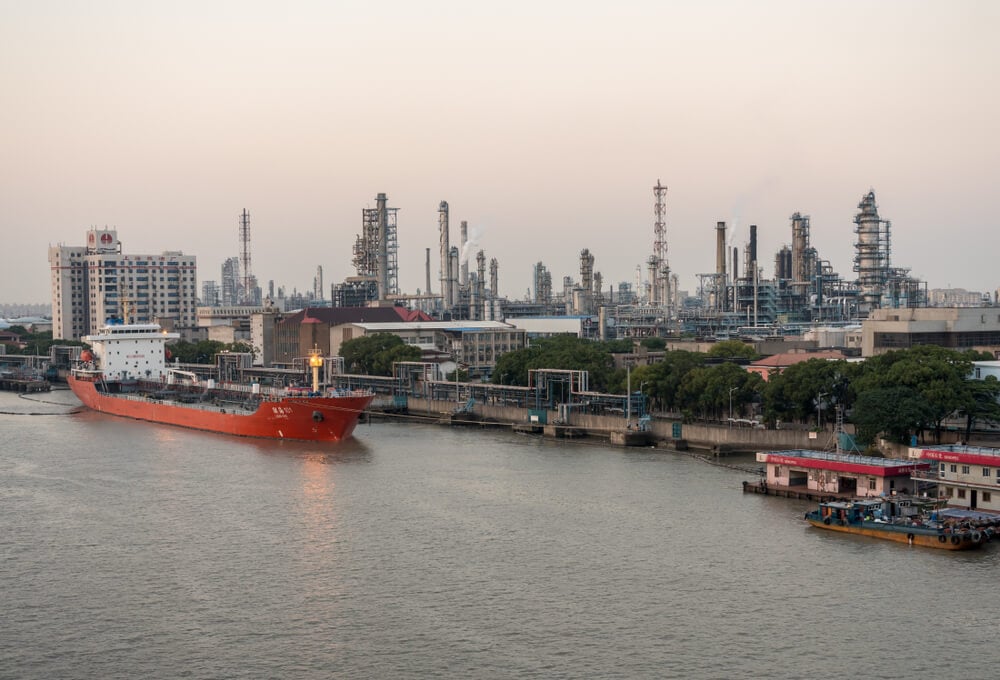 prolonged transit disruption would have direct consequences for China's energy supply and economic growth
At the same time as the events in the Persian Gulf, the Yemeni Houthis announced the renewal of attacks on ships in the Red Sea and Bab-el-Mandeb. In 2024 and 2025, they have already demonstrated the ability to seriously disrupt traffic and force ships to reroute around Africa.
The combination of instability in Hormuz and Bab-el-Mandeb creates a scenario in which both key maritime passages between Asia, the Middle East, and Europe are simultaneously threatened.
This has direct consequences not only for energy producers but also for global supply chains.
China directly bears the consequences of disruptions in the Strait of Hormuz, as it purchases most of Iran's oil exports. A prolonged transit disruption would have direct consequences for China's energy supply and economic growth.
Because of its extensive trade and energy ties, China has a unique capacity to influence Tehran's behaviour. The duration and intensity of the crisis will depend not only on Iran's actions but also on whether Beijing will use that influence to limit further deterioration of the situation.
This case shows that control over global energy flows no longer requires physical force at sea but the ability to influence the risk, insurance, and liability of private actors. In this context, the issue of Hormuz is no longer military but systemic.
Therefore, Hormuz is legally open, but it is closed to the market.
