At London's initiative, a virtual meeting was held on 2 April, with participation from more than forty countries, including France, Germany, Italy, Canada, Japan, India, and the United Arab Emirates, as well as representatives from the European Union and the International Maritime Organization.
The meeting focused on the blockade of the Strait of Hormuz and its ongoing impact on the global energy and transport markets.
Despite the broad participation, the meeting did not produce any specific operational conclusions.
There were no announcements regarding the deployment of naval forces, nor any willingness to take the risk of securing navigation while the conflict continues.
The reason is clear: any such decision would mean direct exposure to Iran's military capabilities, which none of the participating states is currently prepared to accept.
UK and the attempt to take the initiative in Europe
London assumed the role of organiser, as the space remained vacant. Washington does not wish to lead this part of the crisis.
In this context, Britain is attempting to demonstrate that Europe can act in a coordinated manner without American leadership.
London seeks to re-establish itself as a political centre capable of bringing countries together around specific security issues
This ambition has both domestic and foreign policy dimensions. The war in the Persian Gulf directly affects energy prices, transport, and inflation in Europe.
At the same time, London seeks to re-establish itself as a political centre capable of bringing countries together around specific security issues.
A coalition of forty countries lends weight to this ambition. However, it does not resolve the fundamental problem: Europe can organise a political response, but without American capabilities, it cannot ensure navigation in wartime conditions on its own.
An area where Iran has an advantage
The Strait of Hormuz is not an open maritime space; it is a narrow passage constantly within reach of the coast. Whoever controls the coast controls the risk.
Iran is not attempting to close Hormuz in a formal sense. It does not need to. It is sufficient to make the passage so risky that the market effectively shuts it down.
According to data from market and shipping services, since the conflict began at the end of February, the number of crossings through the strait has dropped by more than 80 per cent.
At anchorages in the Gulf and at the entrance to the strait, hundreds of ships are waiting, while it is estimated that tens of thousands of seafarers are effectively blocked, awaiting decisions from companies that no longer wish to take the risk.
This effect is achieved without constant attack. A series of incidents is enough to raise insurance costs to the point where navigation is no longer profitable.
Any serious operation to restore navigation would mean entering direct conflict with Iran
Premiums have already increased several times, and in some cases, insurance is not offered at all for entering the zone.
This is the way Iran is conducting this phase of the war. Not every ship is controlled; rather, Iran controls the decision of whether a ship enters the strait at all.
Under these conditions, any serious discussion about restoring traffic comes down to one question: who is prepared to physically protect ships in the area where Iran has the advantage?
In such an environment, any serious operation to restore navigation would mean entering direct conflict with Iran.
This is the point where diplomacy ends and military decisions begin. And that is precisely where no country in this coalition is willing to go.
Without America, there is no operational coalition
The absence of the United States determines the actual scope of the entire initiative.
The US Navy is not just another participant in such operations; it is their foundation. Europe currently lacks the mine countermeasures capabilities, air defence, logistics, and command structure necessary for independent deployment in a conflict zone.
Without American involvement, the coalition can exert pressure and plan next steps
The talks in London were not about how to open the Strait now. No one even attempted to ask that question seriously, because the answer would be the same for everyone: without readiness to provide military protection for ships, the passage will not return to operation.
That is why the focus has shifted to what can be done once the fighting subsides – political pressure, coordination of sanctions, and preparation of scenarios for later control of navigation.
The limit of that initiative is clear. Without American involvement, the coalition can exert pressure and plan next steps. It cannot secure the passage under conditions where Iran still has the ability to close it whenever it chooses.
Iran as an actor dictating the pace
Iran is not merely reacting to the crisis; it is exploiting it. Control of Hormuz provides Tehran with what it previously lacked in its direct military relationship with the US and Israel: influence on a global scale.
Any disruption in energy supply spills over into the markets, budgets, and political decisions of states not involved in the conflict. It alters the logic of negotiations.
The issue of Hormuz cannot be viewed as an isolated security problem
As long as the blockade has this effect, Iran has no reason to lift it. On the contrary, it has every reason to maintain it until it receives concrete concessions.
Therefore, the issue of Hormuz cannot be viewed as an isolated security problem. It is part of a broader negotiation space that will define the conditions for ending the war.
A decision everyone is postponing
The current situation leaves little room for uncertainty.
If the fighting continues at this intensity, the strait will remain restricted. No political formula can change that.
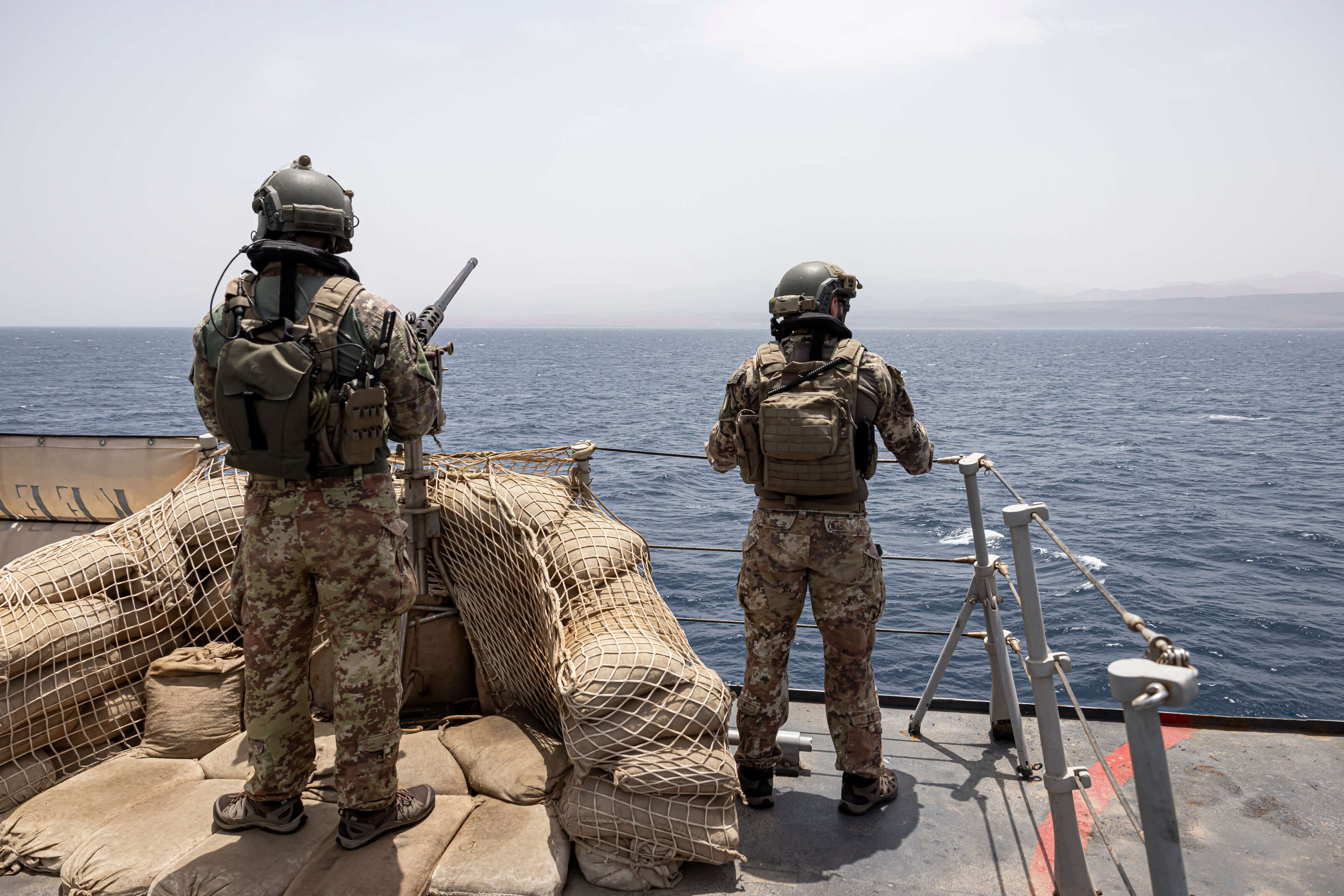 If there is a de-escalation of the conflict, the same coalition that London is now assembling can quickly move into the operational phase
If there is a de-escalation of the conflict or a ceasefire, the same coalition that London is now assembling can quickly move into the operational phase – demining, escorting, and stabilising traffic.
There is also a third possibility, not often mentioned but real. If economic pressure continues to increase, individual states may begin to act independently, protecting their own ships without broader coordination. This would create opportunities for incidents and further destabilisation.
At this point, none of these scenarios has been fully developed. But they all depend on one factor: the dynamics of the war itself.
London has managed to set the political framework and bring together a significant number of countries around a common problem.
It is a serious move. But the Strait of Hormuz does not operate according to the rules of diplomacy; it operates according to the rules of force and risk.
That is why its fate will be decided where the war is fought, not where it is discussed.
