The great theorists of war agreed that squandering one’s military power is the cardinal strategic sin. Sun Tzu, writing some 2,500 years ago, warned that an army that improvidently wastes its resources will collapse before the conflict is won. The people who sustain that army will be ruined along with it.
Likewise, Carl von Clausewitz insisted that a state’s fighting forces, its territory, and its alliances should not all be expended at once, because the capacity to continue the struggle across time must be preserved.
Niccolò Machiavelli even counseled princes against forms of generosity that exhaust one’s resources, warning that a ruler who spends his military means on a single display of power without securing his position in the long run invites disaster.
Whatever their differences, strategic thinkers agree on this: the future is not a luxury. It is the point.
By now, the reality of Trump’s recklessness in Iran has been extensively documented. The Wall Street Journal, TIME, the Financial Times, and a dozen other outlets have reported in detail on the depletion of US munitions and what it means for deterrence in the Pacific and support for Ukraine.
So, what could drive a commander-in-chief to court so foreseeable a catastrophe?
Arms inventory
The answer lies not in miscalculation but in something more radical. Before Trump launched “Operation Epic Fury” against Iran, General Dan Caine, chairman of the Joint Chiefs of Staff, warned that American munitions stockpiles were already dangerously depleted.
The United States had burned through roughly a quarter of its Terminal High Altitude Area Defense, or THAAD, interceptor inventory during the 12-day Israel-Iran exchange last June and had not replenished those stocks in the intervening months.
Trump pressed ahead anyway. The Pentagon has since struck nearly 2,000 Iranian targets with more than 2,000 munitions, including large numbers of Tomahawk cruise missiles that cost $3.6 million each and take years to manufacture. The US purchased only 322 over the preceding five years.
Critical American precision-guided munitions would be exhausted within the first weeks of a high-intensity conflict with China
A Heritage Foundation study estimated that critical American precision-guided munitions would be exhausted within the first weeks of a high-intensity conflict with China.
The operational absurdity of the battle now being waged in Iran was captured by Democratic Senator Mark Kelly, a combat veteran: Iran fires Shahed drones manufactured for $30,000 apiece; America responds with interceptors costing millions per round. As Kelly put it with blunt precision, “The math on this doesn’t work.”
The administration’s response to such concerns has been emphatic and revealing. Secretary of “War” (Defense) Pete Hegseth declared that the US has “no shortage of munitions” and that American stockpiles of “defensive and offensive weapons allow us to sustain this campaign as long as we need to.”
He later described the supply of gravity bombs as “nearly unlimited.” Trump himself posted on Truth Social that the US possesses “a virtually unlimited supply” of the munitions being used against Iran.
The question of scarcity
These reassurances share a common flaw: they treat the question of scarcity as if it were simply a matter of current inventory.
But scarcity, as any economist will explain, is not a snapshot. It is a structural condition – the relation between finite means and the torrent of uses to which those means might be put across time.
To deny scarcity by pointing only to what exists now is to treat the unavoidable future as if it didn’t exist
An arms stockpile adequate for a time-limited campaign against Iran is also one that will not be available to deter other hostile powers tomorrow.
To deny scarcity by pointing only to what exists now is to treat the unavoidable future as if it didn’t exist.
The conventional explanation for such decisions is incompetence or impulsiveness. Neither fits the case here.
Trump's relationship to the future
Whereas incompetence produces random damage, the decision to attack Iran fits a pattern of decision-making that is too consistent to be accidental.
Likewise, impulsiveness implies a future that one has failed to calculate properly, but Trump's relationship to the future is something different than miscalculation.
Across his presidency, in domain after domain – fiscal policy, scientific funding, alliance management, climate commitments, and now munitions stockpiles – present consumption comes at the expense of future resilience.
Trump is not a man who discounts the future too steeply. He is a man for whom the future does not register as a real cost when measured against the spectacle of decisiveness that he wants to stage.
Most of Trump’s temporal nihilism operates on longer, less legible timelines
This is not recklessness within a strategic framework; it is the collapse of any strategic framework’s first axiom: tomorrow is coming.
Most of Trump’s temporal nihilism operates on longer, less legible timelines.
Defunding pediatric cancer research produces no visible casualties this year, but the scientists who will not invent the next generation of breakthroughs were simply never trained.
Hollowing out the Foreign Service creates a missing generation of diplomats whose absence will be felt for decades. The same logic applies when the US abandons its climate commitments.
Strategy’s negation
The case of munitions depletion is different because it is concrete and measurable, with identifiable officials having issued warnings in real time.
The numbers are known, the timeline is defined, and the strategic stakes are specific: the hard military power on which deterrence of China, defense of Taiwan, and support for Ukraine all ultimately depend.
What Trump is spending in the skies over Iran is not borrowed money but finite strategic capacity. This is what distinguishes the current moment from mere policy disagreement.
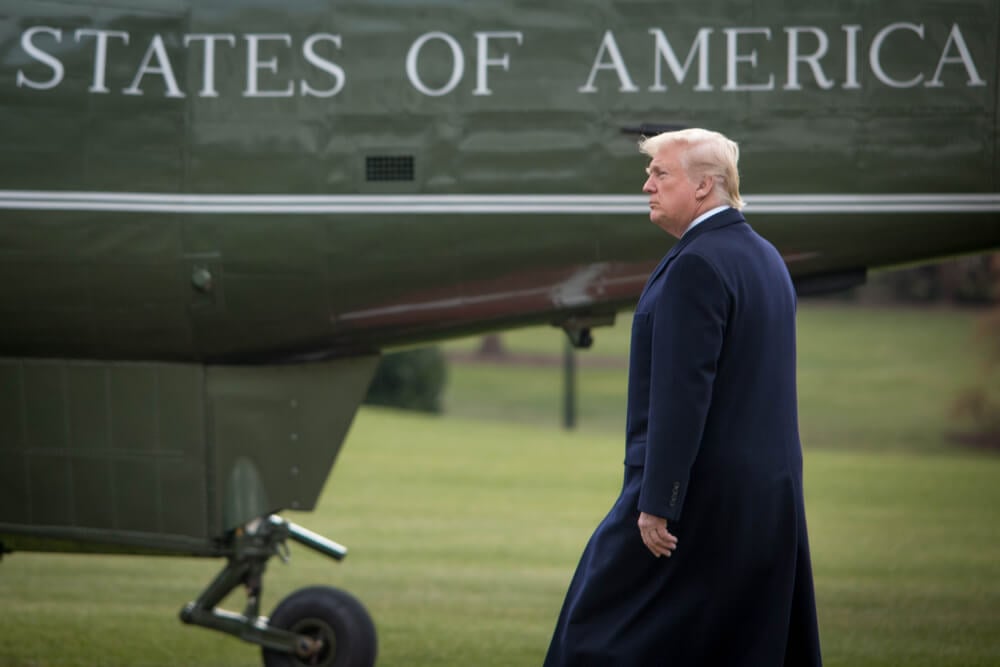 What Trump is spending in the skies over Iran is not borrowed money but finite strategic capacity
It marks a departure from the entire tradition of strategic thought running from Clausewitz through Cold War deterrence theory.
The concept of deterrence itself – maintaining capabilities whose value lies in persuading adversaries never to test them – is meaningful only to a leader who understands that military strength is often best served by not expending it, so that it remains available to shape what comes next.
Trump’s approach is the opposite of deterrence: high-visibility expenditure today that erodes the credibility of deterrence tomorrow.
This is neither isolationism nor unilateralism. It is the militarization of presentism – using the instruments of future security to create today’s imagery of strength.
Clausewitz’s most profound insight was not about tactics, but time. The purpose of strategy is to preserve the capacity to win the war that matters, not merely the battle currently underway.
Trump has inverted this in Iran, which means that America’s adversaries – principally China and Russia – will benefit without firing a single weapon.
This is not a strategy. It is strategy’s negation – and its costs, unlike a news cycle, will not pass.
Stephen Holmes is a Professor of Law at New York University School of Law and a Berlin Prize Fellow at the American Academy in Berlin.
