Many well-known politicians and analysts believe that the destruction of the modern system of international relations began with Russia’s attack on Ukraine – not in February 2022, but in February–March 2014.
In other words, to restore the status quo of the international legal order that existed after 1945, it is necessary to resolve the issue of returning Crimea to its lawful owner, the Ukrainian state.
It should be recalled that at the end of February 2014, Russian troops began the process of occupying Crimea.
Precisely 12 years ago, on 16 March, a pseudo-referendum on joining Russia was held in Crimea at gunpoint. And already on 18 March 2014, an agreement incompatible with international law to incorporate the Ukrainian peninsula into Russia was signed in the Kremlin.
But is the return of Crimea to Ukraine feasible when the new American administration officially declares that the time has come for new geopolitical relations and strategic decisions?
The answer is simple: it has become much more difficult. However, no one in Ukraine is abandoning the issue of the de-occupation of Crimea.
At the same time, the topic of Crimea has begun to disappear from international discussions about the war in Ukraine over the past year. This is largely the result of the US peace plan for ending the war in Ukraine.
Separate Russia from China
To a significant extent, this plan is based on Russian interests, as its original version was effectively copied from the Kremlin’s plan for ending the war.
Although it has been somewhat adjusted, in reality it consolidates Russia’s military seizure of vast Ukrainian territories.
The new administration in Washington seeks to end the war in Ukraine more quickly to lift sanctions on Russia and begin rapprochement with Moscow.
According to the White House, this would make it possible to pull Russia away from China.
After the introduction of Western sanctions, Moscow has become critically dependent on Chinese goods.
For the first time since World War II, a founding state of the United Nations is effectively being asked to renounce vast territories populated by millions of people
If Russia is again able to purchase most goods from the US and Western markets, it is assumed that it will gradually distance itself from its partnership with Beijing.
This is a highly questionable scheme for dismantling the Russia–China partnership.
In Washington’s view, forcing the Kremlin to sign a peace agreement is only possible if its terms fully consider Russian interests.
Therefore, the US administration is exerting maximum pressure on Ukraine to accept provisions important to Moscow.
For the first time since World War II, a founding state of the United Nations is effectively being asked to renounce vast territories populated by millions of people.
There is not even any discussion of returning Ukrainian territories seized by Russia in 2014, including Crimea.
Europeans are holding back over Crimea
European allies of Kyiv understand that, in such a situation, constantly emphasising the need to return Crimea to Ukraine only irritates the United States. Washington argues that this complicates achieving peace agreements.
Meanwhile, it is claimed that the Ukrainian people need peace – one that President Trump can deliver.
In principle, this is true. But the key question is: what kind of peace will Ukraine receive? And here many questions arise. Thus, over the past year, the topic of Crimea has indeed been raised much less frequently.
However, it should be noted that to address the issue of the de-occupation of Crimea, an international mechanism – the Crimea Platform – was established in 2021.
Without the United States, the effectiveness of the Crimea Platform is significantly reduced
It has held numerous meetings with the participation of many countries, primarily Western states, as well as several international organisations.
Within its framework, there are intergovernmental, interparliamentary, and expert-level formats.
Before the arrival of the Trump administration, the United States actively participated in it.
Now, however, Washington avoids involvement, citing its role as a mediator in Ukrainian-Russian negotiations.
Of course, without the United States, the effectiveness of the Crimea Platform is significantly reduced, but this international mechanism continues to function in search of ways for the peaceful return of Crimea to Ukraine.
Waiting for better times
Kyiv recognises that, under current conditions, it is very difficult to actively promote the issue of Crimea’s return, so over the past year Ukraine has spoken very little about it on the international stage.
Since Ukraine raises the issue less often, its allies have also largely stopped mentioning the Russian occupation of the peninsula.
Everyone is waiting for better times to bring the issue back to prominence, but it is difficult to say when those times will come.
For now, the United States is unwilling to consider such proposals in international discussions.
Russia’s Black Sea Fleet has been forced to relocate from Sevastopol to Novorossiysk
Thus, while the topic of Crimea’s de-occupation continues to be discussed within Ukraine – albeit less intensively – it has almost disappeared from the global political and informational space. Kyiv hopes this is only temporary.
Alongside diplomatic efforts, the Armed Forces of Ukraine are also working on the possibility of Crimea’s de-occupation.
They regularly strike military and logistical infrastructure in Crimea to reduce the potential of Russian forces operating in the temporarily occupied Kherson and Zaporizhzhia regions.
Due to significant losses inflicted by Ukraine, Russia’s Black Sea Fleet has been forced to relocate from Sevastopol to Novorossiysk.
“Unsinkable aircraft carrier”
It should be noted that the Russian fleet in the Black Sea has lost more than 30% of its ships, effectively turning it into a “submerged fleet”.
In addition, Russia is experiencing significant losses in its air defence systems in Crimea.
At the current rate of destruction, the peninsula may eventually be left without missile defence coverage.
Many expensive air defence systems, such as the S-300 and S-400, have been destroyed.
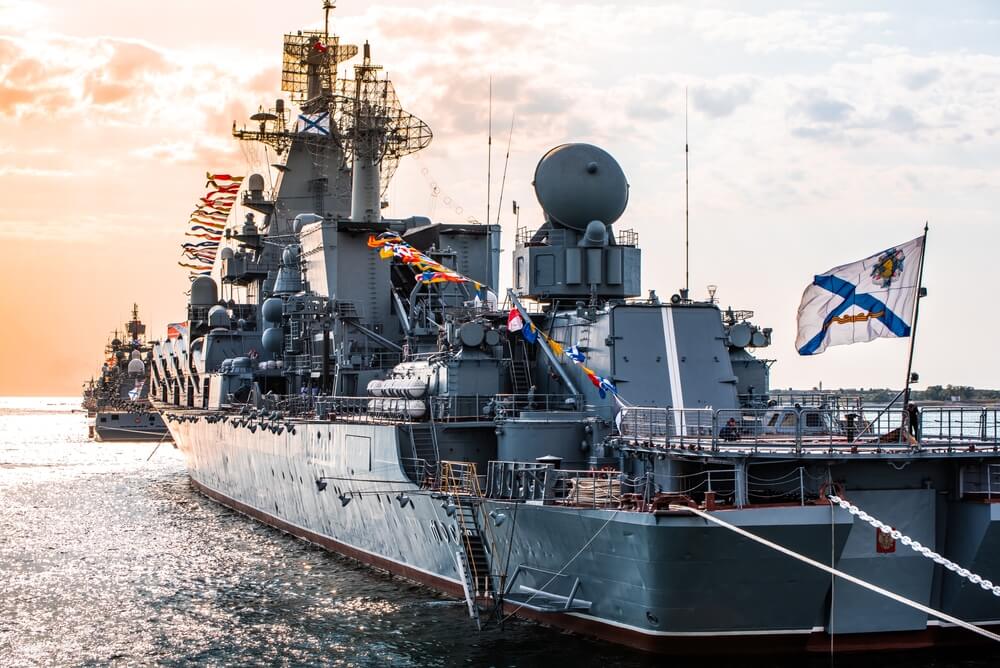
The Russian fleet in the Black Sea has lost more than 30% of its ships, effectively turning it into a “submerged fleet” - Cruiser Moskva
This represents not only billions of dollars in losses for Moscow but also a serious challenge in replacing them, as each such system takes a long time to produce.
As a result, Russia may soon face a severe shortage of air and missile defence systems.
If Ukraine eventually receives medium-range missiles from its allies with a range exceeding 2,000 kilometres, it will be able to strike Russian production facilities for air defence systems, missiles, drones, and ammunition at great distances.
This could alter the course of the war. Washington understands this, yet for four years such missiles have not been supplied to Ukraine.
For a long time, Moscow claimed that Crimea was an “unsinkable aircraft carrier.” In reality, however, this has not been the case.
Many Russian aircraft, helicopters, and air defence systems have been destroyed in Crimea. Kyiv’s strategy is that if the Kremlin considers Crimea an aircraft carrier, Ukraine aims to ensure it is left without aircraft and other combat systems.
In that case, it will no longer be an aircraft carrier but merely an ordinary ship that will eventually drift into a Ukrainian harbour.
Oleksandr Levchenko, a former Ukrainian diplomat, is a professor at the State University (Kyiv) and a member of the Academy of Geopolitics and Geostrategy (Kyiv).
