Recent events have cast European politics into sharper relief. With left-wing protests, some violent, engulfing cities from Paris to Milan to Madrid, the right has remained focused on big upcoming elections, and most mainstream parties appeared to be in retreat.
It may be too soon to guess at the outcomes in Spain, France, Poland, and Italy, but there can be little doubt that far-right and populist ideas will shape the Europe that emerges from these contests.
That much is clear to me after spending the past few months talking to leading “new right” politicians and strategists in France, Poland, Germany, and Italy.
As many observers of this movement have pointed out, European far-right parties differ on Russia, Israel, the economy, the welfare state, and one another.
In France, National Rally leaders Marine Le Pen and Jordan Bardella worry that any contact with Germany’s more radical Alternative für Deutschland (AfD) would risk contaminating the brand they have worked so hard to detoxify.
At the same time, senior figures in Italian Prime Minister Giorgia Meloni’s government worry openly about what a Le Pen presidency would mean for the European Union and NATO.
But in many ways, the issues on which these parties converge tell us more about where the continent may be headed.
The firewall between the radical right and the mainstream
All reject globalization and are appealing to working-class voters, whom they see as its victims.
And all are offering a similar solution: to take back control of their country, its borders, and its economy.
Within this shared agenda, three projects stand out. The first is to destroy the firewall between the radical right and the mainstream.
As a senior figure in Meloni’s Brothers of Italy party put it to me, the European Parliament’s political cordon sanitaire against the far right is a “fascist institution” that shuts out democratically elected parties.
Meloni managed to break a domestic cordon around her own party, and now the plan is to do the same at the European level
Meloni managed to break a domestic cordon around her own party, and now the plan is to do the same at the European level.
According to this vision, the European Conservatives and Reformists (ECR)—the pan-European grouping that includes the Brothers of Italy—could become a bridge between other far-right parties, even the AfD, and the center-right European People’s Party. The goal is to expand the market for right-wing ideas.
But whether applied domestically or at the European level, “Melonization” (moderation once in power) may be an illusion.
Centrists trot out this scenario to convince themselves that they can defang far-right forces by inviting them into the tent.
Exclusion, they insist, only fuels more radicalization. But this hardly describes what is happening in Europe today.
It is the far right that is increasingly co-opting the center right, not the other way around.
Deportation state
The new right’s second project is the deportation state. Mainstream parties have spent a decade tightening asylum rules and policing borders, on the assumption that voters care deeply about limiting new arrivals.
But according to Benedikt Kaiser of the AfD, mere border enforcement misses the point.
The public’s chief concern, he argues, is with the millions of non-Europeans who are already living in Europe and, in his eyes, changing its culture and Stadtbild (cityscape).
He and his party would not stop at deporting recent arrivals or turning away refugees.
The question now may be when, not if, “re-migration”—pushing immigrants to leave—becomes a mainstream talking point
They want to remove everyone who is in the country illegally, as well as all immigrants with criminal records, religious fundamentalists, and those whose basis for asylum may no longer hold, such as Syrian refugees.
Reform UK has made similar noises, promising an ICE-style deportation campaign to remove hundreds of thousands of people from the United Kingdom.
With the far right having effectively won the original debate on migration (reflected in its surging approval), the question now may be when, not if, “re-migration”—pushing immigrants to leave—becomes a mainstream talking point.
Remaking the EU
The third project is to end what Le Pen portrays as immobilisme, by which she means the establishment’s fatalistic insistence that nothing can be done about many of the electorate’s biggest concerns.
Give her power, she claims, and she will just “do things,” including when it comes to dealing with the EU.
The implication is that EU policies on supporting Ukraine, fostering a green transition, and protecting individual rights could all be up for negotiation.
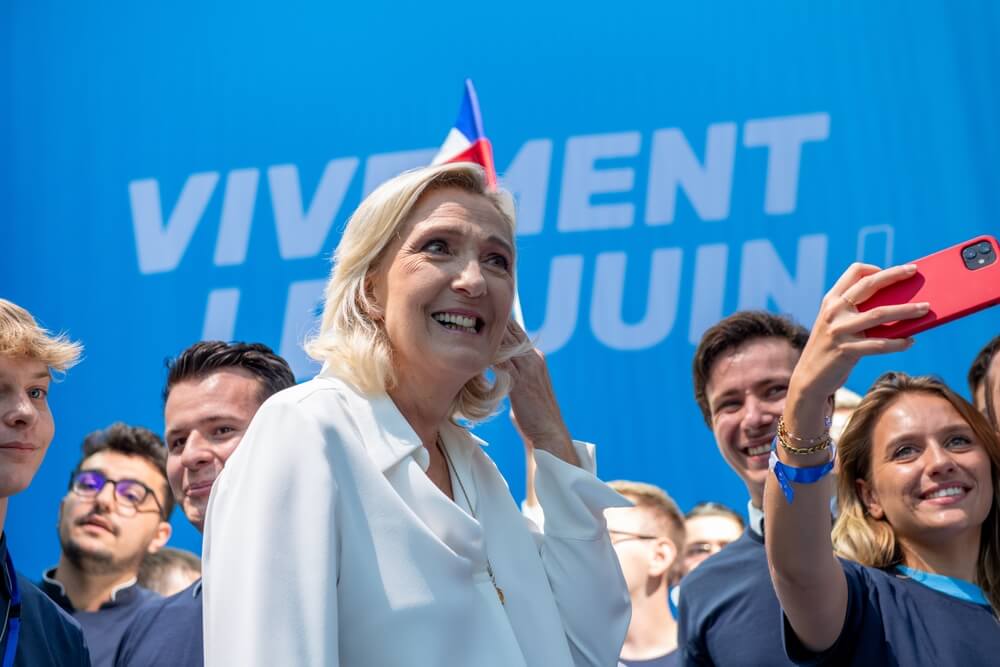 Marine Le Pen has proposed a referendum on cutting France’s net contribution to the EU budget
Owing to the Brexit debacle, most European far-right parties have abandoned talk of leaving the EU and pivoted to proposals on remaking it.
Hence, my Italian interlocutor quoted Giorgio Almirante, the founder of the neo-fascist Italian Social Movement: “Europe will be right-wing or it will be nothing.”
To that end, Le Pen has proposed a referendum on cutting France’s net contribution to the EU budget and ousting EU Commission President Ursula von der Leyen.
Similarly, Kaiser expects the AfD, after its co-chair Alice Weidel’s flirtation with leaving the euro this past summer, to settle on renegotiating the EU’s terms instead.
A recently leaked AfD “manifesto” proposes reducing the EU to a few “core competences,” and insists on wide-ranging German opt-outs on migration, foreign and defense policy, and cohesion (intra-EU fiscal transfers).
That would probably suit Le Pen, too. Speaking to the Financial Times, she recently mused that a pared-down EU might give the UK an incentive to rejoin the bloc.
The far right has already won
In many ways, the far right has already won, regardless of what happens at the ballot box.
Its parties may still quarrel among themselves, but they agree on the three big issues that will define much of the political agenda.
If centrist parties want to avoid being associated with the status quo, they might find themselves adopting similar positions
If centrist parties want to avoid being associated with the status quo, they might find themselves adopting similar positions.
To remain competitive on their own terms, mainstream parties will have to demonstrate that they, too, have a vision for giving vulnerable citizens control over their future.
If their vision promises sovereignty and security in Europe, rather than more liberalization and globalization, it might even create a dilemma for the far right, which would need to show that it can prevent Europe from being subjugated by the likes of Donald Trump, Vladimir Putin, and Xi Jinping.
Mark Leonard is a Director of the European Council on Foreign Relations.
