Shortly after the US midterm elections on November 3, Hakeem Jeffries, the Democratic leader in the House of Representatives (and the chamber’s likely next Speaker) announced, “America is back.”
With the Democrats having retaken both chambers of Congress by wide margins, even winning in longstanding Republican strongholds—including Kansas, Texas, and South Carolina—Jeffries certainly has much to celebrate.
But when it comes to US allies, the question is: Back to what, and for how long?
I have written extensively about the rise of a G-Zero world, where the United States has stepped back from the international order it created, and where no other country or group of countries is willing or able to take its place.
Yes, Russia’s behavior as a rogue state, and China’s refusal to liberalize its political system and economy upon being integrated into global markets, has contributed to this new reality.
But American retrenchment has been central to the erosion of the international system, and accelerating it was a deliberate policy choice across President Donald Trump’s two terms.
Trump’s MAGA movement drew on growing public skepticism of US foreign policy.
As key segments of the American population were left behind by globalization and angered by failed wars in the Middle East, the bedrock political belief that the US should lead the international order was shaken.
But American leadership abroad suffered not only because of a conscious political decision prompted by electoral dynamics, but also because dramatic domestic political swings undermined policy consistency.
Unraveling of America’s bipartisan approach to foreign policy
With the Democrats winning this year’s midterms, 12 of the 14 national elections over the past 26 years have flipped the executive branch or part of the legislative branch to the other party, a marked difference from the preceding 40 years, when only seven of 20 elections did so.
Paired with rising polarization between the parties and the unraveling of America’s historically bipartisan approach to foreign policy, this volatility has led to sharp policy reversals, from repeatedly joining and leaving the Paris climate accord and the UN Human Rights Council to Trump’s decision to rip up President Barack Obama’s Joint Comprehensive Plan of Action with Iran.
As a result, American allies, especially in Europe, have suffered whiplash. Former US President Joe Biden encountered this dynamic as he worked to rebuild US relationships after the fraying of transatlantic ties during Trump’s first term—repeatedly citing conversations in which he told world leaders, “America is back,” only for them to ask, “But for how long?”
With Trump’s return to the White House European countries saw the writing on the wall and hedged accordingly
With Trump’s return to the White House—and his subsequent questioning of the value of NATO, threats to seize Greenland, and dealmaking with Russian President Vladimir Putin—European countries saw the writing on the wall and hedged accordingly.
The goal was not to decouple from the US, but to derisk. For European countries growing distrustful of American security guarantees, that meant reinvesting in defense, with Germany changing its debt rules to rebuild its military.
This dynamic also showed up in the Middle East as countries searched for security in the wake of the US’ destabilizing war against Iran, with Saudi Arabia, Turkey, and Pakistan forming the Mecca Joint Defense Agreement.
Many US allies are relieved to see the Democrats’ resurgence
Many US allies also looked for new economic partners. Canada, under pressure from Trump, is upgrading its relationship with the European Union and pursuing deeper engagement with China.
The EU, meanwhile, has forged new deals with Mercosur (Argentina, Brazil, Paraguay, and Uruguay) and India.
The Democratic Party is more committed to international institutions, despite isolationist tendencies among its far-left wing
To be sure, many US allies are relieved to see the Democrats’ resurgence in the midterms, since the Democratic Party is more committed to international institutions, despite isolationist tendencies among its far-left wing.
The reinstatement of legislative checks on Trump’s power through Democratic leadership of the Senate Foreign Relations and House Foreign Affairs Committees will be welcome news to many foreign observers, even if it will be unlikely to halt the administration’s hawkish policies toward Iran, Cuba, and Venezuela.
Hoping for a more multilateral approach
Allies hoping for a more multilateral approach to policymaking will have to wait until after 2028, at the earliest.
But even if a less unilateralist president succeeds Trump, the US possesses neither the will nor the capacity to resume its role as the undisputed global leader, given its own political divisions and hardening fiscal constraints, not to mention the influence of an ascendant China.
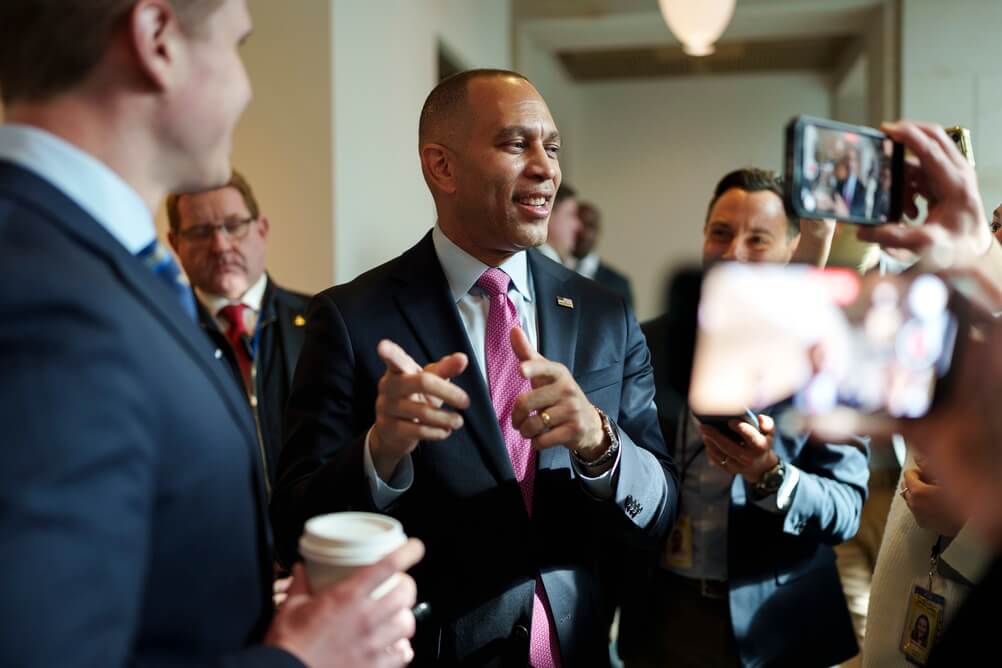 Even if the Democrats’ victory marks the beginning of the end of the Trump administration’s “America First” approach to foreign affairs, it does not augur the return of a consistent US foreign policy - Hakeem Jeffries
This was signaled in the immediate aftermath of the midterms, when Vice President JD Vance released a long X post in which he blamed the Iran war for his party’s losses, prompting speculation that the US could curtail future strikes in favor of negotiations.
US decisions about war and diplomacy are being made at an increasingly rapid and unpredictable pace.
Even if the Democrats’ victory marks the beginning of the end of the Trump administration’s “America First” approach to foreign affairs, it does not augur the return of a consistent, reliable US foreign policy.
That is a problem for American allies, and a key reason why—for now at least—the G-Zero world is here to stay.
Ian Bremmer, Founder and President of Eurasia Group and GZERO Media, is a member of the Executive Committee of the UN High-level Advisory Body on Artificial Intelligence.
