Syrian military involvement in Yemen could shift the balance on the battlefield, giving Saudi Arabia a potentially significant advantage in its campaign against the Iranian-backed Houthis, while also raising geopolitical questions related to Syria’s possible inclusion in the Mecca Alliance that would tilt the balance of power in the region.
Speculation about possible Saudi requests for Syrian military assistance emerged following President Ahmed al-Sharaa’s brief visit to Riyadh on 6 October, accompanied by his foreign minister.
Al-Sharaa met Crown Prince Mohammed bin Salman before returning to Damascus, with no details of their discussions made public.
Four weeks later, on 4 November, he returned to Riyadh with a larger delegation, including the ministers of foreign affairs, defence, finance and industry, and the head of general intelligence.
The two countries concluded a defence agreement alongside economic agreements providing Syria with more than $403 million in concessional loans to finance public service projects.
The second visit came amid escalating hostilities in Yemen and growing questions about Syria’s potential contribution to regional security. Days earlier, Syria’s foreign minister had disclosed discussions about possible membership of the Mecca Alliance.
Meanwhile, Saudi Arabia was struggling to secure additional combat support against the Houthis, with Pakistan and Turkey ruling out the deployment of their troops to Yemen.
Yet the prospect of Syrian forces entering the war remains uncertain. On 9 November, Syria’s foreign minister, Asaad al-Shaibani, stated that “Syria has no troops deployed in Yemen and no plans to send forces there in the near future”, stressing that the agreement with Riyadh focuses on rebuilding Syria’s armed forces.
Damascus had earlier clarified that the agreement covers training, the exchange of expertise and military consultations.
Saudi Arabia commands considerable economic and religious influence across the Middle East and the wider Muslim world, but persuading other governments to commit troops against the Houthis is another matter.
The prospect of heavy casualties, an uncertain military outcome and the domestic repercussions of a failed intervention make such commitments difficult to secure.
Egypt’s costly military campaign in Yemen during the 1960s remains a cautionary example. Even so, the kingdom’s role as custodian of Islam’s holiest sites may still draw individual volunteers to fight alongside Yemeni forces against the Houthis, even though their governments hold back.
Why Syria?
Syria could offer Saudi Arabia a valuable source of military experience in its confrontation with the Houthis. Its emerging army draws heavily on former opposition factions whose fighters spent years battling Assad’s forces and Iranian-backed militias, often under Russian air strikes, before the regime’s collapse in December 2024.
Their experience in guerrilla and urban warfare, including operations in mountainous terrain resembling parts of Yemen, could prove valuable against the Houthis, whose methods have posed difficulties for conventional forces.
Syria also has veteran fighters and experienced commanders who have yet to be integrated into its new military institutions, but whose operational knowledge could contribute to training and military planning.
Trainers or troops?
The two visits were followed by reports that Saudi–Syrian military cooperation was already taking shape. According to Reuters, dozens of Syrian military personnel had travelled to Saudi Arabia in recent weeks to advise and train Saudi and Yemeni units, while Saudi coordination visits to Syria were expected the following month.
Accounts of the extent of Syrian involvement, however, differ sharply. AFP, citing military and defence sources associated with Yemen’s Saudi-backed authorities, reported that hundreds of Syrian soldiers were already stationed on both sides of the Saudi–Yemeni border.
Some Syrians have welcomed the possibility of military involvement against the Houthis as a continuation of their struggle against Iran-backed forces
Damascus rejected the reports, reiterating that its priorities remained domestic security, reconstruction and economic recovery.
A diplomatic source quoted by SANA nevertheless left open the possibility of expanding cooperation with Riyadh into a mutual defence agreement or eventual membership of the Mecca Alliance.
Damascus’s swift denials also came amid public unease over the prospect of Syria entering another war, while the country is still struggling to recover and faces serious internal security threats.
Some Syrians, however, have welcomed the possibility of military involvement against the Houthis as a continuation of their struggle against Iran-backed forces.
The limits of military cooperation
Military cooperation between Saudi Arabia and Syria could benefit both countries, though in different ways. Syrian fighters’ experience in irregular warfare could prove valuable against the Houthis, whose ability to sustain a prolonged war of attrition has been highlighted by The Wall Street Journal.
Yet that experience cannot substitute for Saudi capabilities in air defence, drone interception or advanced military systems. Syria’s own army, meanwhile, still requires extensive training, institutional development and restructuring to become a professional, conventional force, areas in which Saudi Arabia could provide valuable assistance.
The two countries have complementary military needs and capabilities, although the potential contribution of Syrian forces should not be overstated
A senior Saudi official told Reuters that the cooperation was “mainly to restructure the Syrian forces”, while also acknowledging their experience in “fighting militias”.
The two countries therefore have complementary military needs and capabilities, although the potential contribution of Syrian forces should not be overstated.
A new geopolitical alignment
Extending the agreement to include Syrian membership of the Mecca Alliance could also tilt geopolitical power in the region, but it might face considerable difficulties, given Syria’s current security situation.
The alliance operates on the principle that an armed attack on one member is regarded as an attack on all. Syria, meanwhile, continues to face Israeli air strikes and incursions, while Israel occupies the Golan Heights and maintains positions in southern Syria beyond the 1974 disengagement line.
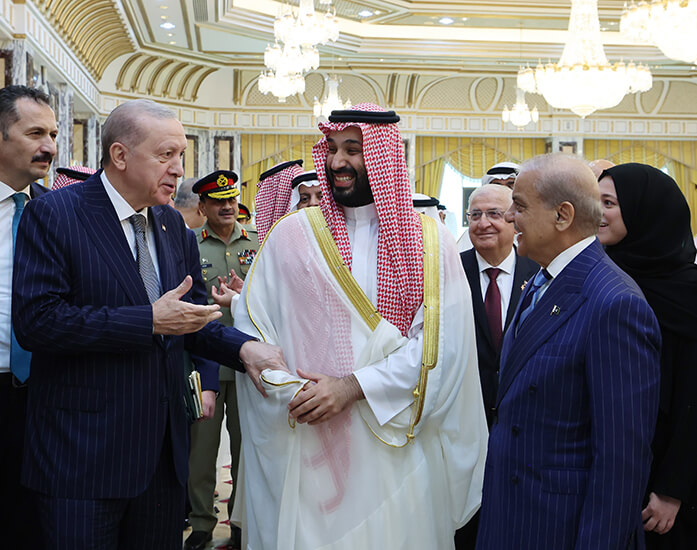 Extending the agreement to include Syrian membership of the Mecca Alliance could tilt geopolitical power in the region
Admitting Damascus could therefore confront Saudi Arabia, Turkey and Pakistan with the prospect of defending Syria against Israel, potentially drawing them into a conflict they are under no current treaty obligation to enter. Israel could also regard Syrian membership as a shift in the regional balance of power and respond accordingly.
For Riyadh, the risk of wider confrontation would run counter to its interest in containing regional tensions.
An alliance intended to strengthen Syria’s security could instead expose Damascus and its prospective partners to greater risks, making membership difficult to envisage under present circumstances.
The Iran factor in Saudi–Syrian relations
The confrontation with Iran gives the agreement wider strategic significance. Under Assad, Syria served as Iran’s land corridor to Hezbollah in Lebanon.
Today, its stability is an important Saudi interest, with Riyadh seeking a Syria capable of controlling its territory and institutions while preventing renewed Iranian influence.
Yet the agreement signals a new partnership rather than the opening of another front against Iran. During al-Sharaa’s visit, both leaders called for regional de-escalation, while Riyadh has maintained channels of communication with Tehran.
Riyadh also hosted al-Sharaa’s first meeting with Donald Trump in May 2025
Damascus has its own reasons for strengthening ties. Saudi political and economic backing has helped the new leadership consolidate its position and develop relations with Washington and Europe. Riyadh also hosted al-Sharaa’s first meeting with Donald Trump in May 2025.
With Syria still struggling to rebuild its economy, Gulf investment remains important, while its ambition to become a transit route for Gulf energy exports to Europe depends on continued regional stability.
How far can it go?
The Saudi–Syrian agreement, following Syria’s military training and advisory accord with Turkey in August 2025, marks another step in Damascus’s efforts to professionalise and restructure its new armed forces and to secure a place in regional security arrangements.
As the war in Yemen evolves, however, cooperation with Riyadh could evolve too. That would raise serious questions about how far it might go, how Iran would respond, and whether the Houthis, Hezbollah or Iran-aligned factions in Iraq’s Popular Mobilisation Forces might retaliate against Syrian territory.
The risk of opening another front while Syria is still struggling to consolidate its internal security may discourage both governments from expanding its military role. Even within its current limits, however, the agreement could still alter conditions on the ground in Yemen.
Siba Madwar is a Syrian political commentator and PhD researcher at King’s College London, specialising in conflict resolution in divided societies and post-conflict statebuilding.
