Former Japanese defence minister Gen Nakatani asked Prime Minister Sanae Takaichi on Friday to respond more decisively to US sanctions against the International Criminal Court (ICC) and its president, Tomoko Akane, a Japanese judge.
Nakatani, a veteran of the ruling Liberal Democratic Party, described the US decision as an attack on the rules-based international order and called on Tokyo to urge Washington to lift the sanctions. The cross-party group of MPs he leads intends to submit its demands formally to the Japanese government by mid-September.
Nakatani has raised an issue that is far more significant for Japan than the fate of one of its citizens. Japan is one of America’s closest allies in Asia, and its security agreement with the United States remains the cornerstone of its defence.
For years, Tokyo has presented the rule of law and a rules-based international order as the foundations of its foreign policy.
Nakatani insists that the alliance with Washington and the defence of those principles cannot be treated as competing obligations. The dispute with the US over sanctions against Akane is now putting that stance to a serious test.
Sanctions that carry particular weight for Japan
On 18 August, the United States imposed sanctions on Tomoko Akane and Abdoulaye Seye, a Senegalese lawyer on the ICC prosecution team.
Akane has been president of the court since March 2024 and is the first Japanese woman to hold that position. Washington imposed the sanctions as part of a broader campaign by the Trump administration against the ICC, which the US accuses of overstepping its authority in actions against US and Israeli citizens. The United States is not a party to the Rome Statute that established the court.
The sanctions have immediate consequences. Any assets held by sanctioned individuals under US jurisdiction are frozen, and their access to the US financial system is severely restricted.
Akane has thus been drawn into a much wider conflict between the Trump administration and the court in The Hague. By the time the sanctions against her were announced, a large number of ICC judges and prosecutors were already subject to US measures.
Tokyo has sent Japanese judges to international judicial institutions, presenting this as part of its contribution to strengthening the rule of law in international relations
America’s conflict with the ICC did not begin with Akane. Washington has for years opposed the prospect of the court investigating US citizens without its consent, and the current administration specifically challenges the ICC’s treatment of Israeli officials.
For Japan, this case is highly sensitive politically because it affects the president of an institution that Tokyo strongly supports, not only in principle.
Japan has been a member of the ICC since 1 October 2007 and remains its largest financial contributor. According to official data from the Japanese Ministry of Foreign Affairs, Japan provided approximately 15 per cent of the total mandatory contributions to the court’s budget in 2024.
For years, Tokyo has sent Japanese judges to international judicial institutions, presenting this as part of its contribution to strengthening the rule of law in international relations.
Tokyo reacted, but cautiously
The Japanese government did not support the US sanctions. On 19 August, the Ministry of Foreign Affairs announced that Japan consistently supports the ICC in prosecuting the most serious international crimes and in strengthening the rule of law, and described the US measures as highly regrettable. Tokyo has stated that it will continue talks with the countries involved in the dispute.
Parts of the Japanese political establishment considered this response inadequate. Criticism came from the opposition, human rights organisations and sections of the ruling LDP.
Prime Minister Takaichi later rejected claims that her government had been too lenient towards Washington. She stated that, right up until the last moment, Japan had tried at various levels to convince the US administration not to impose sanctions on Akane, and that the US decision was incompatible with Japan's position.
Akane called on the Japanese government to play a more active role
Foreign Minister Toshimitsu Motegi confirmed that, before the sanctions were announced, Tokyo had asked Washington several times, and at various levels, not to place Akane on the sanctions list.
Since Tokyo's previous attempts to prevent the sanctions had failed, the question now is how far the Japanese government is prepared to go to increase pressure on Washington.
On 26 August, Akane called on the Japanese government to play a more active role. She urged Tokyo to use its close relationship with the United States to ease pressure on the ICC and to thwart efforts to encourage member states to leave the court.
In doing so, Akane effectively invited Tokyo to demonstrate that its support for international law does not end when Japan finds itself in a dispute with the US over the issue. Two days later, Motegi spoke to Akane by telephone. The Japanese Ministry of Foreign Affairs stated only that they had exchanged views on the situation surrounding the ICC.
The US alliance and Japan's international credibility
Japan cannot treat its relationship with the United States as simply one of several roughly equal foreign policy options. The US–Japan security alliance remains central to deterring North Korea and to Japan's defence at a time when China's military power is growing and Beijing's pressure in the East China Sea remains a persistent security concern.
That reliance, however, does not resolve the question of Japan's credibility. Tokyo has long sought to elevate its international role beyond that of a country whose security depends on US military power.
The sanctions against Akane create a far broader problem than the protection of a single Japanese citizen
Japan invests political capital in international institutions, insists on respect for international law, and cites the rule of law as one of its main arguments when addressing the Russian invasion of Ukraine or attempts to unilaterally change the status quo in Asia by force.
Japan's Ministry of Foreign Affairs states that the country aims to make a significant and constructive contribution to establishing the rule of law in the international community, citing support for the ICC as one example of this policy.
The sanctions against Akane therefore create a far broader problem than the protection of a single Japanese citizen. If Tokyo claims that international institutions and rules constrain the behaviour of states, that principle must carry weight even when the pressure comes from Washington. Otherwise, the argument that Japan uses against other major powers will be far easier to challenge.
Washington disputes the court's jurisdiction
The US position on the ICC rests on a different legal and political understanding. The United States has not ratified the Rome Statute and refuses to accept that the court has the right to exercise criminal jurisdiction over US citizens without US consent.
Washington also challenges the court's jurisdiction over Israeli citizens in cases involving the Palestinian territories.
Tokyo must decide how much political capital it is prepared to expend
Washington maintains that the ICC lacks the authority to act against US and Israeli officials in ways the US deems unacceptable. Japan, however, has supported the court politically and financially for almost two decades, leading to serious disagreement between Tokyo and Washington over the role of the ICC.
It is no longer enough for Tokyo simply to restate its support for the court; it must decide how much political capital it is prepared to expend on defending a principle it has for years presented as a core part of its international identity.
Alliance does not imply agreement on everything
Nakatani is trying to present the dispute in a way that does not call the US–Japan alliance into question. His point is not that Japan should choose the ICC over the United States.
He believes that a serious ally must be able to tell Washington openly when it considers a US decision harmful to the international order Japan is trying to protect.
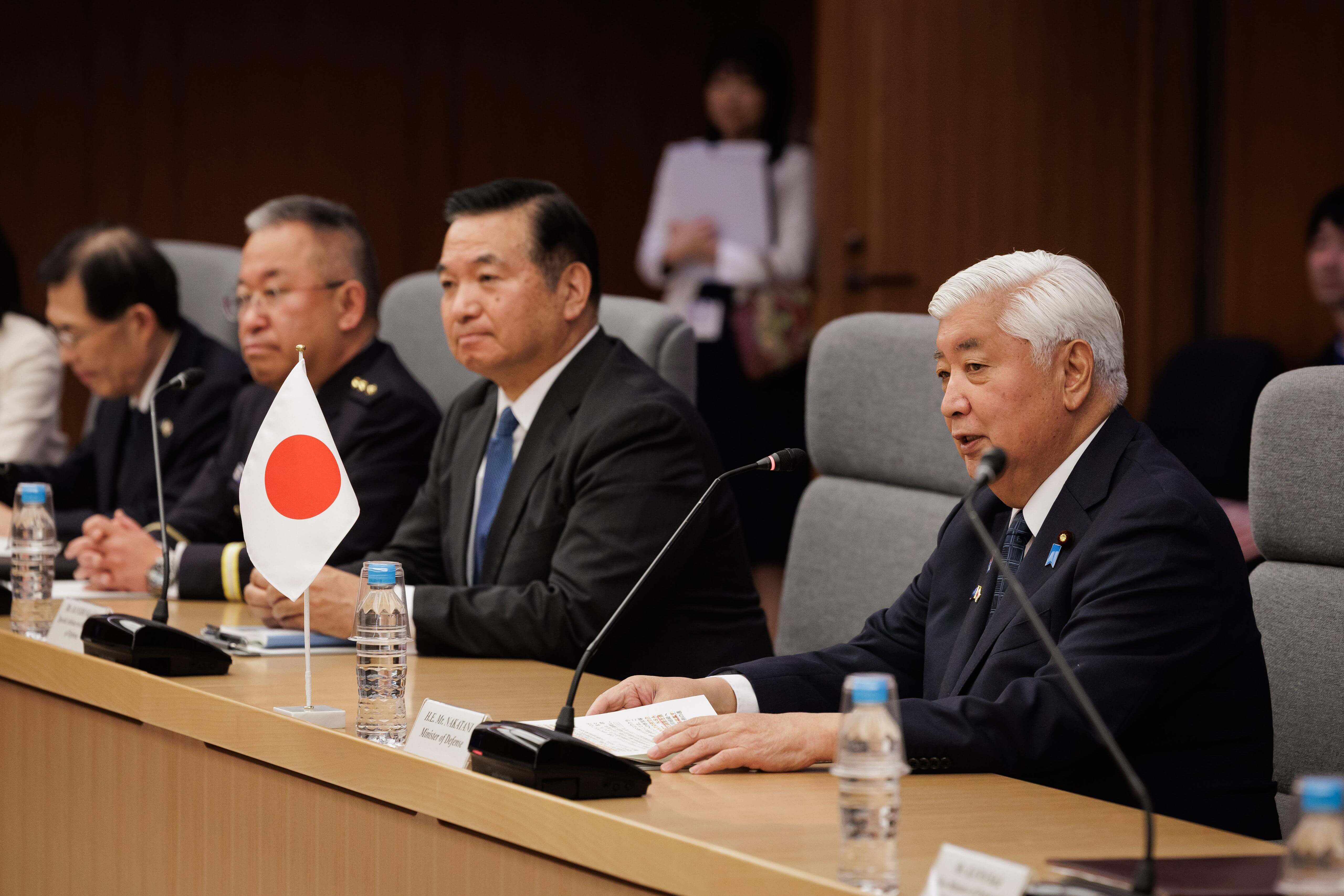 Gen Nakatani is trying to present the dispute in a way that does not call the US–Japan alliance into question
For Takaichi, this is a more politically acceptable course than an open confrontation with the Trump administration. Japan can seek the lifting of sanctions against Akane, continue funding the ICC and rally other member states in support of the court, while keeping its security relationship with Washington intact.
Such a policy, however, is likely to create some friction with the United States. This will demonstrate how far Takaichi is prepared to go.
Nakatani and his cross-party group intend to submit a formal request to the government by mid-September, several weeks before Takaichi is expected to travel to the United States for the United Nations General Assembly, during which she could meet Trump. If that meeting takes place, the sanctions against Akane are unlikely to disappear completely from the bilateral agenda.
How far Tokyo is willing to go
Takaichi is likely to try to keep the dispute within the bilateral relationship with Washington, while demanding that the sanctions against Akane be lifted, without turning the issue into an open conflict with the Trump administration.
For such an approach, Nakatani has already given her political cover within the ruling party: opposition to the US decision can be presented as the stance of a serious ally, rather than as a move away from the United States.
Much will depend on Washington's response. If the Trump administration stays on its current course and continues to pressure the ICC, it will become increasingly difficult for Tokyo to confine itself to expressions of regret and diplomatic talks.
The margins of disagreement within America's alliance system are much narrower than its partners care to admit
The Japanese government will then have to decide whether to rally other members of the court more actively and defend its work politically, or to accept the US sanctions as a reality it does not wish to challenge seriously.
This dispute may have ramifications far beyond Japan's relationship with the ICC. If it turns out that one of America's closest allies can oppose Washington on an important international issue without seriously disrupting bilateral relations, other countries that increasingly have reasons to disagree with US policy will seek similar room for manoeuvre.
If Tokyo limits itself to a token protest, however, the message will be equally clear: the margins of disagreement within America's alliance system are much narrower than its partners care to admit.
