The United Nations Security Council failed to extend the mandate of the panel of experts responsible for monitoring the implementation of sanctions against Iran.
The United States’ proposal received 11 votes; Pakistan and Somalia abstained, while Russia and China voted against it and, using their vetoes, blocked the extension of the mandate, which expires at the end of September.
The formal sanctions regime, which, according to the position of the UN Secretariat and the majority of Security Council members, was reactivated in September 2025, remains in force.
The Council is now, however, without its own independent expert body to verify how these measures are implemented and to document their breach.
The 17 September vote deepened an already existing split in the Security Council over the legal status and enforcement of sanctions against Iran.
Sanctions against Iran have been in place for a year in an institutionally unusual state. Russia and China dispute the legal validity of their reactivation and consider that the obligations under Resolution 2231 have expired.
The US, the European members of the Council and most other members take the opposite view, according to which the mechanism for reinstating earlier sanctions, known as ‘snapback’, legally reactivated earlier resolutions and sanctions measures.
The consequences of that dispute are now moving beyond the realm of legal debate and are affecting the day-to-day implementation of the regime.
Within the UN, there are sanctions that most members of the Council consider binding, while two permanent members challenge the very institutions required for their full implementation.
The year of the blockade in the 1737 Sanctions Committee
France, Great Britain and Germany triggered a ‘snapback’ in August 2025. After the expiry of the procedure set out in Resolution 2231, the previous resolutions of the Security Council were reapplied on 27 September 2025.
According to the UN framework, this restored the 1737 Sanctions Committee and the panel of experts that provides it with technical support.
The reconstituted structure barely functioned during the next twelve months. In 2026, the Security Council did not elect a chair of the 1737 Committee, so the countries presiding over the Council only occasionally carried out the most essential procedural tasks.
The Committee did not hold any meetings during that period. In April, Russia and China blocked eight candidates proposed by the UN Secretariat for the panel of experts. Without experts, regular meetings or a permanent chair, the mechanism remained virtually paralysed.
The veto of 17 September makes the blockade far more permanent
The veto of 17 September makes the blockade far more permanent. Until now, there was at least a procedural possibility that the panel would be filled as soon as the Council agreed on the candidates.
With the expiry of the mandate, that possibility also disappears, while the political dispute that prevented its formation remains entirely unresolved.
The problem for the Security Council is that a sanctions regime without a functional monitoring mechanism increasingly depends on the national assessments and instruments of individual states.
The sanctions system requires constant monitoring of the implementation of decisions, identification of new patterns of circumvention, verification of information provided by states and adaptation of measures to changes in trade, funding and procurement.
The panel of experts provided exactly that. Its mandate covers nuclear issues, ballistic missiles, conventional weapons, export controls, customs, funding and maritime transport.
The IAEA addresses only part of the problem
The International Atomic Energy Agency remains the central institution for verifying Iran’s nuclear programme, but its mandate covers only part of the issue.
The IAEA monitors nuclear material, facilities and Iran’s obligations under the Safeguards Agreement. In its latest reports, the Agency cites serious restrictions on access and a loss of continuity of knowledge regarding some of Iran’s stockpiles of enriched uranium.
Sanctions monitoring requires a distinct set of expertise and tools. When there is suspicion that prohibited equipment has reached Iran, it is necessary to trace the origin of the goods, the companies involved in the transaction, banking channels, intermediaries, ownership structures, ports, ships and jurisdictions through which the transaction was carried out.
The use of cryptocurrencies, front companies and trade arrangements with countries that challenge the sanctions regime further complicate such investigations.
The United States, Great Britain, France and others will continue to uncover the networks that connect Iran to the international financial and trading system
The absence of the panel will not halt that work. The United States, Great Britain, France and others have their own intelligence, financial and regulatory capabilities and will continue to uncover the networks that connect Iran to the international financial and trading system.
A more difficult problem will be the status of their findings. US or European evidence may be sufficient for new national sanctions, the freezing of assets or the termination of business relationships.
For countries that challenge Western policy towards Iran, such evidence does not carry the weight of the findings of an expert body of the Security Council.
One regime, two interpretations
The division is already evident at the legal level. The Security Council’s official framework lists the sanctions against Iran as reactivated and sets out the obligations of member states.
Russia and China argue that the process by which the sanctions were reinstated was legally invalid and that Resolution 2231 expired in October 2025.
Therefore, Moscow and Beijing do not regard the 1737 Committee as a legitimately renewed body.
The dispute now extends to the question of who will establish the facts. Western countries will collect data through their own institutions and partner networks, while Russia, China and Iran will be able to dismiss these findings even more easily as politically motivated.
States seeking to maintain relations with both the West and Iran will be exposed to two types of pressure
States seeking to maintain relations with both the West and Iran will be exposed to two types of pressure.
One consists of obligations that the majority of the Council and the UN Secretariat consider valid. The other consists of US and European measures, whose impact derives from control of the dollar, financial markets, insurance, technology and a large share of international trade flows.
Such a situation is unlikely to reduce economic pressure on Iran in the short term. Washington and European capitals have instruments they can apply without the consent of Moscow and Beijing.
The change will be more evident in how sanctions gain international legitimacy and how breaches are documented.
The more this work moves from the UN to national institutions and coalitions of states, the harder it will be to maintain a unified oversight system with authority beyond the circle of states that directly support it.
A precedent from North Korea
A similar development followed the Russian veto in March 2024, which ended the mandate of the panel of experts on North Korea.
Sanctions against Pyongyang remained in force, and a few months later eleven countries established the Multilateral Sanctions Monitoring Team outside the United Nations structure.
This mechanism continued to collect data and publish reports on sanctions breaches, with the political support of states that share the same assessment of the North Korean regime.
Many already cooperate in the exchange of intelligence data, financial supervision and export control
Following the vote on Iran, France has already raised the possibility of a similar course of action.
Such a move has a clear institutional logic. States that consider sanctions against Iran legitimate have an interest in preserving a shared capacity to analyse financial, commercial and technological networks.
Many already cooperate in the exchange of intelligence data, financial supervision and export control, so the new mechanism could be established without lengthy institutional preparation.
Such a mechanism would have an obvious political limitation. The reports of the coalition of states might be expertly detailed and based on high-quality data, but they would not have the status of reports from a Security Council body.
Moscow, Beijing and Tehran would have even less reason to accept them, and some countries outside Western alliances would assess more carefully how far they wished to follow their findings and recommendations.
The next dispute will be over whose evidence is accepted
In the coming months, a key change will be the transfer of practical oversight from UN institutions to national and coalition structures of states that consider the sanctions valid.
This will further increase the importance of US and European financial, intelligence and regulatory capacities, while their findings will simultaneously carry less weight with countries that challenge the legal basis of the entire regime.
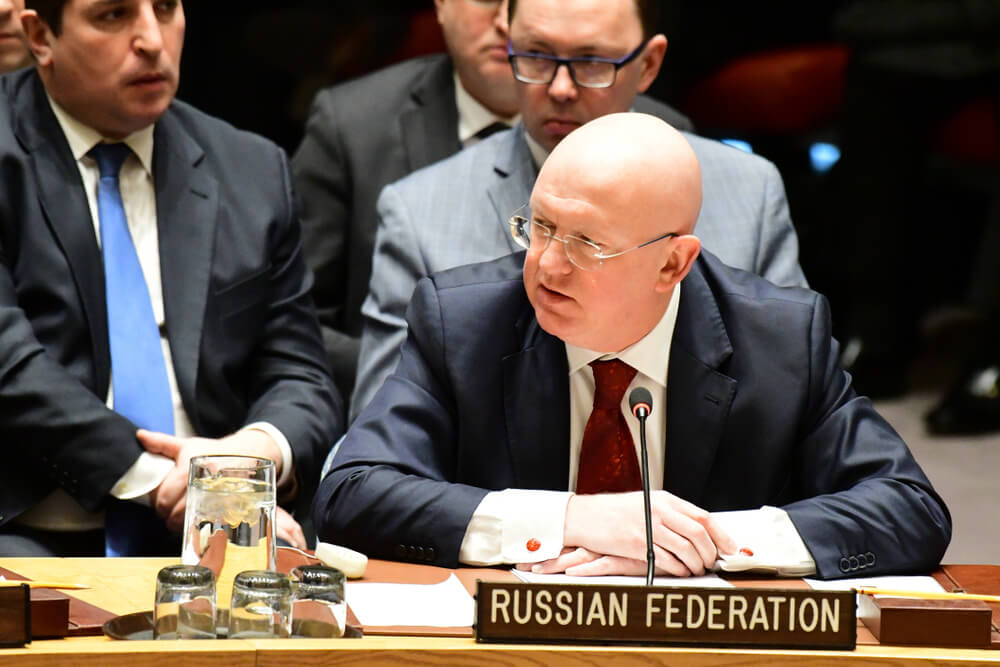 Russia and China dispute the very legal basis on which the sanctions and accompanying institutions were renewed - Vasily Nebenzya
There is little reason to expect a swift restoration of functional oversight within the UN. Russia and China dispute the very legal basis on which the sanctions and accompanying institutions were renewed.
That dispute can hardly be resolved by agreeing on the names of experts or by technical changes to the mandate.
A renewed institutional agreement would require a broader political bargain on Iran’s nuclear programme and sanctions status, and there are currently no indications that such an agreement is close.
The true impact of the 17 September veto will become clear when the next serious case of a possible sanctions breach emerges.
At that point, the origin of equipment, money or weapons will be only one part of the dispute.
Equally important will be who collected the evidence, who verified it and which countries are prepared to accept it.
If the current stalemate continues, the Iranian sanctions regime will remain formally in place, while its implementation will increasingly depend on parallel systems of states that no longer share a common mechanism for determining the same facts.
