On 7 September, Germany asked the International Court of Justice in The Hague to dismiss the legal action brought by Nicaragua, which accuses Germany of violating its obligations under the Genocide Convention and international humanitarian law by supporting Israel.
Over four days of public hearings, which run until 10 September, Berlin is trying to halt the proceedings before the judges reach the substance of the case, challenging the Court’s jurisdiction and the admissibility of Nicaragua’s claim.
At this stage, no decision has been made on whether Germany aided the commission of genocide, whether German weapons were used to violate international law, or how Israel’s operations in Gaza are to be legally classified.
However, behind the procedural dispute lies a question with consequences far wider than German–Israeli relations: to what extent a state that does not itself take part in a war can bear international responsibility for the way it supports the state waging it, whether militarily, financially or politically.
Berlin wants a ruling on who can be sued at all
On 1 March 2024, Nicaragua initiated proceedings under the official title Alleged Breaches of Certain International Obligations in respect of the Occupied Palestinian Territory (Nicaragua v. Germany). Managua claims that Germany, through its political, financial, and military support for Israel, has violated the obligation to prevent genocide and other international obligations.
In the original claim it also cited Germany’s decision at the time to temporarily withhold approval of new funds for UNRWA in Gaza.
Nicaragua’s claims remain those of one party to the proceedings, and on 30 April 2024 the International Court of Justice rejected its request for interim measures ordering Berlin to suspend certain military aid to Israel, finding that the circumstances at the time did not require immediate intervention, but without dismissing the case or ruling on Germany’s responsibility.
Behind the apparently technical dispute over a diplomatic note lies a much more sensitive question: the limits of the Court’s jurisdiction
In the written phase, Nicaragua submitted a memorial in July 2025, and Germany filed preliminary objections on 21 October of the same year, suspending the hearing on the merits until the Court decides whether it has jurisdiction to proceed.
On the first day of the hearing, Julia Monar, a legal adviser to the German Foreign Ministry, said that the conditions for the Court’s jurisdiction had not been met and asked for Nicaragua’s request to be rejected.
One part of the German argument is that Managua did not make a sufficiently serious attempt to resolve the dispute diplomatically before going to The Hague. Nicaragua sent a note to Germany on 2 February 2024 and filed a legal action less than a month later.
Berlin argues that this interval is insufficient for a genuine attempt to resolve the dispute bilaterally, while Nicaragua interprets the same period in the context of the urgency of the situation in Gaza.
Behind the apparently technical dispute over a diplomatic note lies a much more sensitive question: the limits of the Court’s jurisdiction.
Court without Israel
The most serious German argument arises from the fact that Israel is not a party to this case. Nicaragua claims that Berlin violated its own international obligations by assisting Israel, while Germany responds that the Court cannot determine its responsibility without first evaluating Israel’s actions, as Israel is not before the Court and has not consented to its jurisdiction in these proceedings.
Berlin relies on the principle known as Monetary Gold, established in a case decided by the International Court of Justice in 1954. This principle limits the Court’s ability to resolve a dispute between two states when it would first have to determine the rights or international responsibility of a third state that is not participating in the proceedings.
Applied to the present case, the German position is that the allegation of assisting Israel’s internationally unlawful conduct can hardly be separated from a prior assessment of Israel’s own behaviour.
If that assessment were the necessary basis for a judgment against Berlin, Israel’s absence would obstruct the continuation of the proceedings.
The Court did not resolve the conflict in April 2024, as it addressed only the request for interim measures
The Nicaraguan argument begins with Germany’s independent obligations, including the obligation to prevent genocide, which rests with each member state of the Convention individually, and with Article III of the Convention, which also covers complicity.
Managua therefore seeks to place at the centre of the proceedings what Germany knew, what legal obligations it had and how it acted when deciding on aid to Israel.
At that point, two serious legal principles collide: protecting a state that has not agreed to have its responsibility determined in specific proceedings, and enabling examination of the donor state’s own international obligations independently of the formal participation of the aid-recipient state.
The Court did not resolve that conflict in April 2024, as it addressed only the request for interim measures. However, in a separate opinion, Vice-President Julia Sebutinde accepted the German reasoning and concluded that determining Germany’s responsibility would require a prior assessment of the legality of Israel’s conduct.
The decision on preliminary objections will be the first real indication of how much scope the ICJ sees for considering the conduct of a supplier state in a case where the state using its assistance is not before the Court.
The boundary between permission, delivery and use
The most politically sensitive aspect of the case concerns German exports of military equipment to Israel, where the figures can easily give a misleading impression of what was actually approved, delivered or used.
In 2023, the value of German licences for the export of military goods to Israel reached approximately €326 million, but German law makes an important distinction between weapons of war and the broader category of other military equipment, and the licences themselves do not prove either final delivery or location of use.
Germany relies on these distinctions before the Court, with Monar stating that since 2024 Berlin has not approved the export of weapons of war with a final destination in Israel that could be used in the conflict in Gaza. This is a much narrower claim than asserting that German military exports to Israel have stopped.
This level of scrutiny could be particularly significant for other European and Western arms exporters
Official parliamentary figures show that from November 2025 to March 2026, exports of military goods worth approximately €167.4 million were approved, across categories including ammunition, missiles, armoured vehicles and naval equipment. These data refer to approved transactions, so they do not show that every product was delivered, nor that it was used in Gaza.
On 8 August 2025, Chancellor Friedrich Merz temporarily suspended approval for the export of military equipment that could be used in Gaza. Subsequent data on new licences confirm that military trade with Israel has continued, but any case on the merits will require much more precise analysis than simply adding up the value of the licences.
The Court would have to consider the categories of equipment, the content of decisions by the German authorities, the risk assessments that accompanied the issuing of permits and the information available to Berlin at the time those decisions were made.
This level of scrutiny could be particularly significant for other European and Western arms exporters, as it would show how closely an international court can examine the actions of a supplier state when there is an allegation of a serious risk of the gravest violations of international law.
Germany has already changed the rules for future disputes
The case carries added weight because Germany has since changed the conditions under which future disputes against it can be brought before the ICJ. In 2008, Berlin accepted the Court’s compulsory jurisdiction under Article 36 of the Statute, with certain reservations, including, from the outset, one relating to the deployment of German armed forces abroad.
That reservation has been in place since Germany accepted the Court’s compulsory jurisdiction and does not stem from the dispute with Nicaragua.
The October 2025 change concerns a different procedural requirement. Germany updated its declaration and introduced a rule that any state intending to bring a dispute before the ICJ must notify Berlin in writing at least six months in advance of the application and of its intention to refer the matter to the Court if a friendly settlement is not reached.
In 2024 Nicaragua moved from a formal note to a legal action in less than a month
The new provision does not have retrospective effect, and the declaration itself expressly preserves proceedings initiated before 30 October 2025, so the Nicaraguan case is governed by the rules in force when the action was filed.
However, the chronological sequence has clear practical significance, because in 2024 Nicaragua moved from a formal note to a legal action in less than a month, whereas a future claimant relying on the German declaration will no longer be able to follow the same path at such speed.
A decision that could change the position of supplier countries
Germany's preliminary objections rest on serious legal grounds, particularly where Berlin insists that German responsibility cannot be considered without first assessing Israel's conduct.
The International Court of Justice is traditionally cautious when the question of its jurisdiction encroaches on the rights of a state that has not agreed to specific proceedings, so it cannot be assumed in advance that the case as a whole will survive this stage.
Full acceptance of Germany's broadest argument, however, would raise the difficult question of the scope of the obligation to prevent genocide.
If the absence of the state directly waging war were automatically to preclude judicial review of the aid-giving state's own obligations, the practical scope of that obligation for supplier states would be much narrower.
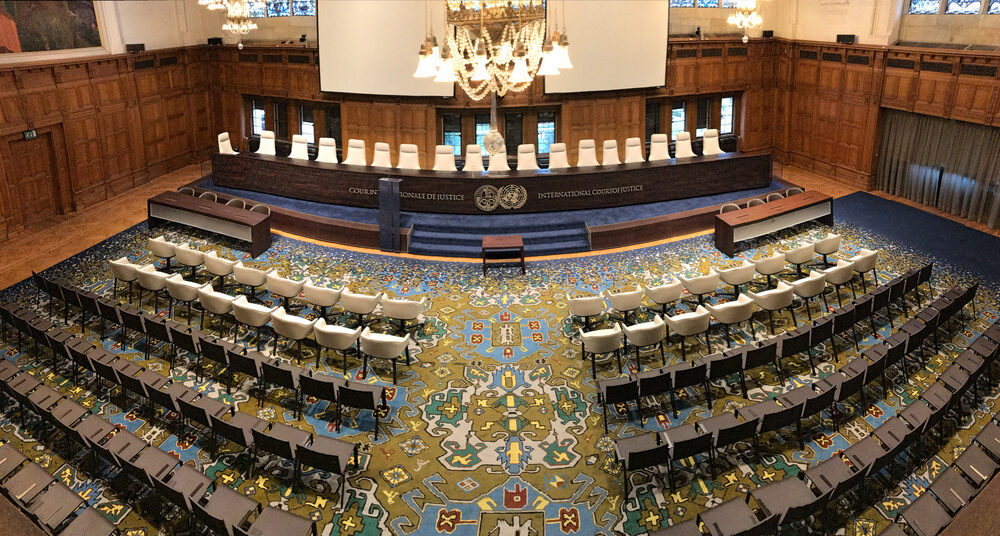 The ruling on Germany's preliminary objections will be important even if the ICJ never delivers a final decision on Berlin's responsibility
The Court therefore has sufficient legal room to make a limited decision, rejecting some of Nicaragua's claims and retaining those it considers possible to examine in light of Germany's separate obligations.
Such an outcome currently seems more likely than a broad judgment that would define the entire responsibility of arms supplier states at the preliminary stage. In complex cases, the ICJ often leaves room for later decisions instead of determining more than necessary at the preliminary stage.
If the case proceeds to the merits, the proceedings will be extended for years, and Berlin will have to explain in much greater detail not only what it approved for export to Israel, but also the assessments on which it concluded that those decisions were compatible with its international obligations.
Such developments would immediately interest London, Paris, Washington and other capitals that supply arms to partners involved in wars.
International law already governs arms transfers through various treaty-based and national regimes, but the Hague case may determine how far international judicial review reaches into the very decision-making of an exporting state when there is a serious risk of the gravest international crimes.
The ruling on Germany's preliminary objections will therefore be important even if the Court never delivers a final decision on Berlin's responsibility.
If the Court accepts Germany's broadest argument, it will be much more difficult to hold states that supply arms to their allies internationally responsible when the warring state itself is not a party to the proceedings.
If the Court upholds any part of Nicaragua's claims, it will raise the far more demanding question of what a state arming another state must do when it has information about a serious risk of violating international law.
Germany went to The Hague to prevent precisely such a continuation of the proceedings, and the Court's decision will determine whether the issues in this case will even reach the merits stage.
