The resumption of open hostilities between Washington and Tehran stemmed from fundamentally divergent interpretations of a key clause in the Memorandum of Understanding signed on 17 June 2026 regarding maritime transit through the Strait of Hormuz.
While Iran asserts that all vessels must coordinate their passage with Iranian authorities, the United States maintains that freedom of navigation in the strait is unconditional.
These differing interpretations led to the continuation of the conflict, as Iranian forces repeatedly opened fire on merchant vessels in late June and early July, prompting the United States to retaliate with airstrikes against Iranian coastal positions.
The spiral of hostility continued, with Iranian retaliatory volleys of missiles and drones targeting US bases in Bahrain and Kuwait.
On 23 July, the White House announced a suspension of strikes to allow space for renewed negotiations. Iranian authorities issued a similar statement shortly afterwards.
Behind the implicit ceasefire, however, lay deeper concerns. Several US media outlets reported that the President had been advised that stocks of critical munitions were running low and that the campaign had virtually no prospect of forcing Tehran into negotiations on American terms.
While this highlights the United States’ military challenges, the situation may in fact be even more serious for at least three reasons.
Iranian air defences
The first factor concerns Iranian air defences. Far from being annihilated, they continue to protect the country’s airspace.
This forces the United States and its allies to expend large quantities of high-end, long-range munitions to minimise the risk to their aircrews.
At the same time, Iran claims to have shot down at least seven MQ-9 Reaper drones between 7 and 23 July, with three losses confirmed by visual evidence so far.
Tehran also asserts that several more were destroyed on the ground during its missile and drone strikes, although satellite imagery has confirmed only one such loss to date.
Although the destruction of unmanned aircraft receives limited public attention, MQ-9 Reapers play a vital role in the US kill chain.
The US Air Force had already lost 30 Reapers since the start of the war – roughly one sixth of its inventory at the end of 2025
They provide real-time intelligence and can strike elusive targets with precision munitions.
Because they are more expendable than manned platforms, they are routinely employed as the tip of the spear.
During Operation Epic Fury, Chief of Staff Gen. Kenneth S. Wilsbach described them as “perhaps the most valuable player.”
By early July, however, the US Air Force had already lost 30 Reapers since the start of the war – roughly one sixth of its inventory at the end of 2025.
This level of attrition is steadily eroding America’s ability to conduct dynamic targeting against time-sensitive objectives over Iran, such as air defence systems or missile and drone launchers.
This is particularly damaging, as the Iranians are protecting their most crucial assets by using widespread concealment and dispersal tactics.
Attacks on military bases in Kuwait, Bahrain, and Jordan
The second factor is the continued ability of the IRGC and Artesh to launch relatively small but effective salvos combining ballistic missiles, attack drones and, to a lesser extent, cruise missiles.
These operations aim to degrade US offensive capabilities across the region while pursuing the broad suppression of enemy air defences.
Thanks to robust satellite, drone, human, and cyber intelligence, these salvos are well coordinated.
Iranian forces employ simple yet effective saturation tactics: low-altitude drones and cruise missiles exploit radar gaps before converging simultaneously with ballistic missiles.
The US military lacks the ability to eliminate Iran’s long-range strike capacity
Conventional missiles serve as decoys, clearing paths for advanced systems equipped with manoeuvring re-entry vehicles, such as the Kheibar Shekan.
Launches are dispersed across multiple sites, complicating enemy counter-strikes.
In the latest exchanges, Iranian strikes have hit dozens of hangars and support buildings at military bases in Kuwait, Bahrain, and Jordan.
Open-source satellite imagery also confirms damage to a Patriot battery in Erbil, Iraq, and the destruction of a long-range FPS-117 early-warning radar at Ali Al Salem Air Base.
Tragically, three American servicemen were killed and one hundred wounded. As in March and early April 2026, the US military lacks the ability to eliminate Iran’s long-range strike capacity, because launchers and infrastructure are widely dispersed, camouflaged, or deeply buried.
Missile interceptor shortage
The third factor is the dwindling supply of missile interceptors. According to a recent study, US Patriot interceptor stockpiles may have fallen to between 759 and 827 units, while air defence units are already prioritising engagements to conserve ammunition.
What is more, several Gulf states appear close to exhausting theirs. Kuwait, for example, reported intercepting 387 Iranian missiles by 16 July 2026.
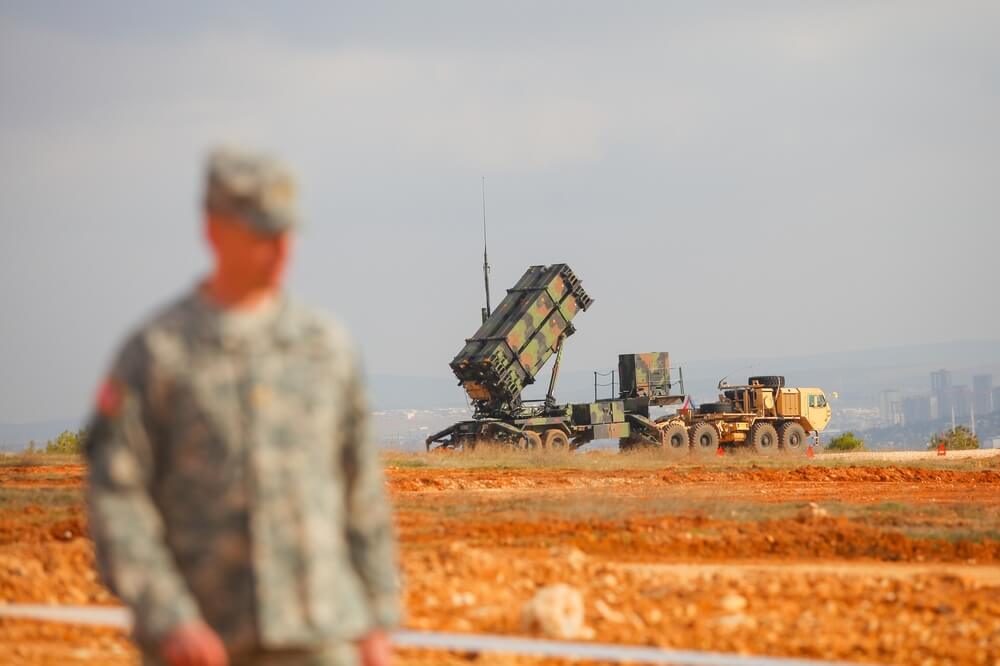 US Patriot interceptor stockpiles may have fallen to between 759 and 827 units
Using a conservative ratio of two interceptors per ballistic missile, this represents the use of at least 784 interceptors – well above the 563 anti-missile systems that, according to the Stockholm Peace Research Institute, it had acquired for its Patriot batteries before 2021.
A resumption of sustained strikes would likely result in a higher proportion of Iranian ballistic missiles reaching their targets as interceptor stocks decline.
At the same time, the ongoing attrition of the MQ-9 Reaper fleet is degrading the ability to locate and destroy launchers and air defence systems.
These converging trends are enabling the IRGC and Artesh to increase the lethality of their already potent combined-arms salvos.
Adrien Fontanellaz is a military historian and analyst specialising in contemporary warfare. He is a member of the scientific committee of the Centre d’Histoire et de Prospective Militaires (Pully, Switzerland).
