What is the most reliable development path for an increasingly fragmented global economy?
China and India, the world’s two most populous countries, each represent a different answer. But can other countries emulate them?
With its traditional manufacturing-first development model, China has sought to keep manufacturing’s share of GDP at nearly twice the advanced-economy benchmark, whereas India has leapfrogged into a services-led growth model, eschewing a manufacturing base.
Yet a side-by-side comparison based on a decade of data from the OECD’s Trade in Value-Added database is sobering.
Neither approach, it seems, is a plug-and-play solution. Each contains structural weaknesses that contemporary developing countries must anticipate.
Opposite extremes
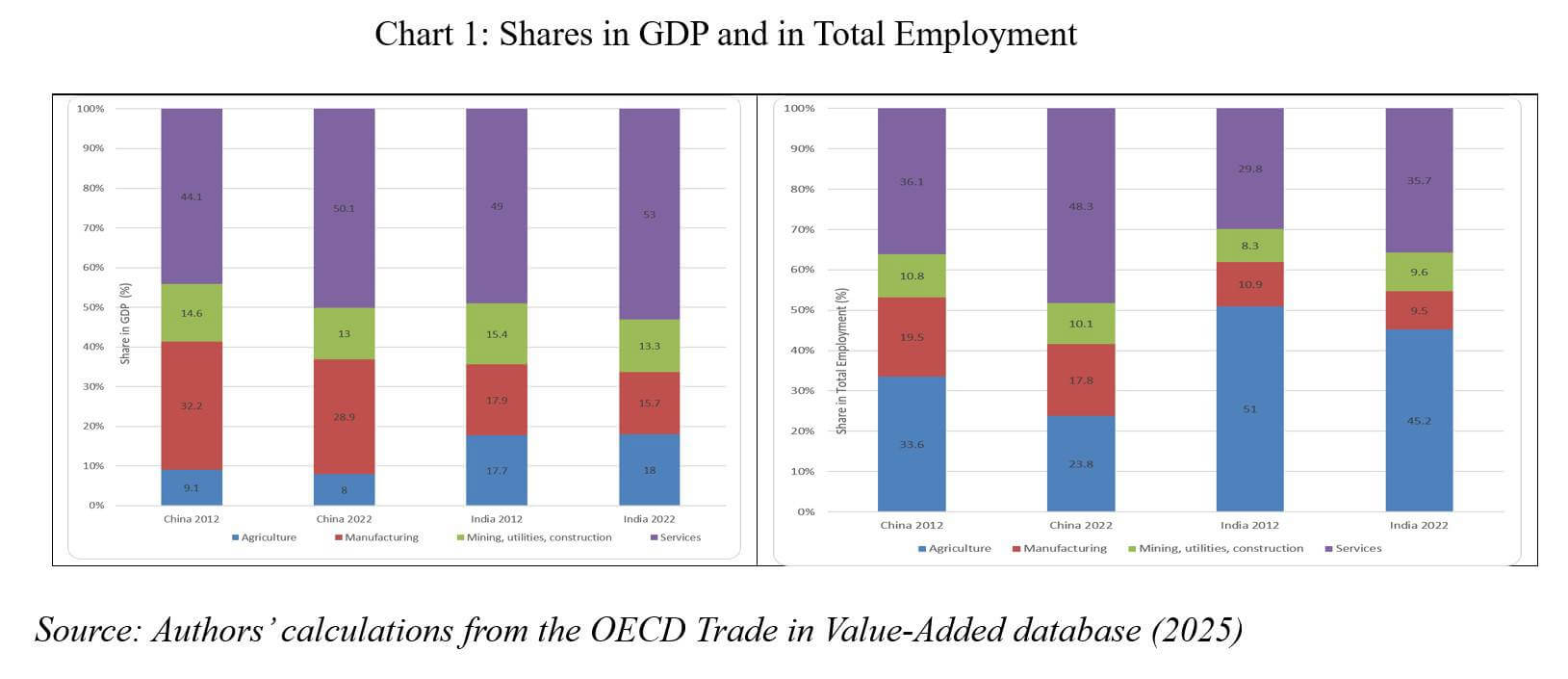
China and India entered the 2012–22 decade at opposite extremes. China was the world’s dominant exporter of manufactured goods, with manufacturing accounting for roughly 32% of its GDP—more than twice that of advanced European economies.
Services, meanwhile, accounted for 44% of GDP, an unusually small share given China’s income level (Chart 1).
In India, by contrast, services already generated about half of GDP, owing to the country’s internationally competitive information-technology and software exports.
Manufacturing, at 18% of GDP, was small and shrinking, and half of India’s workforce remained in low-productivity agriculture.
Public infrastructure remained underfunded, and reforms were highly contested.
Both governments pursued deliberate development strategies during this decade.
The “Made in China 2025” program, launched in 2015, poured hundreds of billions of dollars into ten strategic industries to sustain China’s high share of manufacturing output and upgrade the economy’s technological capabilities.
India tried something more difficult: reviving manufacturing through the 2014 Make in India campaign and, from 2020, providing $26 billion in production-linked incentive payments across 14 sectors.
A decade on, the results complicate both official narratives. China did stabilize manufacturing’s share of output at around 29% of GDP, but automation severed the old link between industrial output and employment.
As displaced factory workers moved overwhelmingly into services, that sector grew to half of GDP and roughly 48% of employment (Chart 1).
Yet most of the new jobs were in low-productivity retail, hospitality, and personal services rather than in knowledge-intensive activities.
Meanwhile, the value added per worker quintupled in water transport and roughly tripled in telecommunications, not because of broad-based hiring, but owing to capital-intensive consolidation and automation.
As China approaches high-income status, its labor force is increasingly concentrated in one area while its productivity growth is concentrated in another.
India’s knowledge sector
India’s story inverts the problem. Its flagship knowledge-services sector has grown impressively, with value added per worker in computer programming and information services roughly tripling as the industry’s integration into global value chains rose fivefold.
But India’s knowledge industries increasingly look like a siloed enclave, given their weak links to the rest of the domestic economy.
With returns increasingly flowing to capital rather than workers, labor’s share of total value added collapsed from about 26% in 2012 to roughly 11% in 2022.
India’s knowledge sector is too small to play the role that manufacturing once did for earlier industrializers
Moreover, India’s knowledge sector is too small to play the role that manufacturing once did for earlier industrializers.
Despite Make in India incentives, manufacturing’s GDP share slipped to about 16% by 2022, and close to half of Indian workers remained in agriculture (Chart 1).
Outside of IT, India’s services present a stark trade-off: Subsectors that can absorb large numbers of workers hold little potential for productivity gains, and subsectors with the most productivity potential are too small to absorb workers at scale.
Neither route is available to developing countries
The deeper lesson is that neither route is available to today’s developing countries.
China’s manufacturing-led ascent depended on shifting hundreds of millions of workers from farms into labor-intensive export-oriented factories; but robotics and AI are steadily eroding this mechanism.
And India’s services-led ascent depended on a largely unrepeatable convergence of English-language education, diaspora networks, and early-mover advantages in software.
Instead of a blueprint, the Chinese and Indian trajectories offer only warning signs.
Governments tempted to take the manufacturing road to development should beware.
Given that output and employment can decouple entirely, an industrial policy judged only by output share can overstate job creation.
And displaced workers tend to land in low-productivity employment (as in China’s “local-services trap”), rather than in knowledge work, unless policies are in place to build skills and overcome geographical constraints.
Moreover, sustaining an elevated manufacturing share typically requires state-directed capital allocation, which in turn generates serious misallocation and waste—a major risk for countries lacking China’s fiscal firepower.
Finally, since manufacturing competitiveness ultimately hinges on enabling services—logistics, finance, telecommunications—building factories without upgrading other capabilities can trap an economy in low-value assembly work.
 India’s services-led ascent depended on a largely unrepeatable convergence of English-language education, diaspora networks, and early-mover advantages in software
Governments tempted by the services-led route face different but equally demanding constraints.
First, relying on sectors that can absorb workers at scale—local retail, hospitality, and personal services—implies the risk of a low-productivity trap.
Moreover, since a “successful” services sector can channel productivity gains primarily to shareholders (through economies of scale, automation, and increasing returns to capital), labor’s income share can become uncoupled from productivity.
Without deliberate policies to build linkages, high-productivity sectors can become enclaves that generate impressive exports but weak spillovers to the rest of the economy—as India’s IT boom increasingly demonstrates.
Because productivity varies relatively little across manufacturing subsectors but widely across services, labor reallocation raises aggregate productivity only if workers move into the right segments; and the right ones are usually those with the least absorptive capacity.
A common lesson of the Chinese and Indian experiences is that regardless of endowments, neither manufacturing-led nor services-led development succeeds without policies to address market coordination failures.
Skills, infrastructure, institutions, and sectoral support all must be aligned.
These components reinforce one another, and will create imbalances when only some are in place.
China’s failing is the local-services trap; India’s is siloed high-value services. Both are avoidable, but only if governments anticipate them and plan accordingly.
Hinh T. Dinh, a former lead economist in the Office of the Senior Vice President and chief economist of the World Bank, is a senior fellow at the Policy Center for the New South.
Karim El Aynaoui, Executive President of the Policy Center for the New South, is Executive Vice-President of Mohammed VI Polytechnic University and Dean of its Humanities, Economics, and Social Sciences Cluster.
