The European Union’s fury at Serbia honouring convicted war criminal Ratko Mladić at his funeral in Belgrade exposes a dangerous European policy weakness at a crucial time for the future of the Western Balkans.
High-stakes elections are scheduled for October both in Serbia and in Bosnia-Herzegovina. These could determine the direction for years to come in a region in which global and regional players are jostling hard for position.
Strategically located at the heart of the EU’s eastern flank, the neighbourhood is a locus of competition between all major powers, with particularly the EU, Russia and the US vying for influence, with China lurking in the background.
Regional powers, such as Turkey, as well as Saudi Arabia and the Gulf states farther afield, are also eyeing the situation and exert a particular pull in deeply divided Bosnia.
The competition centres on highly strategic and volatile issues, including energy supplies and pipelines, strategic mineral reserves, migration and geostrategic alliances, especially in terms of Serbian proximity to Russia.
The EU has most at stake, as the region is surrounded by its member states. It has direct input, along with the US, in the governance of Bosnia, through the mechanism that ended that country’s war in the 1990s.
In Serbia, as in the other countries of the Western Balkans, it has relied mainly on the lever of eventual EU membership and the need for convergence with the bloc’s standards.
Now both these avenues of influence are in disarray due to a combination of a rift in the transatlantic alliance, which used to work in concert, as well as European and local circumstances that make enlargement ever more fraught.
The EU’s impotence in Serbia
The EU’s impotence in the face of Serbia’s nationalist establishment honouring Mladić, who was convicted by the International Criminal Tribunal for the former Yugoslavia in The Hague for crimes against humanity and genocide in Bosnia-Herzegovina, is telling in several ways.
An EU statement warned that the official tributes to Mladić “contradict the most fundamental European values and have no place in the EU or in EU candidate countries.”
Yet, analysts in the Balkans point out that the bloc’s outrage came after years of nationalist propaganda and educational narratives in Serbia, including ones that promoted Mladić’s status as a national hero, with only limited EU action.
The EU’s outrage obscures that the bloc has been well aware of the de facto ultra-nationalist direction of the country’s main parties and the democratic backsliding that has occurred during the last 14 years under the governing SNS-SPS coalition, mostly led by Aleksandar Vučić.
Vučić is now seeking to ‘do a Putin’ and swap his position as president in the early elections scheduled for 25 October
Vučić is now seeking to ‘do a Putin’ and swap his position as president, for which he’s nearing his term limit, back to the one he previously held as prime minister, in the early elections scheduled for 25 October.
He has faced an unprecedented challenge for the past two years with sustained protests by students and activists over the deaths of 16 people when the canopy collapsed of the Novi Sad railway station, which to many came to symbolise state corruption.
While the EU has periodically called on the Serbian government to respect the human rights of the protesters, the bloc only recently attached some concrete measures to those warnings.
This has led to allegations of EU hypocrisy, as the bloc also seeks to secure access to crucial lithium deposits in Serbia and also seeks to mitigate the country’s relatively pro-Russian position.
The EU leverage trap
Public support for EU accession is reported to be under 40%, possibly still partly informed by lingering resentment over the NATO bombing of the country in 1999, during the conflict in Kosovo.
Vučić has balanced his increasingly autocratic tendencies with playing several realpolitik cards towards the EU, such as the lithium deposits, and also allowing crucial munitions exports to Ukraine, with which Serbia also maintains relations.
The EU has been caught in a trap by seeking to pursue its various interests while relying deeply on Serbia’s path to accession.
The country’s democratic backsliding, pro-Russian business deals – such as seeking a long-term gas supply agreement with Moscow – and disruptive influence in Bosnia signal that progress towards accession is questionable at least.
Eight EU countries earlier this year blocked an attempt to fast-track the accession negotiations
In response, eight EU countries earlier this year blocked an attempt to fast-track the accession negotiations, precisely over shortcomings on corruption, sanctions against Russia, and media freedom.
This comes at a time when the appetite for enlargement in the bloc itself is also under pressure and could suffer a further blow if ultra-nationalist forces come to power in a major EU country over the next couple of years.
The trap consists of EU leverage gradually eroding as speedy accession becomes ever more remote.
At cross-purposes over the Western Balkans
Added to this is growing disagreement between the EU and the US over how to approach the Western Balkans.
Under the Trump administration, the US, and particularly the circle around Donald Trump, has been more open to doing business in Serbia and Bosnia at the expense of coordinating an approach with the EU.
In Bosnia, the EU and the US retain heavy joint influence through the Office of the High Representative, which oversees implementation of the Dayton Accords that ended the country’s war in the 1990s.
As the Europeans and Americans are increasingly at cross-purposes, there has been no agreement on the appointment of a new High Representative, while the previous one has been effectively forced out as a result of this power struggle.
Two main factors appear to be driving the disagreement: The first is EU opposition to an American company, AAFS, with links to Trump’s circle having been awarded a Bosnian energy project worth several billion dollars in what it says is an uncompetitive and non-transparent process.
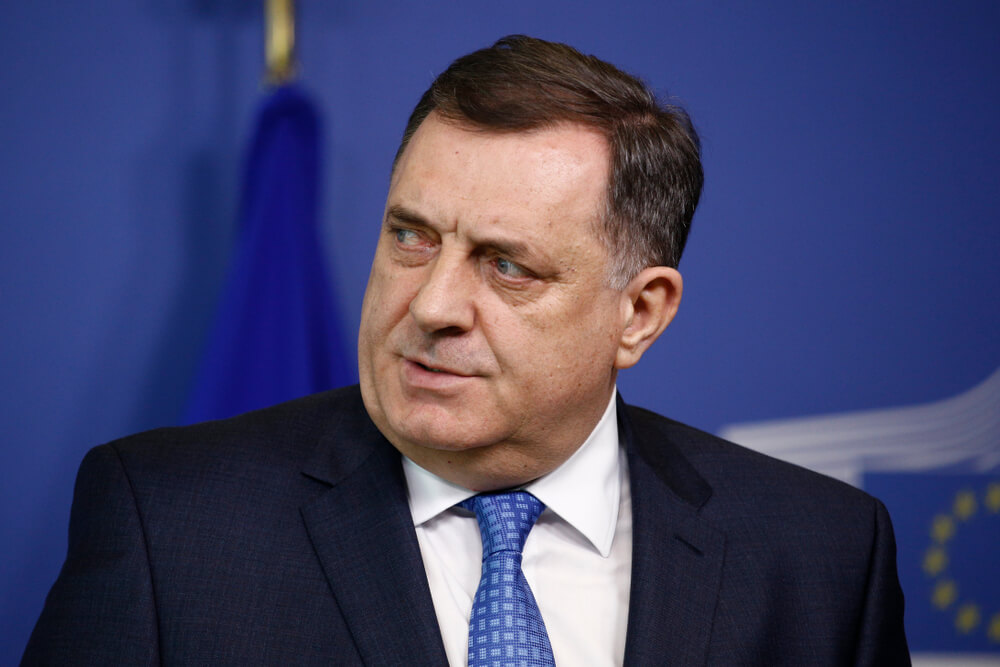 While the EU and most countries maintain sanctions on Milorad Dodik, the US lifted them last year
And the possible partly related American shift in position towards Milorad Dodik, the dominant Serbian-nationalist and separatist politician in the Republika Srpska, who was removed from that entity’s presidency by the court in Bosnia last year for defying decisions by the then High Representative.
While the EU and most countries maintain sanctions on Dodik, the US lifted them last year, ostensibly because he complied with the court order, but this also coincided with the controversial gas pipeline contract being announced.
Now, elections in Bosnia on 4 October could change the situation yet again. Support for both the AAFS pipeline and a pardon procedure for Dodik could depend on the outcome.
The Bosnian pipeline issue is particularly frustrating to the EU because it shares the American goal of making the region less reliant on Russian supplies. It just objects to Bosnia’s own national company being bypassed without proper procedure.
The EU has some leverage, as it provides hefty aid sums to Bosnia and also gives it access to its energy market.
Struggling to adapt in the Balkans
In Serbia, energy is also playing an important role in the regional balance. With the defeat of Viktor Orbán in Hungary earlier this year, Vučić and Moscow lost an important ally and potential conduit for Russian gas.
Still, the loss of Orbán, while strengthening the EU position in the region in several ways, is unlikely to shift either Serbia or the Republika Srpska from their nationalist, pro-Russian and increasingly autocratic course without effective action from the EU.
A failure to resolve outstanding issues more quickly is now undermining both its position and regional stability
In the Balkans, the bloc is encountering the same issues that have bedevilled it both domestically and internationally for more than a decade: it appears to be struggling to adapt to a rapidly changing world.
While the EU’s methods worked to stabilise the situation in the immediate aftermath of the Balkan wars of the 1990s, a failure to resolve outstanding issues more quickly is now undermining both its position and regional stability.
