Major wars usher in new international orders. The Thirty Years’ War brought the Peace of Westphalia. The Napoleonic Wars gave rise to the Concert of Europe.
World War II spurred the creation of the Bretton Woods system, decolonization, and European integration. Even the Cold War gave way to a liberal world order, with the United States as its hegemon.
But not all wars lead to better international orders. The Iran war is likely to prove particularly damaging in this respect.
The war is likely to make matters considerably worse than they were when the US and Israel launched it.
Far from being replaced by a more Western-friendly entity, the Iranian regime has hardened into a military dictatorship.
Whatever concessions this regime ends up making on its nuclear program, its ties with China, Russia, and North Korea will remain intact, and Iran will remain a destabilizing force in the Middle East.
The difference is that Iran’s neighbors in the Gulf have now lost faith in their American protector and are weaker and more divided than they were before the war.
To be sure, the Gulf’s position was always somewhat tenuous. There were deep rifts between the United Arab Emirates and Saudi Arabia, and between Qatar and all the other sheikhdoms.
The Gulf Cooperation Council (GCC) never lived up to its potential as a political and economic union, let alone a military alliance.
And the Gulf’s carefully cultivated image as a haven of stability and a lucrative commercial hub had its blemishes.
The GCC’s dysfunction
But the Iran war has shattered that image, constraining their sovereigns’ lavish investment projects and undermining—perhaps fatally—their efforts to diversify their economies away from oil.
Moreover, the war has exposed the GCC’s dysfunction and deepened cleavages among its members.
Saudi Arabia sought to prevent this war through diplomacy, prohibited the US from using its bases and airspace to escort oil tankers through the Strait of Hormuz, and continues to work with Pakistan behind the scenes to mediate an end to the conflict.
The result is an emerging Saudi-Pakistani alignment and a continued Saudi policy of appeasement toward Iran.
The UAE has sharply criticized its neighbors for their failure to mount a decisive response to Iran’s attacks on their territory
Qatar (with its ties to Turkey) and Oman are also likely to continue appeasing Iran.
The UAE, by contrast, has sharply criticized its neighbors for their failure to mount a decisive response to Iran’s attacks on their territory, and it has withdrawn from OPEC.
The country is now increasingly aligned with Israel, as well as Bahrain and India.
Trump’s antagonistic stance toward Europe
Similar fragmentation can be seen in the West, as the war deepens the rift in the transatlantic alliance.
Contrary to the prevailing narrative of recent decades, the transatlantic alliance was never a foregone conclusion.
The US has a long history of isolationism and protectionism, exemplified by President Woodrow Wilson’s withdrawal in 1919 from the League of Nations and refusal to provide any commitment to Europe’s security—a stance that opened the way for Adolf Hitler’s rise and another war.
More recently, President Barack Obama sacrificed the planned deployment of ballistic missile defenses in Eastern Europe on the altar of his diplomatic “reset” with Russia.
His defense secretary, Robert M. Gates, later criticized America’s European allies for their “apparent unwilling[ness] to devote the necessary resources” to act as “serious and capable partners in their own defense.”
After Russia’s 2014 invasion of Ukraine and illegal annexation of Crimea, Obama chose not to rally America’s NATO allies to deter the Kremlin.
European neo-Gaullism, like the original, will sooner or later embrace the logic of nuclear deterrence
But Donald Trump has taken this to the next level, adopting an overtly antagonistic stance toward Europe, which has included threats to annex Greenland and withdraw the US from NATO.
Europe has responded by embracing a new form of Gaullism, characterized by heavy investment in strengthening its defense capabilities and achieving strategic autonomy.
But Europe’s security transformation is just beginning. The continent—which does not control its own digital infrastructure—will have to close the innovation gap with the US and achieve some level of technological autonomy.
And European neo-Gaullism, like the original, will sooner or later embrace the logic of nuclear deterrence.
The Iran war has injected new urgency into this process. Despite having launched the war without consulting America’s NATO allies, Trump demanded that Europe join the US in the fight—in particular, to help reopen the Strait of Hormuz.
When Europe refused, the US announced that it would withdraw 5,000 troops from Germany and threatened further action against Italy and Spain.
At this point, no reasonable European considers US security guarantees to be reliable.
China has positioned itself as a force for stability
But it is not only Europe that has lost faith in the US. The Global South, which Trump had already alienated with his tariffs and suspension of development aid, is bearing the brunt of his war of choice in Iran.
America’s inability to compel its own allies to help reopen the Strait of Hormuz, together with the spectacle of developing countries scrambling for energy and fertilizer supplies, feeds a narrative of US overreach and decline.
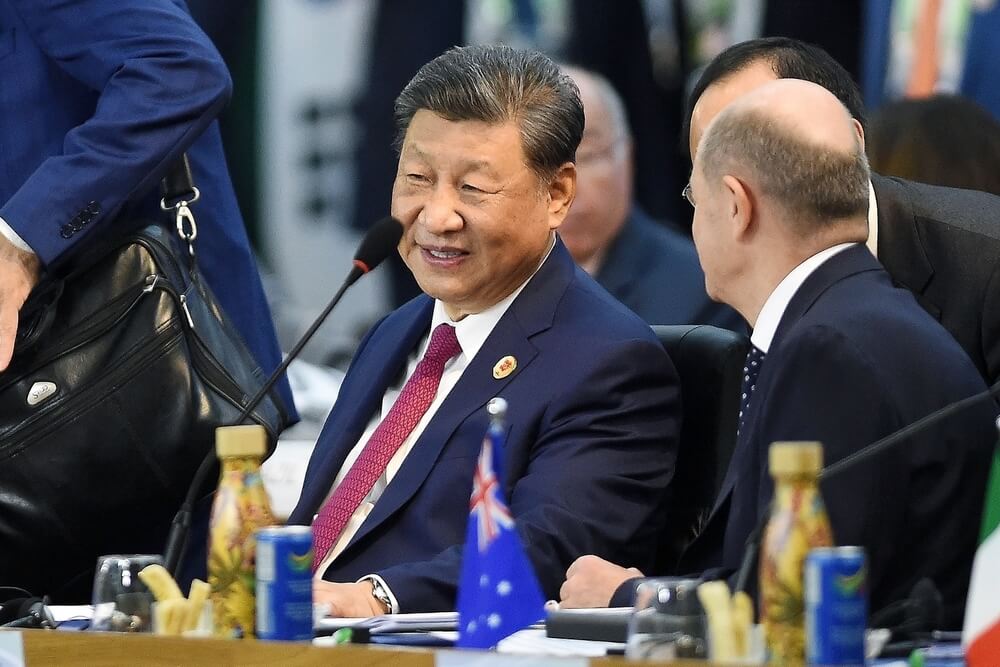 Amid the US-induced chaos, China has shrewdly positioned itself as a force for stability - Xi Jinping
Meanwhile, amid the US-induced chaos, China has shrewdly positioned itself as a force for stability. It has thus raised its global profile at a very low cost.
Many European leaders have visited Beijing in search of a reliable trade partner, but China has made no concessions on Ukraine, human rights, or overproduction and dumping.
At this week’s summit with Chinese President Xi Jinping, Trump has an opportunity to negotiate a deal that would ease trade tensions and open the way for cooperation on critical issues, not least the wars in Ukraine and Iran.
An agreement to mitigate the risks posed by AI would be no less consequential than the US-Soviet Strategic Arms Limitations Treaties were during the Cold War. But if Xi maintains his zero-sum diplomacy, as seems likely, the world will be the loser.
Shlomo Ben-Ami is a former Israeli foreign minister.
