In a post-war Iran scenario, the future of the GCC will become one of the defining strategic questions in the Middle East.
The war exposed vulnerabilities that had previously been ignored, underestimated, or concealed by wealth, technology, and foreign alliances.
It demonstrated that the smaller Gulf states remain structurally exposed to disruptions in trade, food imports, shipping, and energy flows.
It also demonstrated that, in the event of a major regional crisis, the only state with the demographic scale, territorial depth, military mass and logistical capacity to hold the wider Gulf system together is Saudi Arabia.
That reality will increasingly shape the debate over whether the GCC remains a loose grouping of highly successful but strategically fragmented states or evolves into something deeper under Saudi leadership.
There has long been a theoretical dream in the Arab Gulf of turning the GCC into something resembling the European Union: a bloc with common institutions, deeper economic integration, unified borders, and perhaps even a unified military command.
That idea resurfaces after almost every crisis. It resurfaced after the Arab uprisings, after the Qatar dispute, and now, following the recent war with Iran and the effective closure of the Strait of Hormuz, it has returned with even greater urgency.
The GCC will never become the EU
But the GCC will never become the EU.
Not because the Gulf lacks wealth, sophistication or ambition. It has all three in abundance. The structural reason is much simpler. The GCC has a Germany, but it does not have a France.
In Europe, Germany is the dominant economic power. But Germany does not tower over Europe in the same way that Saudi Arabia towers over the Gulf. Germany is balanced by France, which remains continental Europe’s principal military power, the EU's only nuclear power, and a permanent member of the UN Security Council.
It is also Europe's oldest nation state with sufficient demographic, political and military weight to anchor the western half of the continent. Italy provides further demographic, industrial and economic scale.
Nothing remotely similar exists in the GCC.
Today, Saudi Arabia’s economy stands at roughly $1.3 trillion. The second-largest economy in the grouping, the UAE, is slightly above $600 billion.
The smaller GCC states are among the most successful countries in the world
Qatar is around $220 billion. Kuwait is roughly $160 billion. Oman is near $105 billion. Bahrain is below $50 billion. Saudi Arabia alone accounts for nearly 55% of total GCC GDP.
Meanwhile, the smaller GCC states are among the most successful countries in the world.
Qatar remains one of the wealthiest states globally on a GDP-per-capita basis. The UAE has built one of the most diversified, cosmopolitan and globally integrated economies worldwide.
Kuwait retains enormous sovereign wealth reserves and one of the strongest fiscal cushions anywhere in the international system. Bahrain has become a financial and services hub. Oman continues to play an important diplomatic role.
There is nothing unsuccessful about these states. On the contrary, they are remarkable success stories.
But wealth is not the same as raw power and scale.
Expatriates come and go
Saudi Arabia’s total population is about 37 million. The combined total population of the UAE, Qatar, Bahrain, Kuwait and Oman is approximately 27 million.
Saudi Arabia alone therefore has a larger population than the other five GCC states combined.
The imbalance becomes even more pronounced when the native population is considered, because in the GCC the headline figures are often misleading.
Expatriates can help build economies, but they do not constitute the permanent demographic core of a state. They come and go.
Saudi Arabia’s population alone is substantially larger than the combined populations of the other five GCC states
They do not form the reserve manpower base for the armed forces, police, bureaucracy, intelligence services, or political system.
Saudi Arabia has about 20 million citizens. By contrast, the UAE has around 1.2 million, Qatar around 330,000, Bahrain around 800,000, Kuwait around 1.5 million, and Oman around 3 million.
Saudi Arabia’s native population alone is therefore substantially larger than the combined citizen native populations of the other five GCC states.
That reality matters enormously in a region where states are once again being forced to think in terms of survivability, endurance, and strategic depth.
The current war with Iran has demonstrated this reality brutally.
The smaller Gulf states became exposed
Once Iran effectively closed the Strait of Hormuz through mining, missile threats, drones and maritime coercion, the smaller Gulf states immediately became exposed.
Kuwait, Bahrain, Qatar and, to a lesser extent, the UAE were suddenly confronted with the reality that they are geographically trapped between Iran, Saudi Arabia, and, to a lesser extent, Iraq.
Without the Saudi land border and the land bridge established in the opening phase of the war, these states would have struggled to maintain the flow of food, medicine, industrial commodities and basic consumer goods.
Saudi Arabia’s geography, scale and territorial depth became the region’s insurance policy.
The smaller states succeed because there is a balance between the major states
This is why the comparison with Europe is fundamentally flawed.
Small European states such as Switzerland, Luxembourg, Belgium, or Liechtenstein thrive because they exist within a continent where the major powers reached a historic settlement after World War II in 1945.
Germany is Europe’s economic giant. France is continental Europe’s military power. NATO underwrites the broader security structure. The smaller states succeed because there is a balance between the major states.
The Gulf has never achieved that balance.
Iran will remain the Gulf’s permanent geopolitical problem
Iran will remain the Gulf’s permanent geopolitical problem for decades to come.
Even if a ceasefire holds, Tehran is unlikely to forget that certain Gulf monarchies hosted American combat aircraft, command and control nodes, intelligence facilities, and logistics hubs during the war. That memory will shape Iranian policy for years, perhaps decades.
The smaller Gulf states therefore face a structural reality. They live beside a large, hostile, and potentially revanchist Iran with more than 90 million people.
The United States will remain engaged, but the era of unlimited American guarantees is over
They also live beside Iraq, whose long-term orientation remains uncertain. And they exist in a world where the American role is clearly being redefined through the scaling down of the war with Iran.
The assumption that Washington will indefinitely return, at enormous cost, every time the GCC faces a crisis is becoming less credible.
The United States will remain engaged, but the era of unlimited American guarantees is over.
This is precisely why the idea of a Saudi-centric Gulf Union will become more important, not less.
Saudi Arabia is not simply a Gulf country
Saudi Arabia is not merely the GCC’s largest economy. It is the region’s only true continental-scale state.
It has the largest total population, the largest native population, the largest territory, by far the largest military, the deepest missile-defence architecture, and by far the greatest strategic depth.
It is also the world’s energy superpower: by far the Gulf’s largest oil producer, the world’s largest oil exporter, and the only state in the region with the territorial scale, infrastructure, and redundancy to maintain exports during a major crisis.
The same imbalance exists militarily. Saudi defence spending routinely exceeds that of the other GCC states combined.
The Royal Saudi Air Force is by far the largest and most powerful. Saudi Arabia’s missile-defence architecture is the deepest.
The future of Saudi Arabia defence strategy cannot be understood only through the Gulf
And the Saudi National Guard (not the Royal Saudi Land Forces), by itself, is larger than the combined standing land armies of the other five GCC states put together.
Saudi Arabia also represents more than 70 per cent of the landmass of the Arabian Peninsula.
That fact matters because Saudi Arabia is not simply a Gulf country. It is equally a Red Sea, Levantine, and increasingly a Horn of Africa state with vital national security interests.
The future of Saudi Arabia defence strategy cannot be understood only through the Gulf.
It is inseparable from the future of the Red Sea, Jordan, Syria, Lebanon, Palestine, Yemen, and Sudan.
The future regional architecture
The major flashpoints of the coming decade will not be confined to the Gulf littoral. They will span across the Red Sea basin, the Horn of Africa, the Levant, and southern Iraq.
That means the future regional architecture may ultimately extend beyond the GCC itself.
The question is no longer simply whether the smaller Gulf states are willing to integrate more deeply with Saudi Arabia. It is whether Saudi Arabia itself increasingly sees its future within a broader Arabian and Red Sea framework that includes Jordan, Syria, and Yemen.
That cannot be imposed on the smaller Gulf states. They will have to decide for themselves whether deeper integration under Saudi leadership serves their interests.
That is where the real structural problem lies.
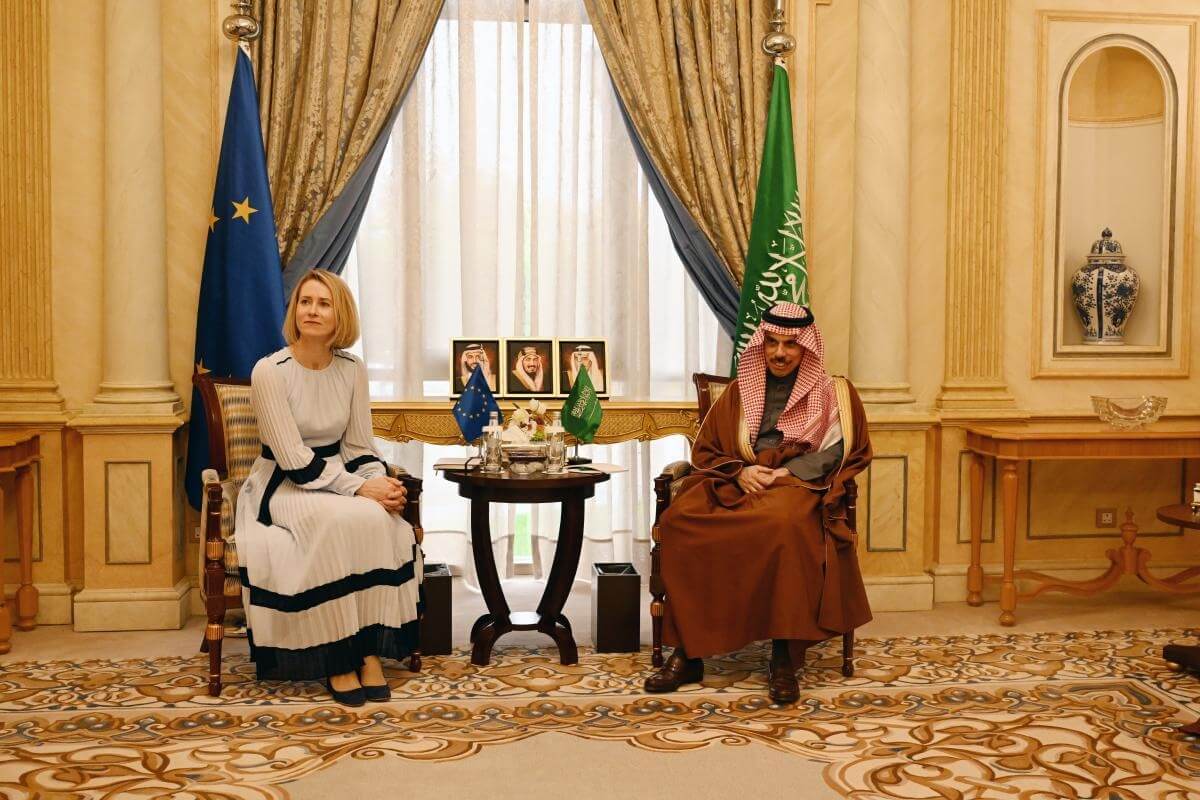 The logic of a larger Gulf union would not be to eliminate the smaller monarchies, but to guarantee them: to preserve their borders, their systems, and their prosperity - Kaja Kallas, Faisal bin Farhan Al Saud
Certain smaller Gulf states continue to behave as though wealth, activism, foreign partnerships and carefully cultivated international profiles can compensate for the absence of demographic depth, military scale, territorial resilience, and strategic endurance. They cannot.
When the crisis came, none of the smaller Gulf states could secure itself alone. None could maintain its own supply chains alone.
None could guarantee the uninterrupted flow of food, medicine, fuel and basic goods alone. And none could independently deter or withstand a major regional power such as Iran alone.
That does not diminish their success. Qatar, the UAE, Kuwait and Bahrain remain among the wealthiest, most innovative and most globally connected states in the world. In many ways, they resemble the smaller success stories of Europe: Switzerland, Luxembourg, Belgium or Liechtenstein.
But those European states exist and prosper because they are part of a security and political architecture built on an understanding between Europe’s larger powers.
Germany and France became allies. Germany does not seek continental domination. France balances Germany militarily. Together, they created the conditions in which the smaller European states could thrive.
Saudi Arabia does not seek imperial domination over the Gulf. It has no interest in annexing neighbouring states or erasing their sovereignty.
The logic of a larger Gulf union would not be to eliminate the smaller monarchies, but to guarantee them: to preserve their borders, their systems, and their prosperity within a wider structure capable of surviving the kind of shocks the region is now entering.
But petty politics, historical grievances, rivalries, status competition, and unrealistic claims to regional leadership have repeatedly prevented that logic from advancing.
If these illusions of grandeur persist, the project of a deeper Gulf union will remain stalled. And that failure will ultimately be to the detriment of all the smaller Gulf states themselves.
Because the reality is that the Gulf does not have several major powers balancing one another, as Europe does. It has only one.
Dr Nawaf Obaid is a Senior Research Fellow at the Department of War Studies, King’s College London.
