Donald Trump’s critics have long accused him of harboring a peculiar affinity for Russia and its murderous leader, Vladimir Putin.
They cite the still-unexplained contacts between his 2016 campaign and Russian operatives, as well as his deferential meetings with Putin during both his first and second terms.
However, inside his administrations, Trump assembled a baffling mix of advisers and policies that lurched between confronting and accommodating the Kremlin.
Now, recent events surrounding negotiations to end the war in Ukraine, together with the administration’s newly released National Security Strategy, make a stark conclusion hard to avoid: Trump is behaving in ways that consistently benefit Moscow. If any doubt remained, it is time to put it to rest. The real question is why.
I do not subscribe to the notion that Donald Trump is a witting agent of the Russian state.
However, it is not much of a stretch to conclude that Moscow has played a key role in shaping Trump’s skewed outlook.
Indeed, the mind meld between businessman-turned-president Donald Trump and Russian propagandists may be the most successful covert influence effort since the Churchill government’s secret campaign to draw Franklin Roosevelt into World War II.
Trump has fallen prey to a years-long Russian influence campaign that exploits his worldview, shady business instincts, and personal grievances.
Trump has walked into every trap
Based on a decade of comments and decisions, he appears to have internalized Russian propaganda and talking points almost wholesale. For those who have followed Moscow’s strategy, it is as if Trump has walked into every trap.
Since the Kremlin’s 2016 interference in U.S. elections, Americans have become more familiar with Russian concepts of hybrid and cognitive warfare.
For a second-rate power that cannot directly defeat its prime adversaries, covert and political warfare is waged as a means to defeat an opponent by turning them against themselves.
Moscow targets an opponent’s reasoning, decisions, and will to act rather than challenging its military forces head-on
Analysts such as Nataliya Bugayova at the Institute for the Study of War have described Moscow’s use of cognitive warfare.
That is, Moscow targets an opponent’s reasoning, decisions, and will to act rather than challenging its military forces head-on.
By manufacturing false realities and alternative narratives that exploit an adversary’s preconceived notions, Russia seeks to shape that adversary’s choices while concealing its own weaknesses and discrediting its opponents through disinformation.
Reflexive control
In Russian military and intelligence parlance, this approach is called “reflexive control.”
Reflexive control means inducing an opponent to voluntarily do what you want by subtly shaping how they perceive reality.
Instead of forcing an adversary’s hand, you feed them carefully chosen information, signals, and stories - true, half-true, or outright false - so that when they make decisions, they sincerely believe they are acting in their own best interest.
In fact, they are following a path laid out for them by someone else. Donald Trump has become an almost ideal target for this kind of Russian operation.
These practices sit within a broader tradition of “active measures” and hybrid warfare that long predates Vladimir Putin.
As retired KGB General Oleg Kalugin put it, these measures have long been the “heart and soul” of Russian intelligence
Tsarist and Soviet services spread forged documents and conspiracy theories - from claims that the United States created AIDS to rumors that Washington orchestrated the 1979 mosque seizure in Mecca to stories blaming the U.S. for the death of foreign leaders.
They fueled anti-U.S. peace movements, promoted narratives of American racism across the developing world, and ran elaborate deception operations.
Today, this legacy continues through disinformation campaigns against NATO, efforts to manipulate European debates over nuclear weapons, cyberattacks, and covert funding of extremist and opposition groups abroad.
As retired KGB General Oleg Kalugin put it, these measures - subversion, not mere espionage - have long been the “heart and soul” of Russian intelligence.
Alignment with Moscow’s strategic objectives
This strategy surfaced most openly in Donald Trump’s 2016 presidential campaign.
It was the first time in modern U.S. history that a major-party nominee ran amid extensive, publicly documented contacts between his team and representatives of a hostile foreign power.
Even as U.S. intelligence agencies and Congressional investigators concluded that Russia was intervening on his behalf, Trump defended Vladimir Putin and cast doubt on his own intelligence community, violating the most basic expectation of an American leader: to shield the republic from foreign manipulation rather than provide political cover for it.
His campaign logged well over 100 interactions with Russian nationals and intermediaries, involving senior advisers such as Paul Manafort, Michael Flynn, and George Papadopoulos - figures who concealed their Russia-related activities and later lied about them to federal investigators.
Michael Cohen’s pursuit of the Trump Tower Moscow project during the campaign created a direct business interest in currying favor with the Kremlin
In a normal counterintelligence setting, that pattern of behavior would have been disqualifying for even a low-level security clearance.
Those contacts were not random or harmless; they dovetailed with Trump’s financial and political incentives.
Michael Cohen’s pursuit of the Trump Tower Moscow project during the campaign created a direct business interest in currying favor with the Kremlin, negotiations hidden from the American public but known in detail to Russian officials.
That undisclosed leverage (that the Russians call kompromat) sat alongside Trump’s long-standing business entanglements, his reported ties to Russian organized crime figures, and his readiness to echo Kremlin narratives on NATO, Ukraine, and Western sanctions.
Trump’s near-total refusal to criticize Putin and his attacks on U.S. intelligence and law-enforcement institutions all reflected a broader alignment with Moscow’s strategic objectives.
Russian-style information tactic
Once in office, the pattern continued. Trump sided with Putin even after his own Justice Department indicted Russian intelligence officers for hacking Democratic Party servers, dismissed reports that Russia placed bounties on U.S. soldiers, refused to meaningfully condemn Russian assassinations abroad, and repeatedly undermined NATO and America’s European alliances.
At home, he adopted a distinctly Russian-style information tactic to evade accountability: branding every investigation, indictment, or critical report as a “hoax.”
By forcing his political allies to repeat this mantra, he not only neutralized a grave counterintelligence scandal but also normalized foreign interference as just another partisan talking point - eroding public trust in U.S. institutions and mirroring the very cognitive warfare methods the Kremlin uses to corrode democracies from within.
It has become difficult to deny that Trump has been taken in by Russian lies
This pattern has accelerated during the second term. Recent U.S. efforts to end the war in Ukraine, along with the administration’s strategic plan, appear to reflect covert themes promoted by Russia.
Throughout the year, well-meaning commentators, experts, and U.S. allies have tried to find a silver lining in Trump’s attitude toward the Ukraine-Russia war and his engagement with Europe. Among the most optimistic have been European leaders themselves.
However, in light of recent U.S. “peace” proposals on Ukraine and the newly released National Strategy document, it has become difficult to deny that Trump has been taken in by Russian lies.
A blueprint for Ukrainian surrender
Specifically, the November 28-point peace plan reportedly negotiated by Donald Trump’s envoy Steve Witkoff in league with Russian counterpart Kirill Dimitriev landed in Kyiv and European capitals as a bolt from the blue.
Drafted outside normal diplomatic channels, it was circulated without consultation with Ukraine or key European allies.
Substantively, the text read less like a compromise than a list of Russian talking points: Ukraine would have to cede Crimea and all of Donetsk and Luhansk—even territory never held by Russian forces—formally renounce NATO membership, and accept strict caps on the size of its armed forces, with no parallel limits on Russia.
The plan also floated sanctions relief, extensive economic concessions, and amnesty for Russia’s war crimes, while barring Western peacekeepers from Ukrainian territory.
Analysts quickly noticed that sections of the text appeared to be lifted from or modeled on Russian documents, with linguistic quirks suggesting it may even have originated in Russian before being translated into English.
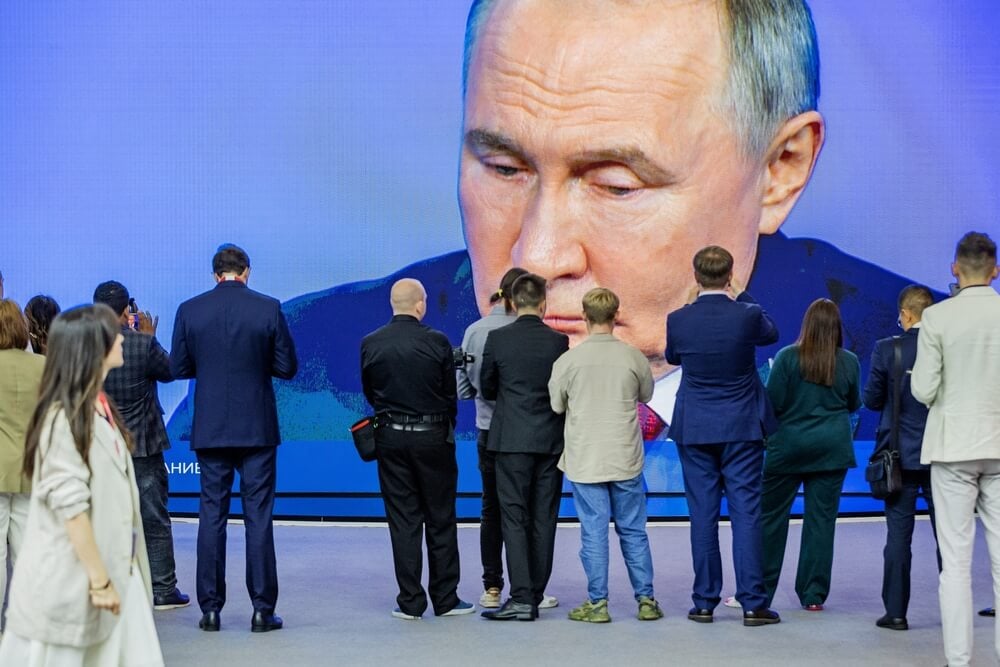 The proposal was widely read as a blueprint for Ukrainian surrender rather than a serious peace framework
Not surprisingly, the proposal was widely read as a blueprint for Ukrainian surrender rather than a serious peace framework.
Ukrainian and European leaders warned that by rewarding territorial conquest and locking in Ukraine’s military vulnerability, the plan would invite a future Russian offensive rather than prevent one.
The Economist condemned it as so vague, unbalanced, and poorly drafted that it effectively legitimated Russian aggression and undermined basic norms against changing borders by force.
In substance, the plan was functionally indistinguishable from what the Kremlin had sought to win on the battlefield but repackaged as an American initiative.
Indeed, the exercise looked less like statecraft and more like a business venture, an opportunity to unlock deals, investments, and access tied to reconstruction and frozen Russian assets, even at the cost of Ukrainian lives and the legitimization of Russia’s brutal campaign.
Echoing Putin’s narrative
Similarly, the new National Security Strategy marks a radical break with the decades-long bipartisan consensus that U.S. alliances in Europe are grounded in shared democratic values.
Instead of emphasizing defense of liberal democracy, the document recasts foreign policy as a series of transactional bargains and zero-sum deals.
It openly rejects the insight that common values cement alliances, replacing it with a blunt assertion that raw power and bullying are back in style.
Nowhere is this clearer than in its approach to Europe and Russia, where the strategy seems less concerned with deterring aggression than with reshaping the transatlantic relationship to fit Trump’s pro-Moscow instincts.
The NSS also aligns the United States with reactionary and far-right parties, echoing rhetoric that portrays immigrants as “garbage” and a fundamental threat to national survival.
In short, the Trump Administration sees the EU as a bigger threat than Russia or China.
Moscow’s warm reception of the NSS is revealing. The BBC has reported that Russia considers the new strategy “largely consistent” with its own vision, and historian Timothy Snyder has argued that the document reads like “flat out Russian propaganda.”
Rather than spotlighting Russia’s repeated aggression under Vladimir Putin, the NSS urges Washington to downplay European perceptions of Russia as a threat and warns that NATO cannot be “a perpetually expanding alliance.”
Both Moscow and Washington are contributing to the destabilization of Europe and the weakening of the EU
In effect, it echoes Putin’s narrative that Kyiv is destined to lose, that Europe is the obstacle to a “peace” on Moscow’s terms, and that the real problem is not Russian imperialism but European resistance.
This looks less like realism and more like appeasement that lays the groundwork for the next crisis.
On this trajectory, both Moscow and Washington are contributing to the destabilization of Europe and the weakening of the EU.
The strategy’s approach to Kyiv and Moscow is particularly troubling. It explicitly weakens support for Kyiv while elevating the goal of “rebuilding relations” with Russia, implying that commercial opportunities will somehow matter more to Washington than the defense of European security.
The central role of figures like Jared Kushner and developer Steven Witkoff in these talks, rather than seasoned diplomats experienced in dealing with autocrats such as Putin, reinforces the impression that the real priority is to line up postwar deals in a kleptocratic system.
As Bill Browder recently noted on X, getting money out of Russia is vastly harder than putting it in, as the wreckage of countless Western ventures has shown.
Any promises of future business cooperation with the Kremlin are almost certain to be broken, yet the NSS treats them as the basis for a strategic realignment.
The result is a policy that sacrifices long-term European security for the mirage of short-term profit.
While allies and foreign policy experts have been shocked by the crass nature of the document, Trump nonetheless has doubled down on Russian-friendly narratives in recent interviews.
A tempting mark
Both friends and foes will need to adapt to this new reality. Donald Trump has fully bought into false Russian narratives.
 The KGB may not have recruited Trump, but its officers have seen him as a target for manipulation since the 1970s - FSB (KGB) HQ
While he seems unable or unwilling to explain his fascination with Russia, it is clear that Moscow has succeeded in creating or reinforcing his views.
The KGB may not have recruited Trump, but its officers have seen him as a target for manipulation since the 1970s.
Vladimir Putin is a career KGB officer who has built his power on the security services and internalized the Chekist view of the world.
For an intelligence professional, Trump is not hard to understand or to manipulate.
To Putin, he is a tempting mark and full of weaknesses that are easily exploited.
He is narcissistic, greedy, morally loose, not especially loyal to his country, and fuzzy on the difference between right and wrong.
For a competent intelligence service, it would be malpractice not to notice his mental blind spots, obsessive need for affirmation, instinct to lie and conceal, and willingness to cut ethical and legal corners for personal gain.
Moscow appears to have used these vulnerabilities to influence Donald Trump, and, unfortunately, has done so with considerable success.
John Sipher ( @johnsipher.bsky.social ) is a non-resident senior fellow at the Atlantic Council and co-founder of Spycraft Entertainment. He worked for the CIA’s Clandestine Service for 28 years and is the recipient of the Agency’s Distinguished Career Intelligence medal. He is also a host and producer of the "Mission Implausible" podcast, exploring conspiracy theories.
