Official Washington claims that the U.S. president, more than anyone else, wants peace for Ukraine.
This is not entirely true. No one wants peace more than the Ukrainian people, who are suffering immensely from the bloodiest war on the European continent since World War II.
Ukrainians understand that achieving peace is not simply the cessation of hostilities, nor merely a set of security guarantees from the United States and its European allies.
Real peace is possible only when the aggressor returns the illegally occupied territories it declared its own after seizing them by force and staging pseudo-referendums.
When an occupying army conducts a “referendum” under the guise of an electoral commission created by the occupiers, it is not only illegitimate but also grounds for bringing all organisers to justice—not for using the results as an argument to legitimise occupation.
The saying, “A bad peace is better than a good war” is misleading. A peace that freezes the results of aggression simply creates the conditions for even larger wars in the future.
If Washington fails to recognise this—or worse, consciously pushes for decisions that contradict Ukraine’s interests—the consequences could be grave. International law explicitly prohibits the acquisition of territory by force.
Ukraine’s sovereign rights
Ukrainians are being told that they can live without the occupied territories, because otherwise the invaders will take their lives and occupy the entire country.
They are being asked to choose between living permanently disabled or dying—because they supposedly “have no trump cards.”
Leaving a founding member of the United Nations without large portions of its territory occupied by a foreign army is unacceptable.
Any peace initiative must be evaluated through the prism of international law, international tribunal precedents, and the obligations of the states that guaranteed Ukraine’s security.
Ukraine’s sovereign rights are supported by the principles of the UN Charter, international law, and the Budapest Memorandum, which—even declaratively—obliges the United States, the United Kingdom, France, and China to assist Ukraine if it is attacked.
Russia, another guarantor of Ukraine’s territorial integrity, was the one that launched the invasion.
Under the Budapest Memorandum, Russia received from Ukraine a nuclear arsenal comparable in size to its own, as well as strategic bombers and cruise missiles.
In supporting Russia’s position rather than Ukraine’s, the U.S. ultimately lost enormous strategic and financial advantages
Today, Russia uses these very bombers and missiles to strike Kyiv and other Ukrainian cities and threatens the world with the nuclear weapons Ukraine relinquished.
All nuclear missiles stationed in Ukraine were once aimed at the United States. After the Budapest Memorandum, they were dismantled.
Over the 30 years that followed, Washington saved nearly $600 billion because these weapons were no longer targeted at the U.S.
Yet this saving ultimately did not materialise as intended, because Washington insisted that the dismantled missiles be transferred to Russia—not stored in Ukraine.
Moscow subsequently returned them to combat duty, again aimed at the United States.
In supporting Russia’s position rather than Ukraine’s, the U.S. ultimately lost enormous strategic and financial advantages.
Kyiv is urged to accept a peace deal aligned with Moscow’s interests
A similar situation has emerged today. Instead of fully supporting Ukraine in resisting Russian aggression—which could spread to neighbouring countries—the new U.S. administration has completely halted financial and military assistance to Ukraine this year, ostensibly to encourage “peace.”
After this suspension, Ukraine’s defence budget effectively dropped by half because Europe alone cannot provide the necessary support.
At the same time, Washington claims that Ukraine’s army is unable to defeat Russia and may even struggle to contain it—a problem clearly exacerbated by the withdrawal of American aid.
White House Press Secretary Levitt stated that Washington is tired of providing weapons to Ukraine.
Kyiv is urged to accept a peace deal aligned with Moscow’s interests
Except for intelligence sharing, the U.S. has stopped all assistance since the start of the year.
Meanwhile, American defence companies are profiting from increased weapons sales to Europe, boosting U.S. revenues and jobs.
Vice President Vance even urged Ukraine to stop being “hostile” to Russians and instead begin trade and cultural exchanges—though the U.S. has never proposed trading or cultural cooperation with the Taliban.
If the U.S. president truly wanted peace for Ukraine, he could press Putin to implement the American-backed ceasefire initiative.
Ukraine accepted the U.S. proposal within ten minutes of negotiations; Russia has refused to do so for ten months, openly dismissing President Trump’s initiative.
Yet the U.S. president now claims that Russia’s contribution to peace would be simply a ceasefire and halting further attacks, and that Ukraine should relinquish the territories Russia has seized in return.
In other words, Kyiv is urged to accept a peace deal aligned with Moscow’s interests.
How can the war be ended?
It has now emerged that all 28 points of the so-called peace plan were drafted by Putin’s special representative Dmitriev and presidential aide Ushakov.
Special representative Witkoff simply relabelled this Russian document as an American proposal.
Many members of Congress have called Witkoff a traitor. In the 1950s or 1960s, he would likely have received a life sentence; in the 1970s or 1980s, he would have been removed from office and barred from politics.
Yet today, the White House describes this as “business as usual.”
Notably, Kyiv did not reject the 28-point Witkoff-Dmitriev plan outright, although some provisions are deeply humiliating for Ukraine.
It would be tragic if Washington simply “washed its hands” and left Ukraine alone to face an aggressive Russia
Instead, Ukraine began discussions with the American delegation, supported by European allies—especially since the U.S. had delegated Europe to “oversee” Ukraine following the suspension of American assistance.
How, then, can the war be ended? Moscow has already announced that it does not recognise the modifications made to the 28-point plan during negotiations between Ukrainian and American teams with European participation.
Secretary of State Rubio has stated that significant progress has been achieved and that there is a real chance for peace—an assessment President Trump has confirmed.
But Putin once again seeks to dictate his own terms: a “Russian-style peace” based on illegal annexations, no responsibility for war crimes, and only minimal compensation to Ukraine.
Russia’s sabotage of the updated peace plan is therefore predictable. The question now is whether the United States will impose new sanctions on Moscow.
It would be tragic if Washington simply “washed its hands” and left Ukraine alone to face an aggressive Russia.
Why is Ukraine treated differently?
Thirty years ago, the United States ended the war in the former Yugoslavia and compelled the warring parties to sign the Dayton Agreement, grounded in international law.
Bosnia and Herzegovina remained within its borders, though restructured as a federal state.
Bosnian Serbs received autonomy but were prohibited from seceding. War criminals were brought to justice, and a large international reconstruction fund was created.
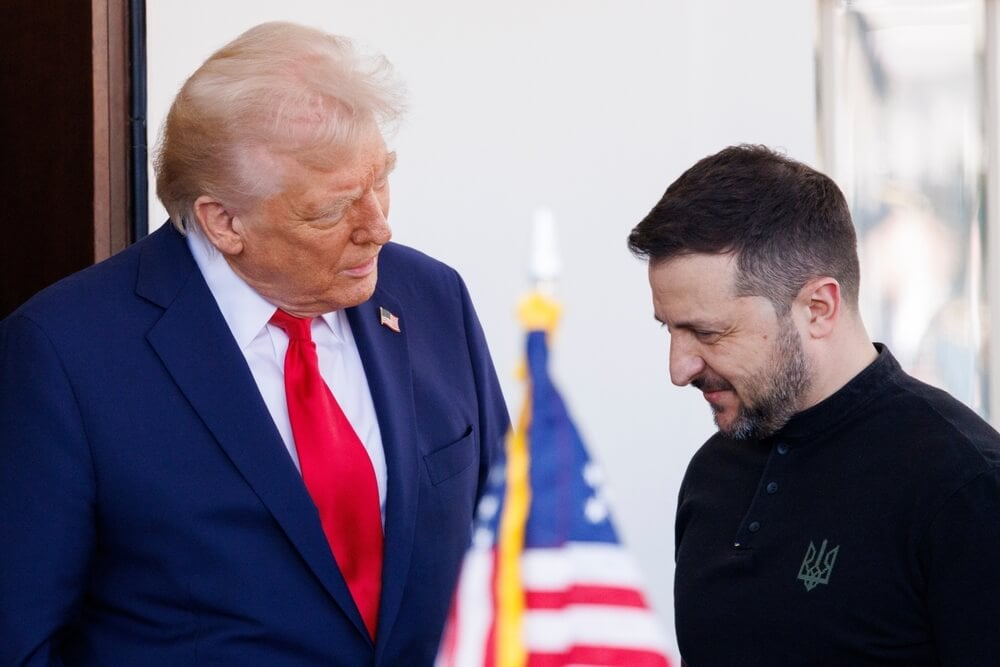 If President Trump ends the war on terms that grant major concessions to Russia, he will never receive the Nobel Peace Prize
These were very different peace terms from those now advanced by Vance and Witkoff.
Even the peace agreement in the Armenian-Azerbaijani conflict respected state borders—an approach Donald Trump himself supported. Why is Ukraine treated differently?
Ukraine relinquished a nuclear arsenal larger than those of Britain, France, and China combined—not so that Russia could dismember its territory.
The strongest security guarantee for Kyiv is the full restoration of all temporarily occupied territories.
Russia began its war by seizing Crimea in February 2014; the war will end definitively only with Crimea’s liberation.
Concessions to Russia’s territorial seizures will not bring stable peace—they will only postpone the next, even bloodier wars, endangering Ukraine, Europe, and parts of Asia.
If President Trump ends the war on terms that grant major concessions to Russia, he will never receive the Nobel Peace Prize.
He will instead be remembered, just as British Prime Minister Chamberlain and French Prime Minister Daladier are remembered for the Munich Agreement.
The cession of Czechoslovak territory to Germany in 1938 did not secure peace—it ushered in World War II.
The cession of Ukrainian territory to Russia will likewise fail to secure peace and will lead only to new wars on the European continent and beyond.
Donald Trump still has the opportunity not to repeat the tragic mistakes of Chamberlain and Daladier.
Oleksandr Levchenko, a former Ukrainian diplomat, is a professor at the State University (Kyiv) and a member of the Academy of Geopolitics and Geostrategy (Kyiv).
