An audacious measure on California’s ballot next month has the potential not only to reshape the state’s economy but also the immediate futures of two Democratic presidential candidates and perhaps the Democratic Party itself.
Voters will decide whether to approve an amendment to California’s constitution and its tax code that would slap the state’s wealthiest residents with a one-time 5% tax penalty, with the funds being used to prop up its public healthcare system. The windfall could number in the tens of billions.
If it passes – and polls right now suggest it might – it may provide Democrats nationwide with an electoral template for attempting to address the mounting dilemma of wealth disparity in the United States.
At the same time, the risk of economic and political blowback is real – so much so that California’s Democratic governor, Gavin Newsom, opposes it, even though it has been championed by lawmakers in his own party as well as by influential labor unions.
Newsom fears that businesses and billionaires will flee the state, which already carries a high tax burden, in favor of friendlier territories such as Texas and Florida, both of which have historically been controlled by Republicans and do not tax personal income.
Its passage could also hand Republicans a potent weapon in the 2028 presidential race, allowing them to argue that Democrats are determined to raise federal taxes and curtail economic growth.
Although he won’t say as much, that has to be on Newsom’s mind as he readies a potential presidential bid next year. As an alternative, he has proposed taxing the wealthy at a national level, which, he argues, would not allow billionaires to flee one state for another.
Not only might the measure dent Newsom’s White House prospects, but it could cut off a spigot of campaign dollars flowing from California’s tech barons to Democratic candidates.
For their part, those billionaires who reside in California are doing their best to derail the measure. The amount spent opposing the proposition dwarfs that supporting it by about 10 to 1, according to an analysis by the Associated Press.
The biggest opponent has been Google co-founder Sergey Brin, who has pumped in more than $100 million to a campaign dedicated to railing against the tax and supporting two other constitutional amendments on the ballot that would arguably nullify the tax even if it is approved.
A model for other states
The impetus for the ballot measure was President Donald Trump’s “One Big Beautiful Bill,” the fiscal package passed last year by Congress that slashed federal healthcare payments to California, including payments to hospitals and support for Medicaid, the program that provides care for low-income residents.
That blew a hole in the California safety and came after the state had expanded Medicaid eligibility to undocumented immigrants. (Newsom has since ended new enrollment in that program.)
Critics say the measure is intended to make up for the shortfall caused by providing healthcare to those in the country illegally, although the federal government already withholds funds for that purpose. Even so, the dynamic adds a layer of political nitro to an already combustible debate.
Proponents say most of the money will instead be used to shore up coverage for the state’s poorest citizens in the wake of the Trump budget cuts. Otherwise, 1.3 million residents could lose coverage by 2029-30.
If successful, the measure could provide a model for other states grappling with reduced federal aid.
Other states, such as New York, Minnesota, and Illinois, are watching closely
As part of that model is the emphasis the measure places on wealth rather than income. The tax would apply to assets that include stocks, privately held businesses, intellectual property, and other investments, other than real estate.
Basically, the state would be chasing assets before they become liquid, which, for some progressives, has long been a holy grail.
That frame is what fuels the fears of Newsom and other opponents that millions – or perhaps billions – of dollars in revenue would be lost as billionaires pack up and move.
It’s why teachers’ and construction unions, and even the abortion rights group Planned Parenthood, have come out against the ballot question. They fear a decline in revenue will translate directly into reduced support.
Other states, such as New York, Minnesota, and Illinois, are watching closely. All have proposals in their legislatures to levy some sort of added tax on the wealthy.
Taking on America’s super rich
Even in the face of the turbocharged campaign to bring it down, the measure’s viability in California amounts to a signal that elements in the Democratic Party, including many voters, are fed up with what they view as their camp’s timidity in taking on America’s super rich.
It’s also a declaration by the left that it plans on continuing to be an increasingly gravitational force in party politics, an effort that has been aided by the election of high-profile left-wingers such as Zohran Mamdani in New York City.
With Newsom taking himself out of the game, the top Democrat stumping for the California tax measure has been the venerable Senator Bernie Sanders, a longtime avatar of the American left who has held a series of rallies in the state.
Are we destined to live in an oligarchic society begging for crumbs - Bernie Sanders
“Are we destined to live in an oligarchic society begging for crumbs while our economic and political lives are controlled by a handful of the wealthiest people on Earth?” Sanders said at an event earlier this month.
According to the Federal Reserve’s latest estimates, the top 1% of American households owns approximately $60 trillion in net worth. The bottom half of households collectively owns roughly $4.3 trillion.
The artificial intelligence gold rush and the surging stock market have benefited that 1% more than any other cohort, Reuters found.
A trap of the Democrats’ own making
With Newsom and Sanders on opposing sides, another Californian, Kamala Harris, has remained oddly quiet on the proposition.
The former vice president and runner-up to Trump in the 2024 election served as an attorney general and senator from the state – and speculation has been mounting that she may make another White House bid.
Her silence may be understandable. If anyone understands the dangers of tacking too far to the left early in a campaign, it’s Harris.
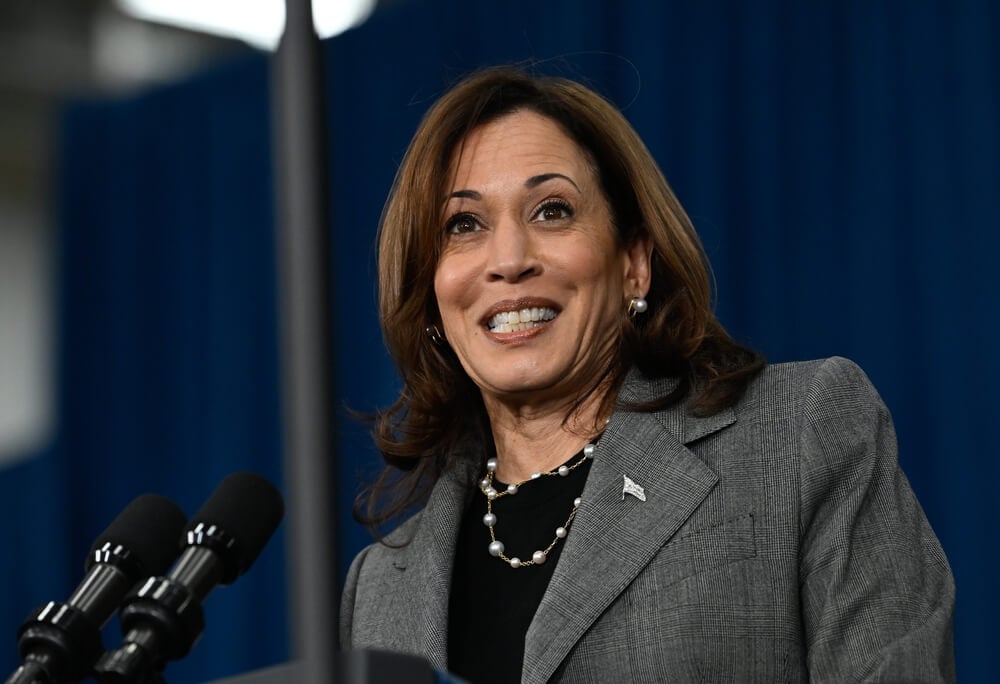 If anyone understands the dangers of tacking too far to the left early in a campaign, it’s Kamala Harris
In 2019, when more than a dozen Democrats were battling for the right to take on Trump as his first term was ending, Harris made a concerted effort to woo the party’s progressives, calling for, among other things, the so-called “Green New Deal” – a package of massive investments in alternative energy – and a federal healthcare program for all.
Later, as her campaign sputtered amid her failure to attract moderate support, she attempted to move toward the center on those positions.
The shift left her rudderless and without a political identity. Her fundraising dried up, and she left the race before the first primary votes were counted.
But if the proposition is a political trap, it’s a trap of the Democrats’ own making. Understandably, Republicans are watching the drama play out like a salivating cartoon wolf.
They’ve already made the prospect of higher taxes under a Democratic Congress a focal point of their closing argument, with the midterm elections just weeks away.
Passage of the California measure, while too late to affect the midterm results, would fortify the party’s argument to maintain control of the White House after Trump moves on.
At the same time, the refusal of mainstream pols like Newsom to embrace the tax may give them some deniability. They may be more than happy to let Sanders be the face of the campaign win or lose.
But if the measure passes and goes into effect, it’s Newsom and his allies who may end up looking out-of-step with the direction of their party as it looks to chart a course for the future. There may not be as much upside in siding with America’s luxury yacht owners as they think.
