Volodymyr Zelensky's meeting in London with Keir Starmer, Emmanuel Macron and Friedrich Merz took place as the war in Ukraine enters its fifth year, with no clear military outcome and no serious prospects for an imminent political solution.
Despite this, the joint statement by the four leaders shows that European powers are increasingly focusing on the issue that will become central once negotiations begin.
It is not only about the future of Ukrainian territories or new military aid packages; it concerns the role Europe will play in defining the security order after the war.
The document is primarily intended for the period following the start of a serious negotiation process.
By emphasising European security interests, security guarantees for Ukraine, and the terms of a future agreement, London, Paris and Berlin are seeking to define in advance the political framework for ending the war, rather than merely influencing its course.
In recent months, there have been more initiatives, proposals, and diplomatic contacts that, directly or indirectly, relate to the possibility of future negotiations between Moscow and Kyiv.
None has produced a result so far, but European governments clearly believe it is more important to define their own positions in advance than to react later to proposals shaped by others.
That is why the London statement gives much more attention to security guarantees, frozen Russian assets, and the principles of the future agreement than to specific military issues.
The European problem with negotiations
There has long been concern in European capitals that serious negotiations could eventually develop primarily through the dominant channel between the United States and Russia, with European states reduced to a supporting role in a process shaped by others.
Regardless of who occupies the White House, America's strategic priorities are expanding. In addition to the war in Ukraine, Washington is simultaneously managing crises in the Middle East, increasing rivalry with China, and security challenges in the Indo-Pacific. For European countries, the situation is different.
European governments refuse to be marginalised in negotiations whose outcomes will shape their own security futures
The war in Ukraine is not merely one of several security challenges; it is an issue that directly affects the continent's security, energy policy, military planning, budgets, and future relations with Russia.
This is why European governments refuse to be marginalised in negotiations whose outcomes will shape their own security futures, and the London meeting is an attempt to define that position well before substantive talks begin.
A changing war
Against the backdrop of the London meeting, changes are also occurring on the battlefield. After more than four years of fighting, it is clear that neither side has achieved a decisive strategic advantage.
Ukraine has preserved its statehood, defended its largest cities, and prevented the realisation of the original Russian objectives, but Russia, despite heavy losses and sanctions, has shown no sign of being ready to give up.
No serious European government today expects a quick military outcome
The result is a conflict that increasingly takes on the character of long-term attrition, and in such circumstances the political dimension of the war inevitably gains importance.
No European government today expects a quick military outcome, but none wishes to be caught off guard when the opportunity for more substantial negotiations arises.
That is why, in London, the discussion was not limited to the present; positions for the future were also addressed.
Security guarantees and the economy of peace
One of the most important elements of the joint statement concerns security guarantees for Ukraine, but the essence of the problem is now clearer than before.
European countries are not only considering how to protect Ukraine from future aggression; they are seeking a model that will stabilise the eastern flank of the continent in the long term.
Even if a ceasefire were declared tomorrow, the question of how to prevent another conflict in five or ten years would remain.
European countries are increasingly openly linking frozen Russian assets to the reconstruction of Ukraine and the issue of war damage
This is why there is increasing discussion about legally binding guarantees, multinational deterrence mechanisms, and security arrangements that would outlast the current political leadership on both sides of the Atlantic.
In parallel, the economic dimension of future peace is becoming increasingly clear. The focus, which until recently was almost exclusively on sanctions, is now gradually shifting to the question of what the financial side of any eventual agreement will be.
European countries are increasingly openly linking frozen Russian assets to the reconstruction of Ukraine and the issue of war damage. This suggests that strategic thinking in European capitals is shifting from waging war to managing its consequences.
Between ambitions and possibilities
However, a serious gap remains between European political goals and European capabilities.
The latest Russian missile and drone attacks have once again demonstrated how crucial air defence is to Ukraine's survival.
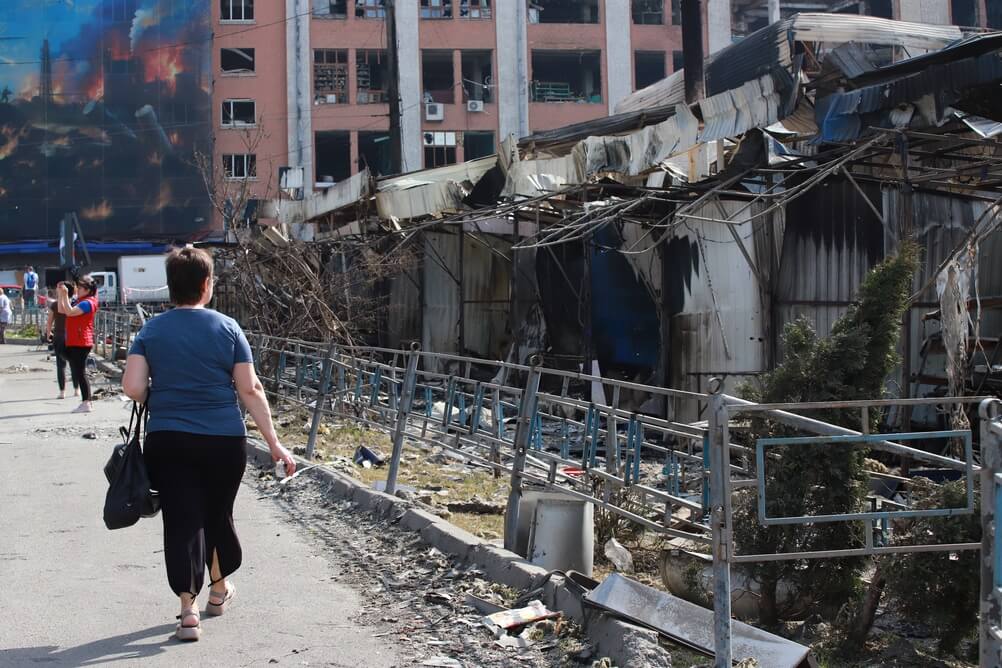 The latest Russian missile and drone attacks have once again demonstrated how crucial air defence is to Ukraine's survival
The need for interceptors, radars, and ammunition remains immense. Today, European leaders find it relatively easy to reach political consensus on supporting Ukraine, but it is much more difficult to increase the production capacity required for a long-term, high-intensity war.
It is precisely this relationship between political ambitions and industrial capabilities that will be the main test of European strategy in the coming years.
Without a significant increase in production, it is difficult to imagine that Europe can credibly assume greater security responsibility in the long term.
For European governments, the problem is no longer just how to keep Ukraine fighting.
Equally important is how to prevent the end of the war from creating new long-term instability on the continent.
Therefore, the discussion is gradually shifting from arms deliveries to security guarantees, the status of occupied territories, frozen Russian assets, and the future relationship between Europe and Russia.
It is on these questions that it will be decided whether any eventual agreement will mark the end of the war or merely a pause between two conflicts.
