At first glance, Nigeria and France make for an unlikely pair. Nigeria, after all, is the “giant of Africa,” whose vast potential has too often been undermined by weak institutions and poor governance.
France, by contrast, is a former imperial power clinging to a military posture that looks increasingly anachronistic in a postcolonial world.
Yet the two countries share some striking similarities. Both possess an inflated sense of their own importance—a politique de grandeur that often privileges style over substance, sustained by nostalgia for past glory.
They have also cultivated national identities associated with fashion, good food, and joie de vivre. And both must contend with more economically powerful regional rivals: South Africa and Germany.
These shared traits help explain the increasingly warm relationship between Nigeria and France.
Since taking office in 2023, Nigerian President Bola Tinubu has developed an unusually close rapport with his French counterpart, Emmanuel Macron, making Paris his most frequent foreign destination.
In 2021, the two countries established the France-Nigeria Business Council, which met at last month’s Franco-African summit in Nairobi.
Distrust of France
This entente marks a stark departure from six decades of Nigerian foreign policy.
Since gaining independence, Nigeria has sought to promote West African integration, most notably through the Economic Community of West African States (ECOWAS), which it helped establish in 1975.
One of the bloc’s central objectives was to reduce the dependence of Nigeria’s neighbors on France, whose regional policies Nigeria had long viewed with suspicion.
Distrust of France has deep historical roots. During Nigeria’s civil war in the late 1960s, French President Charles de Gaulle used Côte d’Ivoire and Gabon to funnel arms to Biafran secessionists.
The aim was to weaken and fragment Nigeria, thereby undermining British influence in a country that de Gaulle regarded as central to the United Kingdom’s interests in Africa and as a potential threat to France’s post-imperial hegemony in West Africa.
Despite this distrust, economic ties between the two countries have remained remarkably resilient.
French firms such as Total, Peugeot, and Michelin entered Nigeria in the 1960s and early 1970s.
By 1978, the country had become France’s largest investment destination in Sub-Saharan Africa.
Economic pragmatism did little to resolve the underlying tensions
Underpinning the relationship was a simple, if unequal, exchange: Nigerian oil for French goods and services.
But economic pragmatism did little to resolve the underlying tensions, which resurfaced in 2013 when France outmaneuvered Nigeria in Mali.
Having intervened militarily to prevent jihadist forces from seizing power, France then used its influence within the United Nations to establish a peacekeeping mission that sidelined a Nigerian-led African force.
Frustrated by its diminished role, Nigeria subsequently withdrew its troops from Mali.
Tinubu’s embrace of Macron
Ironically, Tinubu’s embrace of Macron comes at a moment when much of Francophone Africa is rejecting the exploitative neocolonial system that de Gaulle helped construct.
French troops have already been expelled from Mali, Burkina Faso, Niger, Senegal, Côte d’Ivoire, and Chad.
In several cases, they have been replaced by Russian mercenary groups, most notably the Wagner Group—which has since been largely supplanted by the Kremlin-backed Africa Corps—underscoring both the fragility of West African security and the persistence of external intervention.
Bilateral trade reached $4.7 billion in 2025, making Nigeria France’s largest Sub-Saharan African trading partner
Meanwhile, economic ties have continued to deepen. Bilateral trade reached $4.7 billion in 2025, making Nigeria France’s largest Sub-Saharan African trading partner.
More than 100 French companies currently operate in Nigeria, including Danone, Accor, and Lafarge. Nigerian banks like First Bank, Access, and Zenith have similarly expanded their presence in Paris.
Seeking France’s help
Many Nigerians, however, view the burgeoning partnership with suspicion. A 2024 agreement granting France access to Nigeria’s mineral resources triggered a fierce public backlash, fueled by fears that the country was surrendering control of a key strategic sector to a former colonial power.
Critics have also accused Tinubu of prostrating himself before Macron by seeking France’s help in combating jihadist insurgencies in northeastern Nigeria.
Fears that Nigeria was becoming a proxy for French interests were reinforced by Tinubu’s ill-advised threats of military intervention against Niger in 2023.
They intensified further in 2025 after Nigeria signed an agreement granting French authorities access to sensitive tax information and helped thwart a coup attempt in Benin in December—an operation reportedly supported by French logistics and intelligence.
Nigeria’s notoriously rent-seeking business elite has played a central role in driving the rapprochement with France
Nigeria’s notoriously rent-seeking business elite has played a central role in driving the rapprochement with France.
Among the key figures behind the France-Nigeria Business Council is the Paris-based Lebanese-Nigerian billionaire Gilbert Chagoury, a close associate of Tinubu who previously worked with military dictator Sani Abacha’s corrupt regime.
Convicted by a Swiss court in 2000 of laundering funds stolen during the Abacha era and ordered to return $66 million to the Nigerian government, Chagoury later contributed to Tinubu’s 2023 presidential campaign.
His company, Hitech, subsequently secured a no-bid $11 billion contract for the controversial Lagos-Calabar coastal highway project.
Strategic cost
Against this backdrop, Nigeria continues to grapple with profound social and economic challenges.
Although Tinubu has improved the economy’s growth prospects, stabilized the currency, and expanded the tax base, 139 million Nigerians still live in poverty.
The prices of staple foods consumed by poor households quintupled between 2020 and 2024, while social-protection coverage fell from 20% in 2018 to just 6% in 2023. At the same time, terrorist attacks and criminal violence killed more than 10,000 people last year.
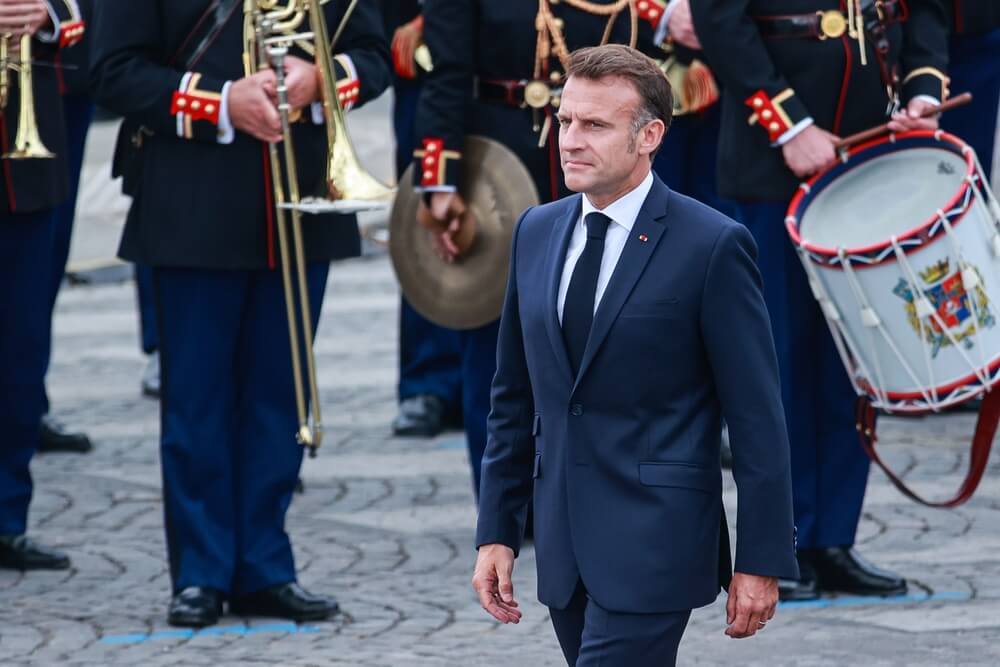 For Nigeria, the strategic costs of aligning with France could prove significant - Emmanuel Macron
France’s own regional standing has been severely weakened. Confronted by mounting resistance to its military presence and growing fiscal pressures at home, the French government has sought in recent years to channel its interventions through the UN and the European Union.
For Nigeria, the strategic costs of aligning with France could prove significant. The military juntas ruling Mali, Burkina Faso, and Niger have withdrawn from ECOWAS and formed the Alliance of Sahelian States, accusing the Nigerian-led bloc of serving French interests.
After the 2023 coup, Niger’s rulers turned to Russia for military support, further weakening Nigeria’s influence in the Sahel.
To be sure, Nigeria needs foreign trade and investment. But an increasingly close relationship with a foreign power that has historically sought to undermine Nigerian influence in West Africa risks benefiting politically connected business elites at the expense of the Nigerian public.
Only by returning to its traditional strategy of strengthening regional integration through a revitalized ECOWAS can Nigeria secure its long-term economic and security interests and forge more balanced, reciprocal partnerships.
Adekeye Adebajo, a professor and a senior research fellow at the University of Pretoria’s Centre for the Advancement of Scholarship, served on UN missions in South Africa, Western Sahara, and Iraq.
