Question: Who runs the Catholic Church when the pope is unconscious, incapacitated or otherwise unable to govern?
Answer: The pope.
The Vatican has detailed laws, rituals and norms to transfer papal power if a pope dies or resigns.
But none of them apply when he is sick or even unconscious, as Pope Leo XIV will be when he undergoes surgery Tuesday to remove a nodule on his lung.
As a result, Leo remains pope and very much in charge even when he goes under general anesthesia at Rome's Gemelli hospital, where he arrived Tuesday afternoon for what is expected to be a weeklong stay.
The pope’s role is universal by design
The pope is the successor of the Apostle Peter, the head of the college of bishops, the Vicar of Christ and the pastor of the universal Catholic Church on Earth, according to the church’s in-house canon law.
Nothing changes in his status, role or power since Leo was elected the 267th pope on May 8, 2025.
Leo may be in charge, but he already delegates the day-to-day running of the Vatican and church to a team of officials
Leo may be in charge, but he already delegates the day-to-day running of the Vatican and church to a team of officials who operate whether he is in the Apostolic Palace or not, and whether he is conscious or not.
Chief among them is the Vatican secretary of state, Cardinal Pietro Parolin. In a sign that Leo’s hospitalization foresaw no change to the governance of the church, Parolin wasn’t even in the Vatican on Tuesday. He was speaking at a conference nearby.
“We were all struck by the serenity with which the pope announced this procedure,” Parolin told reporters as he arrived for the conference. “Am I worried? Yes, because I certainly didn’t expect something like this.”
But Parolin said he had spoken with the pope Monday night and was reassured.
“It’s something that, thank God, we noticed right away. And normally, when these things are caught in time, they can be resolved,” he said. “But these are, as the pope said, God’s surprises.”
Other Vatican functions are proceeding normally, including the announced appointments of two new bishops on Tuesday, albeit with some modifications for events where the pope had been expected to attend.
When a pope gets sick, nothing changes legally
Canon law has provisions for when a diocesan bishop gets sick and can’t run his diocese, but none for a pope.
Canon 412 says a diocese can be declared “impeded” if its bishop — due to “captivity, banishment, exile, or incapacity” — cannot fulfill his pastoral functions.
In such cases, the day-to-day running of the diocese shifts to an auxiliary bishop, a vicar general or someone else.
Even though Leo is bishop of Rome, no explicit provision exists for the pope if he similarly becomes “impeded”
Even though Leo is bishop of Rome, no explicit provision exists for the pope if he similarly becomes “impeded.”
Canon 335 declares simply that when the Holy See is “vacant or entirely impeded,” nothing can be altered in the governance of the church.
But it doesn’t say what it means for the Holy See to be “entirely impeded” or what provisions might come into play if it ever were.
Past popes have written instructions just in case
In 1965, Pope Paul VI wrote letters to the dean of the College of Cardinals hypothesizing that if he were to become seriously ill, the dean and other cardinals should accept his resignation.
Paul foresaw the possibility that as popes continued to live longer, they could become incapacitated by stroke, dementia or another long-term, progressive ailment that would make it impossible for them to do their job and unable to freely resign.
The letter was never invoked, since Paul lived another 13 years and died on the job.
Pope Francis confirmed in 2022 that shortly after he was elected pope he wrote a letter of resignation, to be invoked if he became medically incapacitated
Pope Francis confirmed in 2022 that shortly after he was elected pope he wrote a letter of resignation, to be invoked if he became medically incapacitated.
Francis said he gave it to the then-secretary of state, Cardinal Tarcisio Bertone, and assumed Bertone had delivered it to Parolin’s office when he retired.
The text was never made public and the conditions Francis contemplated for a resignation were unknown.
It also is not known if such a letter would be canonically valid. Canon law requires a papal resignation to be “freely and properly manifested,” as was the case when Pope Benedict XVI announced his resignation in 2013.
Power transfers only when a pope dies or resigns
The only time papal power changes hands is when a pope dies or resigns. At that time a whole series of rites and rituals comes into play governing the “interregnum,” the period between the end of one pontificate and the election of a new pope.
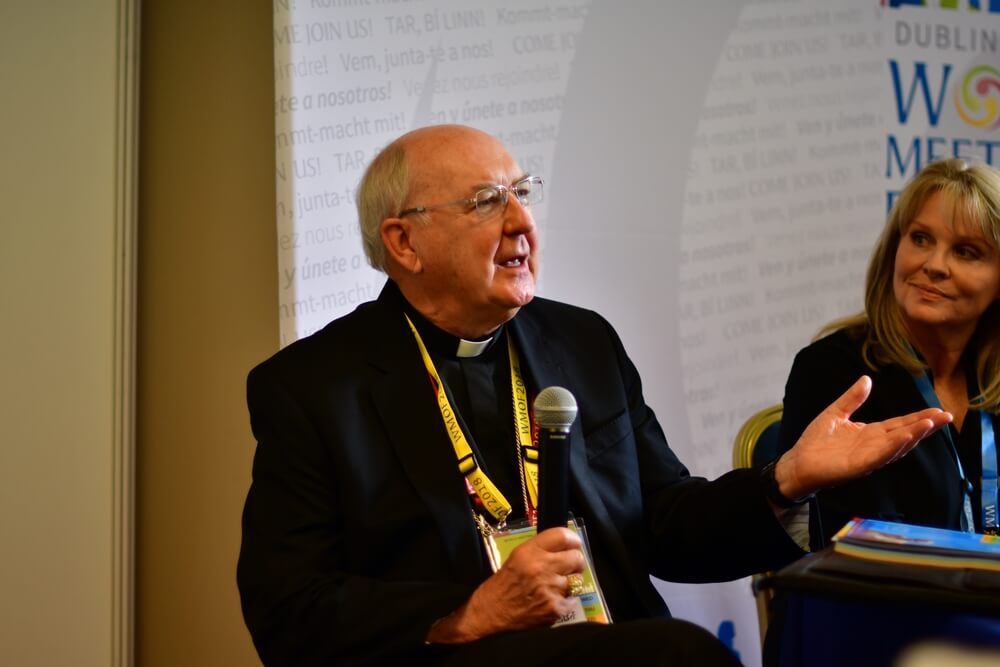 During the period, known as the “sede vacante,” or “empty See,” the camerlengo, or chamberlain, runs the administration and finances of the Holy See - Cardinal Kevin Farrell
During that period, known as the “sede vacante,” or “empty See,” the camerlengo, or chamberlain, runs the administration and finances of the Holy See.
He certifies the pope’s death, seals the papal apartments and prepares for the pope’s burial before a conclave to elect a new pope.
The position is currently held by Cardinal Kevin Farrell, the head of the Vatican’s laity office.
The camerlengo has no role or duties if the pope is merely sick or otherwise incapacitated.
In fact, in these days Farrell is presiding over a Vatican conference on family ministry that Leo had been attending up until his surprise hospitalization.
