US companies Anthropic, which develops artificial intelligence, and OpenEvidence, whose tool helps doctors search the medical literature, announced on 22 September their collaboration on a free version for health professionals in low- and middle-income countries.
According to a list provided by OpenEvidence to Reuters, the programme covers approximately one hundred countries, including Uganda, Sudan, Haiti and Mongolia.
Anthropic provides the underlying technology, and OpenEvidence is expected to tailor responses to treatment conditions in different regions.
The health authorities in those countries will have to determine under what conditions software developed abroad may participate in selecting examinations and therapy.
Its usefulness will also depend on the extent to which domestic institutions can review recommendations, report errors and request changes.
The World Health Organization announced that the number of doctors per head of population in its European region is thirteen times higher than in Africa.
A doctor can use the tool to find the research and guidelines needed to make decisions about a patient more quickly.
It is harder for an already understaffed hospital to assign experienced doctors to check that the software interprets these sources correctly and that its recommendations can be implemented.
Rwandan doctors are examining what can be applied
OpenEvidence already has experience with this problem in Rwanda. The national health and research agency Rwanda Biomedical Centre and the international health organisation Resolve to Save Lives presented a programme in January in which 45 doctors and nurses involved in clinical work reviewed the platform’s responses.
The project began last autumn, with the task of using their comments to adapt the tool to local practice.
A recommendation may be medically accurate, but in Rwanda it is unusable if it requires a drug or examination that the facility does not have.
The January announcement described the verification of such responses, but no data were released to show that the tool improved patient care. Even within Rwanda, institutions do not all have the same resources.
An examination that can be performed in a hospital in the capital may not be available in a remote clinic
An examination that can be performed in a hospital in the capital may not be available in a remote clinic.
Therefore, an answer aligned with national guidelines may still recommend something that the physician at their institution cannot do.
If the required examination is not available, the tool should clearly state what the doctor can safely do immediately and when the patient should be referred to another facility.
The lack of equipment must not be a reason to ignore the need for this examination.
Kenya’s experience limits grand promises
The research, published in the journal Nature Medicine, was carried out in 16 clinics operated by Penda Health, a private network that provides basic healthcare in and around Nairobi.
It included more than 9,600 patients. Healthcare professionals were randomly assigned either to use the AI Consult programme during examinations or to work without it.
The programme is embedded in electronic patient records and, using OpenAI technology, suggests diagnoses and therapies in line with Kenyan guidelines
The programme is embedded in electronic patient records and, using OpenAI technology, suggests diagnoses and therapies in line with Kenyan guidelines. Staff who used it documented findings more fully and planned treatment more effectively.
However, the study did not show that their patients were less likely to experience treatment failure over the following two weeks.
The AI Consult tested in Kenya is not the programme Anthropic and OpenEvidence now offer, so that study does not show how their product will perform.
The Kenyan researchers followed patients after the examination, but because serious complications were rare, they could not reliably determine whether use of the tool affected outcomes.
A much larger number of patients would be needed to reach such a conclusion.
Treatment rules must remain under domestic supervision
On 21 September, the World Health Organization published a report on the ethical oversight of research involving artificial intelligence in health.
It warned that existing bodies may lack the knowledge and resources to assess such projects, while much of the technological development and research takes place in wealthier countries. In particular, it called for a stronger role for local experts and institutions.
The document provides guidelines for research; decisions on the use of specific products remain the responsibility of the relevant health authorities. Particularly relevant to the announced expansion of OpenEvidence is the question of who has sufficient knowledge and authority to challenge an answer that sounds plausible and cites a published study.
When a tool refers to published research, the doctor must check whether its conclusions can be applied to the patient being treated
When a tool refers to published research, the doctor must check whether its conclusions can be applied to the patient being treated.
What matters is who participated in the study and what it actually found. The source link itself does not perform that check.
The hospital must also know which guidelines the tool uses to suggest treatment.
If its recommendation differs from the rules in force in that country, the doctor should recognise this difference.
The competent experts and health authorities decide on any potential changes to domestic rules, especially when these affect which medicines the public system will purchase and pay for.
Verification must remain possible even when the company updates the software. If an incorrect recommendation is later discovered, the hospital should be able to determine which version was used and what response the doctor received at the time.
Without these data, it is difficult to establish the cause of the error and to prevent it from happening again.
Screening and training come at a cost
The financial terms of cooperation between the two companies have not been announced.
Free access can make it easier to get started, but institutions are left with the task of training staff and monitoring implementation.
If the rollout requires experienced physicians to review disputed responses, their time must be planned and budgeted for.
This is a particularly sensitive decision in settings with few specialists. Using the same people to review the software can reduce the time available for reviews, consultations and training junior colleagues.
The investment is justified only if the system subsequently yields sufficient benefits to compensate for the initial and ongoing burden. Each hospital must make this calculation according to its own needs.
The costs that the recommendation creates for the patient should also be taken into account.
Undergoing an additional examination may require transport to another city, absence from work and extra payment.
When evaluating the system, it therefore makes sense to monitor how often the proposed procedure provides information relevant to treatment decisions. Public funders would then be able to assess whether the tool helps to use limited funds more effectively.
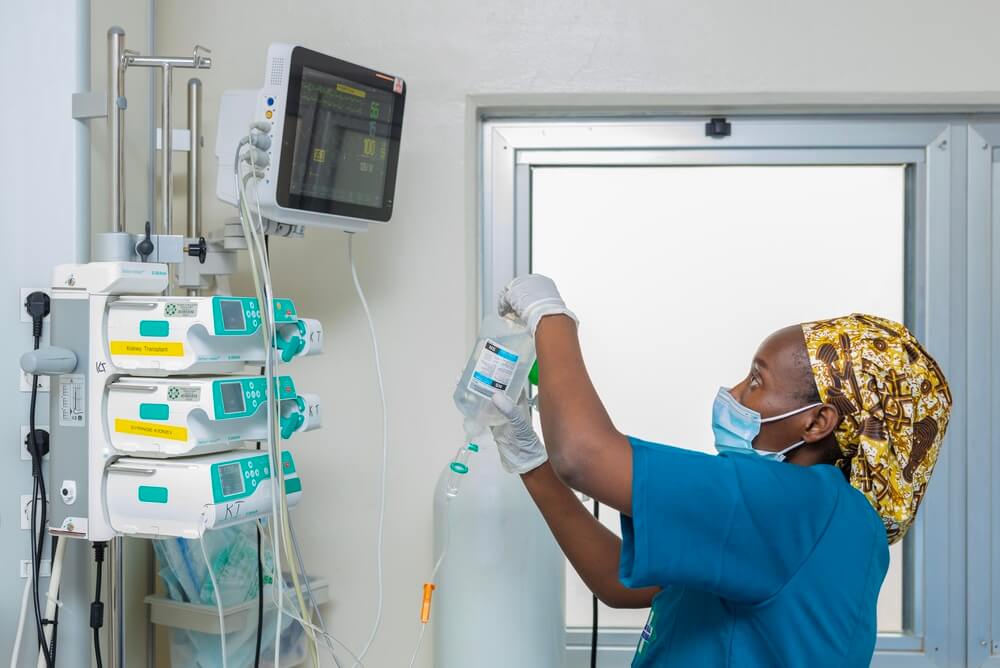 Free access can make it easier to get started, but institutions are left with the task of training staff and monitoring implementation - Kigali, Rwanda
Donors and development institutions could fund joint teams to test the tool across multiple institutions.
This would enable even smaller hospitals to benefit from expert assessments that they can scarcely provide on their own.
Access has been announced as free for healthcare professionals, but hospitals still have to train staff and decide who will review disputed responses.
If that work is carried out by a specialist, they have less time for patients and consultations with colleagues.
In institutions that already lack doctors, this is a cost that is not reflected in the price of the software.
The software can also generate savings in the purchase of medication. The trial in Kenya showed modest savings on antibiotics.
They were prescribed about equally often in both groups, but the average cost per patient was $3.71 with AI Consult and $3.85 without it.
The authors cite the choice of cheaper drugs as a possible explanation. Whether such savings justify use of the tool also depends on the costs of training and supervision, which that figure does not include.
Ministries presented with a done deal
Individual doctors are likely to start using the programme first. Free access allows them to try it on their own initiative, while hospitals and ministries must decide under what conditions its responses may influence treatment.
In some countries, doctors will therefore already be using it with patients before their institutions set rules for its use.
That sequence will make later decisions difficult. Once staff become accustomed to the programme, it will be harder for the hospital to withdraw or replace it if serious deficiencies are discovered.
For governments that accept cooperation, the most important negotiations will concern the ability to audit the system and require corrections
Health authorities wishing to determine the terms of its use will have to agree on them while the programme is still being introduced; after widespread acceptance, they will be negotiating over a product on which the work of their institutions already partly depends.
For governments that accept cooperation, the most important negotiations will concern the ability to audit the system and require corrections.
If local experts are involved on an ongoing basis, the project can also strengthen the country’s capacity to evaluate other medical technologies.
If their participation ends with initial testing, institutions will once again depend on assurances from the supplying company for any major software changes.
