Donald Trump has occasionally led expansionist campaigns since the start of his second presidential term, with Greenland being a constant focus.
In a previous foray into foreign territories, in early 2025, during the first weeks of his term, Trump added the annexation of Greenland to already shocking plans to make Canada the 51st US state and to take over the Panama Canal.
The huge Arctic island, under Danish sovereignty, was soon disregarded in the White House after the US reached trade and security deals with Canada and Panama.
However, Greenland returns to the spotlight at the same time as the US operation in Venezuela and the arrest of Nicolás Maduro.
The force of the action in Caracas, and especially the American disregard for criticism that it violates fundamental norms of international law, places the issue of Greenland in a much more serious context today than a year ago.
Danish Prime Minister Mette Frederiksen is probably right when she says that NATO would cease to exist if the US occupied Greenland militarily.
Indeed, the alliance would likely collapse if one of its members – and by far the most powerful and richest – were to inflict territorial damage on another NATO member.
Another bluff?
While many observers, especially in Europe, believe that the repeated American threat to invade Greenland is another bluff and that there will be no military intervention, the statement by Stephen Miller, Trump's top aide, that "nobody's going to fight the US over the future of Greenland" should not be ignored.
Mr Miller is also correct in this assertion. If a year ago there was reason to speak of Trump's bluff regarding the annexation of Greenland, now there is much less room for such trivialisation.
Over the past year, Europeans have received considerable evidence that the US under Trump is withdrawing from the continent, primarily in terms of security, but also economically and politically.
While Europeans were stunned for months, Trump and his administration provided further evidence of their shift away from Europe
They received a very clear warning about this in the first month of Trump's term, when US Vice President JD Vance, at the Munich Security Conference, explicitly “pushed” Europe out of the circle of allies in Trump's foreign policy.
While Europeans were stunned for months, Trump and his administration provided further evidence of their shift away from Europe.
This was seen above all in relation to Russia and its invasion of Ukraine, where Washington even adopted a patronising stance towards Moscow, to the astonishment of Europeans for whom Ukraine is an existential security issue.
Operation in Venezuela – implementation of the National Security Strategy
The most convincing evidence of the new American policy towards Europe appeared with Trump's National Security Strategy, in which Europe is described as a problem, rather than the first-rate ally it has been for the past 80 years.
To reinforce this, the action in Venezuela provided concrete proof that Washington is beginning to implement the National Security Strategy, which places a central focus on Latin America.
The leaders of the six largest European NATO members, in a joint statement, supported Denmark and its prime minister
The leaders of the six largest European NATO members, in a joint statement, supported Denmark and its prime minister, demanding that the principles of the inviolability of the sovereignty of Alliance members be respected.
"Security in the Arctic must… be achieved collectively, in conjunction with NATO allies including the United States, by upholding the principles of the UN Charter, including sovereignty, territorial integrity, and the inviolability of borders. These are universal principles, and we will not stop defending them," announced the leaders of the UK, Germany, France, Italy, Spain, Poland, and Denmark.
But is their demonstration of unity and solidarity with threatened Denmark, and especially the call to respect the foundations of NATO, sufficient to restrain Trump's ambitions towards Greenland?
Weakening of institutional ties within NATO
A year ago, during Trump's initial "offensive" on Greenland, such a joint statement by Europeans would have had far greater deterrent power.
At that time, it might have influenced Trump and his advisers to approach Europe more cautiously and perhaps even to refrain from openly declaring their intention to turn their backs on traditional partners. The unity of Europe's largest military powers and economies, now demonstrated in the case of Greenland, would undoubtedly have had a greater effect on Washington than it does today.
Now, after the operation in Venezuela and Trump's sense of triumph, it is likely only starting to be noticed in Washington.
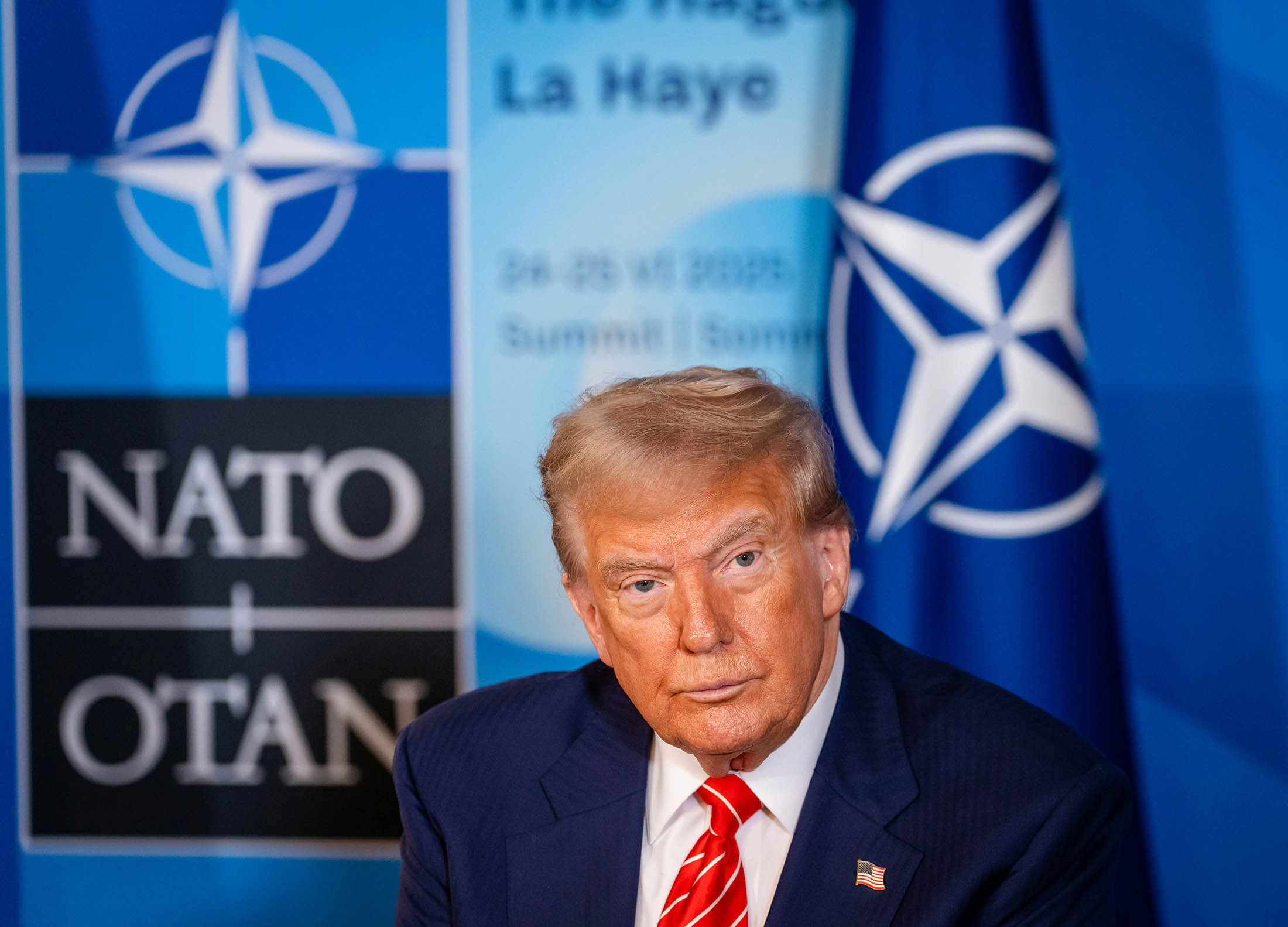 Trump is unlikely to be concerned if Danish Prime Minister Frederiksen's prediction about the collapse of NATO comes true should he take over Greenland
Trump is unlikely to be concerned if Danish Prime Minister Frederiksen's prediction about the collapse of NATO comes true should he take over Greenland.
The alliance does not play a particularly important role in his unilateral foreign policy plans outlined in the National Security Strategy.
For Trump, the outcome in Ukraine is primarily a matter of bilateral deals with Russia or Ukraine and much less about considering long-term European security in the face of Russia’s aggressive behaviour.
If Trump remains consistent with his plans to take over Greenland, the Europeans have few options.
Stephen Miller's assessment that none of them will oppose America militarily over Greenland was made in the wake of military success in Venezuela, but it also reflects the lack of clear European determination to independently build a common security framework without America.
European leaders face another difficult task: to accept the weakening of institutional ties within NATO, which any form of American presence in Greenland will inevitably bring, while also making the difficult effort to strengthen their own security capabilities.
The united front of the most powerful Europeans to protect Denmark and Greenland, as well as the order of the transatlantic alliance, already appears to be the embryo of an effective European response to Trump's security shift. The question is whether it has come in time.
