If you had asked me six months ago about the risks of another massive financial crisis in the United States, I would have said it is always possible, but much more likely elsewhere.
Japan, for example, is dealing with steadily rising interest rates in an economy that has been conditioned for decades to rates being virtually zero.
But I seem to have underestimated the deregulatory zeal of President Donald Trump’s administration.
While it is rightly rethinking the heavy-handed measures implemented after the 2008 financial crisis, it is ruthlessly pruning staff at key regulatory agencies. In many cases, these cuts have included some of the most seasoned experts, whose essential institutional memory leaves with them.
Unfortunately, such an aggressive approach is a tried-and-true recipe for creating big problems down the road, possibly before Trump leaves office.
The savings and loan crisis of the late 1980s followed President Ronald Reagan’s own deregulatory push.
The 2008–09 global financial crisis followed years of deregulation, first under President Bill Clinton and then under George W. Bush.
The Silicon Valley Bank crisis of 2023 radiated out into mid-tier US banks, partly because the first Trump administration had weakened capital requirements.
This is not to say that another crisis is guaranteed—far from it. Still, there are many reasons to worry.
Trump’s deregulation agenda
Trump’s latest deregulation agenda again takes aim at capital requirements, which partly dictate the extent to which banks raise resources by borrowing (from both bond markets and depositors), or by issuing equity.
Capital requirements are a way to ensure that banks have a buffer to cover losses, as well as to ensure that their holdings are sufficiently “liquid,” lest they be forced to offload valuable assets at fire-sale prices in the event of an unexpected surge of withdrawals.
Without going into the technical details, suffice it to say that Moody’s has argued that if the latest regulatory changes lead to lower and less liquid capital resources, that will be a negative development for bank risk.
There are certainly arguments for scaling back or at least refining the post-2008 regulations
As the economists Anat R. Admati and Martin Hellwig showed in their 2013 book, The Bankers’ New Clothes, the less “skin in the game” banks have, the greater the incentive to let taxpayers shoulder the risk.
To be fair, there are certainly arguments for scaling back or at least refining the post-2008 regulations.
Michelle Bowman, a Trump appointee who serves as the US Federal Reserve’s vice-chair for financial supervision, argues that “The result is more efficient regulation and banks that are better positioned to support economic growth, while preserving safety and soundness.”
The conditions for an inevitable crash
The most concerning changes, however, are the ones that are less transparent, including the rules for stress tests (simulations used to assess whether banks would have enough capital in a crisis) and the instructions to regulators about what to examine and when to report problems.
Bowman’s own predecessor as vice chair of supervision, Michael S. Barr, seems to agree.
He remains a member of the Federal Reserve Board, where he has cast dissenting votes against regulatory changes the Trump administration is pushing on multiple occasions.
One obviously wants to avoid a situation in which deregulation of both crypto and the legacy financial system creates the conditions for an inevitable crash
In an institution that prizes consensus to assure investors of policy continuity, so many dissents are rare and therefore noteworthy.
To be sure, advocates of lighter bank regulation point to the fierce competition implied by the deregulation of crypto, especially dollar-based stablecoins (cryptocurrencies pegged by a private issuer to the dollar). Banks do need to be able to innovate and compete.
But one obviously wants to avoid a situation in which deregulation of both crypto and the legacy financial system creates the conditions for an inevitable crash.
Will there be a full-blown systemic banking crisis tomorrow?
When might such a crash occur? As Carmen M. Reinhart and I documented in our 2009 book, This Time is Different, and as a great many papers since then have shown, the timing of crises is extremely hard to predict, partly because both the government and banks have every incentive to keep problems hushed up.
Nonetheless, it is hard to argue with Senator Elizabeth Warren’s February 2025 warning that the risks have risen materially.
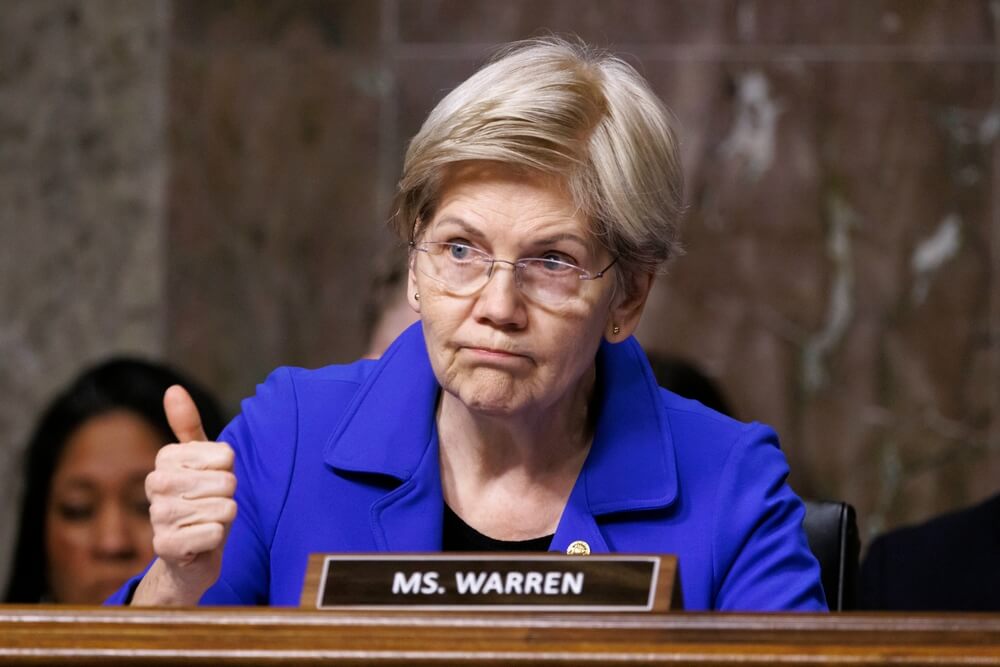 It is hard to argue with Senator Elizabeth Warren’s warning that the risks have risen materially
Historically, one line of defense has been the relative independence of the various regulators, including the Federal Deposit Insurance Corporation, the Office of the Comptroller of the Currency, and the Fed itself.
True, there is a legitimate debate to be had about the extent to which such regulators should be independent—a question that is more nuanced than in the case of monetary policy.
But given the Trump administration’s expansive interpretation of presidential power, regulatory independence has unquestionably been undermined.
The White House is playing an increasingly large role in reviewing regulatory processes, including holding more regular meetings between top financial regulators and the Treasury secretary.
Will there be a full-blown systemic banking crisis tomorrow? Probably not, because even if today’s regulatory safeguards are drastically weakened, it is going to take a few years for the financial system to build up to new heights of vulnerability. Unfortunately, by then, it may be too late to change course.
Kenneth Rogoff, a former chief economist of the International Monetary Fund, is Professor of Economics and Public Policy at Harvard University and the recipient of the 2011 Deutsche Bank Prize in Financial Economics.
