Here he goes again. US President Donald Trump is increasing and decreasing tariffs willy-nilly, violating international agreements that he himself signed and almost surely violating federal law.
The only difference this time is that he has a new pretext for abusing tariffs: stopping forced labor.
Of course, the administration is right that too little is being done about forced labor. But its stated concern is a ruse.
With the new tariffs closely tracking the ones that Trump imposed on the basis of trade balances, are we supposed to believe that bilateral trade deficits just so happen to be highly correlated with the use of forced labor?
After the Supreme Court struck down Trump’s previous tariffs, the administration imposed 150-day temporary tariffs—already deemed illegal by the courts but still under appeal even as they expired in late July—and now these new ones following an “investigation” into other countries’ supposed failure to police labor abuses.
Not surprisingly, China, long a suspected source of goods produced with forced labor, has largely been given a pass.
With its control of rare earths and critical minerals, China can slap Trump down whenever it wants.
When another country has the means and the willingness to fight back, Trump always chickens out (TACO). This time, he didn’t even bother picking a fight with the Chinese.
America has long been a center of forced labor
Moreover, if Trump was really concerned about forced labor, he would address the problem at home.
After all, America has long been a center of forced labor, owing to the loophole in the 13th Amendment to the US Constitution: “Neither slavery nor involuntary servitude, except as a punishment for crime whereof the party shall have been duly convicted, shall exist within the United States, or any place subject to their jurisdiction.”
This language was infamously used in the Jim Crow South to defend the use of chain gangs, and it continues to be abused throughout much of the US, with less than one-quarter of US states forbidding forced labor.
In this new context, reciprocity would call for high tariffs on products made in US states that still exploit prison labor
The US has just 5% of the world’s population but accounts for one-quarter of the world’s prisoners.
According to one of the most thorough studies of forced labor in America (by Michael Poyker), nearly 1.4 million US inmates were employed in 2005, with roughly 600,000 working specifically in manufacturing—4.2% of the total manufacturing workforce at the time. (Those seeking a better understanding of America’s system of captive labor should also watch Ava DuVernay’s 2016 documentary, 13th.)
When Trump wantonly slapped tariffs on the rest of the world last year, he described the move as “reciprocal.” But in this new context, reciprocity would call for high tariffs on products made in US states that still exploit prison labor.
The EU should not capitulate
The new tariffs against the European Union are especially hard to justify, because a 2024 EU law (the Corporate Sustainability Due Diligence Directive) already banned the importation of goods produced with forced labor, including those produced by subcontractors.
In yet another pearl of hypocrisy, US Secretary of Commerce Howard Lutnick previously claimed that the EU law posed “unnecessary negative burdens” on American companies, and that the US was therefore prepared to consider “all conceivable trade tools.”
The EU should call out this hypocrisy and not capitulate. It should impose reciprocal tariffs on goods produced in the US states that use prison labor most extensively.
The list of goods and companies reportedly using prison labor somewhere in their supply chain is extensive and includes leading US firms like Burger King, Cargill, and Walmart.
If Trump’s actions motivate the EU to investigate forced labor in the US, it will be doing US workers a service
If Trump’s actions motivate the EU to investigate forced labor in the US, it will be doing US workers a service. (Sadly, hardly anyone in the EU has made a peep about the issue; all we have heard is a sigh of relief that Europe wasn’t hit harder.)
Nor does the hypocrisy end there. To justify new tariffs against Canada, Trump invoked a provision of the infamous Smoot-Hawley Tariff Act of 1930 allowing the US to respond to discriminatory tariffs.
But recall that the entire World Trade Organization system is based on nondiscrimination, a principle that Trump’s tariff policies have flagrantly defied.
In this case, Canada imposed tariffs on US goods in retaliation for Trump’s discriminatory tariffs.
Trump’s tariff wars have not led to any reshoring of manufacturing
Once again, Trump is subverting international law in an effort to seize a larger share of the value embedded in global supply chains, and harming the US economy in the process.
Lest anyone forget, tariffs are just a distortionary tax that comes at the expense of American consumers and US competitiveness.
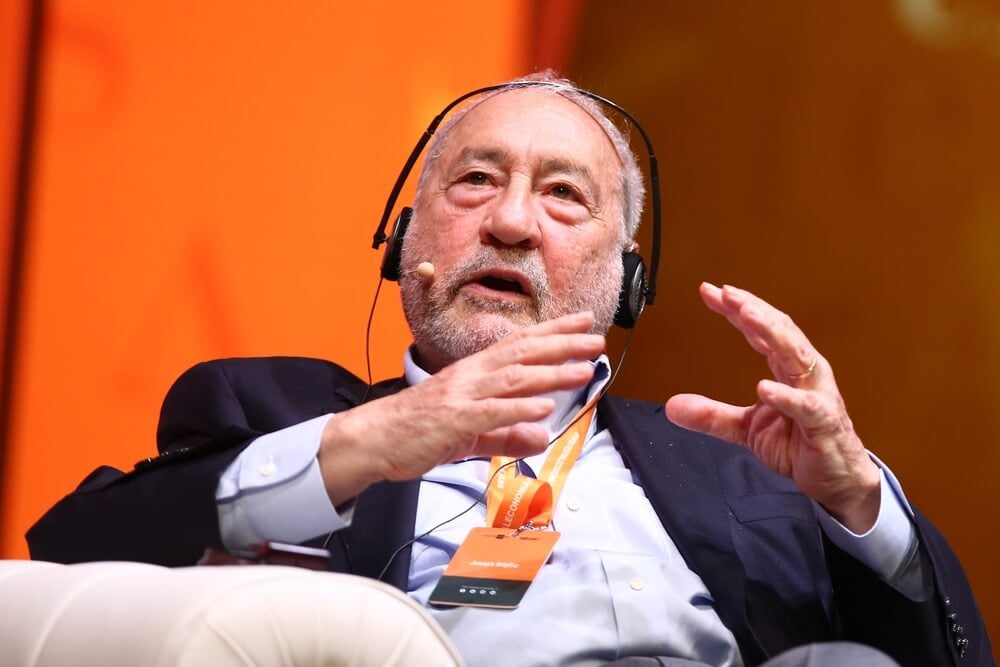 Trump gets away with his bullying because too many people, at home and abroad, have capitulated to him - Joseph E. Stiglitz
Trump’s tariff wars have not led to any reshoring of manufacturing. In fact, US manufacturing jobs have declined by 75,000 since his second inauguration, after rising under President Joe Biden.
In nominal terms, the US trade deficit in goods has actually increased during Trump’s second term, reaching a record high of $1.24 trillion.
That is no surprise to any economist. Multilateral trade deficits depend less on tariffs than on key macroeconomic variables like domestic national savings, a metric that Trump’s record-breaking fiscal deficits have undermined.
Trump gets away with his bullying because too many people, at home and abroad, have capitulated to him.
Most businesses and rival governments have concluded that it is better to go along and get along than to stand up for themselves.
But Trump is just like any other authoritarian leader: he needs to be feared. The longer the world gives him what he needs, the greater the disaster that awaits us all.
Joseph E. Stiglitz, a Nobel laureate in economics and University Professor at Columbia University, is a former chief economist of the World Bank (1997-2000), former chair of the US President’s Council of Economic Advisers, former co-chair of the High-Level Commission on Carbon Prices, and lead author of the 1995 IPCC Climate Assessment. He is Co-Chair of the Independent Commission for the Reform of International Corporate Taxation.
